19 July 2026
When the Cathedral Met the Theatre: Bruckner's First Encounter with Richard Wagner
On Classicapedia: Anton Bruckner, Richard Wagner, Ludwig Schnorr von Carolsfeld
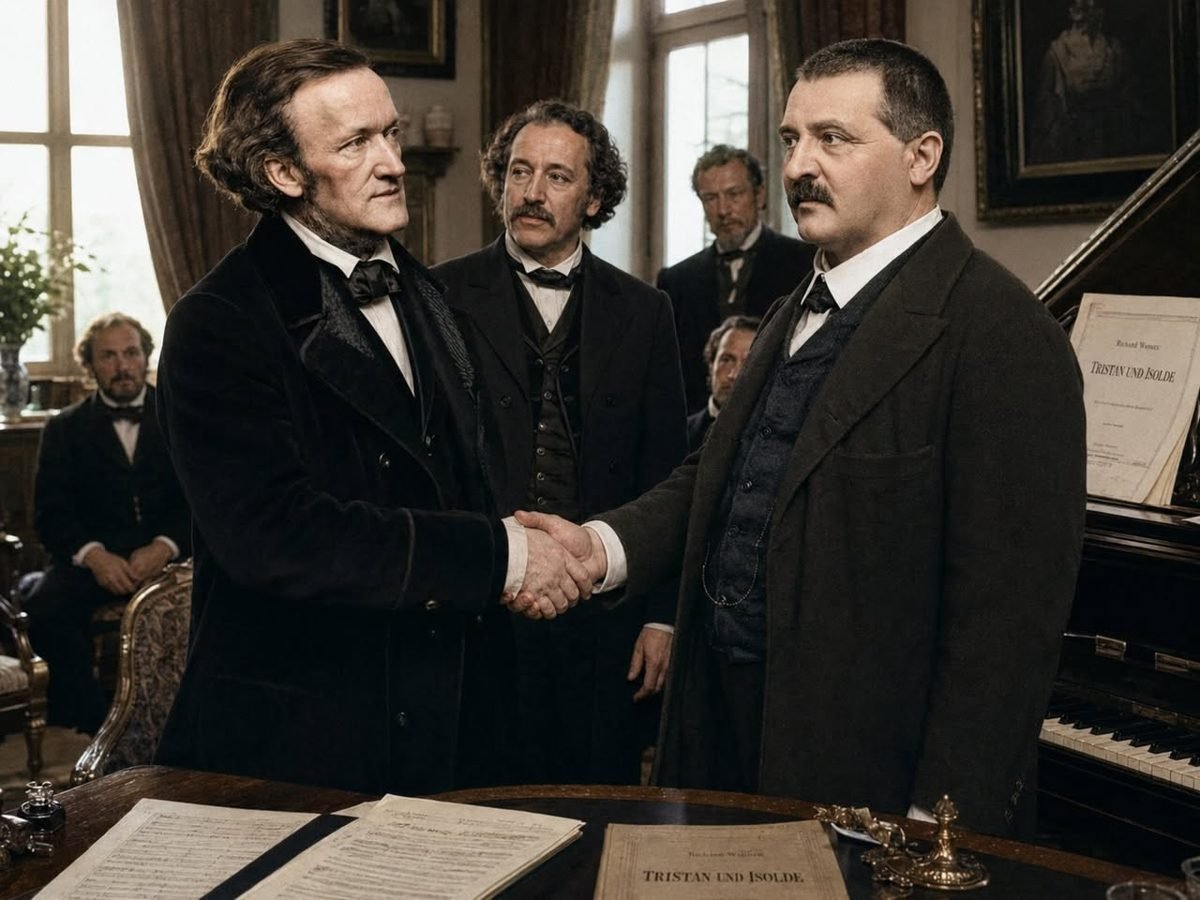
The first personal encounter between Anton Bruckner and Richard Wagner has often been compressed into a picturesque but imprecise formula: Bruckner met Wagner “at the première of Tristan und Isolde in Munich in 1865.” That statement is broadly correct in context, but not literally exact.
The surviving chronology indicates that their first documented face-to-face meeting occurred in Munich on 18 May 1865, more than three weeks before the actual première of Tristan und Isolde. Bruckner had travelled to the Bavarian capital for the production’s originally announced opening, scheduled for 15 May 1865. When the performance was postponed, he remained in Munich long enough to enter Wagner’s circle and to be introduced to him by Hans von Bülow. The most concrete physical evidence is a photograph of Wagner inscribed and dated 18 May 1865, which Bruckner treasured for the remainder of his life.
Bruckner Before Wagner: From Counterpoint to the New Music
By the spring of 1865, Bruckner was forty years old and still principally known as the cathedral organist of Linz, a remarkable improviser and an exceptionally diligent student of counterpoint. His musical education had been unusually prolonged. For years he had submitted exercises to Simon Sechter, mastering the severe traditions of harmony, fugue and contrapuntal discipline before permitting himself to compose on a large scale.
His decisive introduction to Wagner’s musical world came comparatively late. Beginning in 1861, Bruckner studied form and orchestration with Otto Kitzler, the conductor of the Linz theatre. Kitzler guided him through scores representing contemporary orchestral practice and introduced him systematically to Wagner’s music, particularly Tannhäuser, Lohengrin and Der fliegende Holländer. This was not Bruckner’s first contact with Romantic music, but it revealed to him a conception of harmony, orchestral colour and large-scale dramatic continuity that lay far beyond the conservative academic curriculum he had mastered.
Wagner therefore represented more than a famous composer. To Bruckner, he embodied the possibility that rigorous musical construction could coexist with overwhelming sonority, chromatic intensity and visionary scale. The encounter of 1865 was consequently the meeting of an established revolutionary with a composer who was only then discovering the language through which his own mature personality would emerge. Bruckner’s subsequent symphonies would not imitate Wagner’s dramas structurally, but their expanded brass choirs, prolonged harmonic tensions and monumental climaxes would be inconceivable without his assimilation of Wagner’s example.
The Journey to Munich
Bruckner travelled from Linz to Munich in the spring of 1865 because the long-awaited première of Wagner’s Tristan und Isolde had been announced for 15 May at the Königliches Hof- und Nationaltheater, the Royal Court and National Theatre.
The production was an event of exceptional significance. Wagner had completed Tristan in 1859, but repeated attempts to stage it had failed, most notoriously in Vienna, where the work acquired a reputation for being virtually unperformable. The intervention of King Ludwig II of Bavaria, Wagner’s young royal patron, finally supplied the money and institutional authority necessary to mount it in Munich. Hans von Bülow conducted; Ludwig Schnorr von Carolsfeld sang Tristan, while his wife, Malvina Schnorr von Carolsfeld, sang Isolde.
Bruckner did not travel merely as an admirer. He was then working on what became his Symphony No. 1 in C minor, and he apparently carried manuscript material with him. Accounts differ over precisely which movements were present in completed or preliminary form, but the opening movement and at least part of the Scherzo are commonly identified. His presence in Munich therefore coincided with a crucial stage in his transition from church musician and student to independent symphonic composer.
The Première That Did Not Happen
The première scheduled for 15 May 1865 was cancelled because Malvina Schnorr von Carolsfeld was suffering from hoarseness or vocal indisposition. The postponement left the many distinguished musicians and visitors who had assembled in Munich without the event they had come to witness.
This cancellation is essential to understanding the chronology. Bruckner did not first encounter Wagner during the completed première on 10 June. Rather, the unexpected interval created by the postponement provided opportunities for meetings among the musicians gathered around the production.
Contemporary press reports confirm Bruckner’s presence in Munich during the original May visit. Later Bruckner scholarship cites notices in the Linzer Zeitung of 14 May 1865 and the Viennese Neue Freie Presse of 18 May, establishing that his journey was connected with the initially announced première rather than only with the performances eventually given in June.
Hans von Bülow: The Man Who Made the Introduction
The intermediary was Hans von Bülow, one of the nineteenth century’s most formidable pianists and conductors. Bülow was responsible for preparing and conducting Tristan und Isolde, and Bruckner sought contact with him during the Munich visit.
Bruckner showed Bülow some of his symphonic manuscript. The precise extent of Bülow’s examination and his immediate reaction cannot be reconstructed with complete certainty. One later recollection attributes to him the notorious description of Bruckner as “half genius, half idiot.” Such remarks must be treated cautiously: they survive through later testimony and reflect Bülow’s habitually caustic language as much as they reveal anything objective about Bruckner.
What is much more securely documented is that Bülow introduced Bruckner to Wagner. The introduction was therefore not a chance encounter in a theatre corridor. It took place through the central conductor of the Tristan production, inside the professional and social network gathered around Wagner in Munich.
18 May 1865: The First Documented Meeting
The strongest evidence fixes the encounter on 18 May 1865.
On that date, Wagner signed and dated a photographic portrait for Bruckner. Bruckner preserved the photograph throughout his life, turning it into a material relic of what he regarded as an almost sacred meeting. Because the inscription bears the date, it provides firmer evidence than later generalized statements that the composers met “at the première.”
The exact building or room in which the introduction occurred is not identified consistently in reliable modern summaries. It is therefore safer to state that the meeting took place in Munich, within Wagner and Bülow’s circle surrounding the postponed Tristan production, rather than to assign it without firm evidence to the National Theatre, Wagner’s residence or a particular rehearsal room.
This distinction matters. The city and date are well supported; the precise interior location is not.
The encounter itself was apparently brief. There is no dependable transcript of an extended conversation, and no evidence that Wagner studied Bruckner’s symphony in detail on this occasion. Bruckner’s later reverence encouraged biographers to dramatize the meeting, but the documentary core is relatively modest:
Bülow presented Bruckner to Wagner; Wagner received him; Wagner inscribed a photograph for him on 18 May 1865.
For Bruckner, however, that modest exchange assumed enormous emotional significance.
What Bruckner Did Not Do
It is important not to confuse this first meeting with the much more substantial encounter of September 1873 at Bayreuth.
In 1873, Bruckner brought Wagner the scores of his Second and Third Symphonies and asked which of them Wagner would accept as a dedication. Wagner selected the Third, giving rise to its familiar designation as the “Wagner Symphony.” The famous anecdote in which Bruckner, after drinking beer with Wagner, became uncertain which symphony had been chosen belongs to that later Bayreuth visit—not to the first Munich meeting of 1865.
Nor is there secure evidence that Bruckner presented the First Symphony formally to Wagner in May 1865. He carried manuscript material and showed music to Bülow, but he appears to have been too intimidated or diffident to submit the work directly to Wagner. The first meeting established personal contact; it did not yet create the dedication relationship that developed eight years later.
The Return to Linz
Because the première had been postponed, Bruckner had professional obligations that required him to return to Austria. He went back to Linz, where he was involved in a choral festival and continued working on his First Symphony.
The Munich interruption was therefore relatively short, but artistically charged. During the visit, Bruckner moved among musicians associated with the most radical operatic project of the age, met Bülow, encountered Wagner and continued composing. One source records that he completed the Trio of the developing symphony on 25 May 1865, still within the broader period of the Munich journey.
The Actual Première: 10 June 1865
Tristan und Isolde finally received its world première at Munich’s Königliches Hof- und Nationaltheater on 10 June 1865, conducted by Hans von Bülow.
Bruckner was not necessarily present at that first completed performance. The best detailed chronology places him back in Munich for the third performance on 19 June 1865. This is probably one reason later accounts blurred his meeting with Wagner and his hearing of Tristan into a single première-night episode. Both belonged to the same historic production, but they occurred at different moments:
15 May 1865: originally scheduled première; postponed.
18 May 1865: first documented personal encounter between Bruckner and Wagner; Wagner’s photograph signed for Bruckner.
10 June 1865: actual world première of Tristan und Isolde.
19 June 1865: Bruckner attended the third performance according to the more detailed chronology.
A modern account claiming that Bruckner first met Wagner only on 19 June conflicts with the dated photograph of 18 May. The photograph makes the May meeting the more persuasive and documentarily secure conclusion.
Hearing Tristan: The Greater Revelation
If the personal meeting was brief, the experience of Tristan und Isolde was profound.
Bruckner encountered a musical language in which tonal resolution could be delayed across enormous spans, in which chromatic harmony carried psychological and metaphysical meaning, and in which orchestral colour participated continuously in the drama. The famous opening sonority—later called the “Tristan chord”—did not merely introduce an unusual harmony. It initiated a system of expectation, suspension and deferred fulfilment extending across the entire work.
Bruckner did not adopt Wagner’s theatrical method wholesale. His mature symphonies remained rooted in the traditions of Beethoven, Schubert, Catholic liturgical music, organ improvisation and contrapuntal construction. Nevertheless, Wagner helped him imagine:
the orchestra as a monumental organism;
brass sonority as a bearer of transcendence;
chromatic harmony as a means of spiritual intensification;
and vast duration as an expressive necessity rather than a formal defect.
The effect should not be reduced to superficial features such as heavy brass or Wagnerian tubas. Bruckner’s deeper debt lay in the conviction that music could unfold over immense spans while retaining an almost religious sense of inevitability.
Admiration, Not Equal Friendship
The relationship established in 1865 was never an ordinary friendship between equals. Bruckner approached Wagner with extreme reverence and increasingly referred to him as the supreme master. Wagner, for his part, recognized Bruckner’s devotion and eventually accepted the dedication of the Third Symphony, but he did not maintain with him the kind of sustained intellectual relationship he had with figures such as Franz Liszt, Hans von Bülow or Cosima Wagner.
Their temperaments and social identities were radically different. Wagner was a brilliant dramatist of his own personality: politically experienced, intellectually aggressive, socially manipulative and accustomed to royal patronage. Bruckner was socially awkward, intensely Catholic, deferential toward authority and frequently overwhelmed in the presence of famous men.
Yet it would be wrong to portray Bruckner merely as a naïve disciple. His musical response to Wagner was fundamentally creative. He absorbed elements of Wagner’s harmonic and orchestral thought but placed them within a form of symphonic architecture that remained unmistakably his own. Wagner opened a door; Bruckner built a different cathedral beyond it.
The Historical Significance
The first meeting of 18 May 1865 did not immediately produce a collaboration, a dedication or an intimate friendship. Its importance lies elsewhere.
It confirmed for Bruckner that the figure whose music had transformed his imagination was not merely an abstraction contained in orchestral scores. Wagner became a personal presence—a living master who had acknowledged him, however briefly, and had placed an inscription upon a photograph that Bruckner would preserve as a treasured object.
At the same time, Bruckner stood on the threshold of his mature career. He was composing his First Symphony, expanding his command of the orchestra and preparing to move beyond the provincial framework in which much of his life had unfolded. The Munich journey brought together three elements at precisely the right moment:
the emerging symphonist,
the revolutionary dramatist,
and the first production of one of the most transformative works in Western music.
The encounter was outwardly small but inwardly decisive. It did not make Bruckner a Wagnerian imitator. It strengthened his belief that music could seek the monumental, the metaphysical and the seemingly impossible—and that he, too, might attempt it.
Conclusion: The Date That Should Be Remembered
The most rigorous reconstruction is therefore:
Anton Bruckner first met Richard Wagner in Munich on 18 May 1865, after the planned 15 May première of Tristan und Isolde had been postponed. Hans von Bülow introduced them, and Wagner gave Bruckner an inscribed photograph dated that day. The exact room in which they met is not securely established. The actual première occurred on 10 June, and Bruckner returned to Munich to hear the work, most probably at its third performance on 19 June 1865.
Thus, the legendary encounter did not take place amid the applause of the première itself. It occurred in the strange interval created by a cancelled performance—an interval in which one of the nineteenth century’s greatest symphonists finally stood before the man whose music had helped awaken his mature creative identity.