1 April 2026
The Duel of the Giants: Porpora and Handel in London
On Classicapedia: Nicola Porpora, Senesino, Francesca Cuzzoni, Farinelli
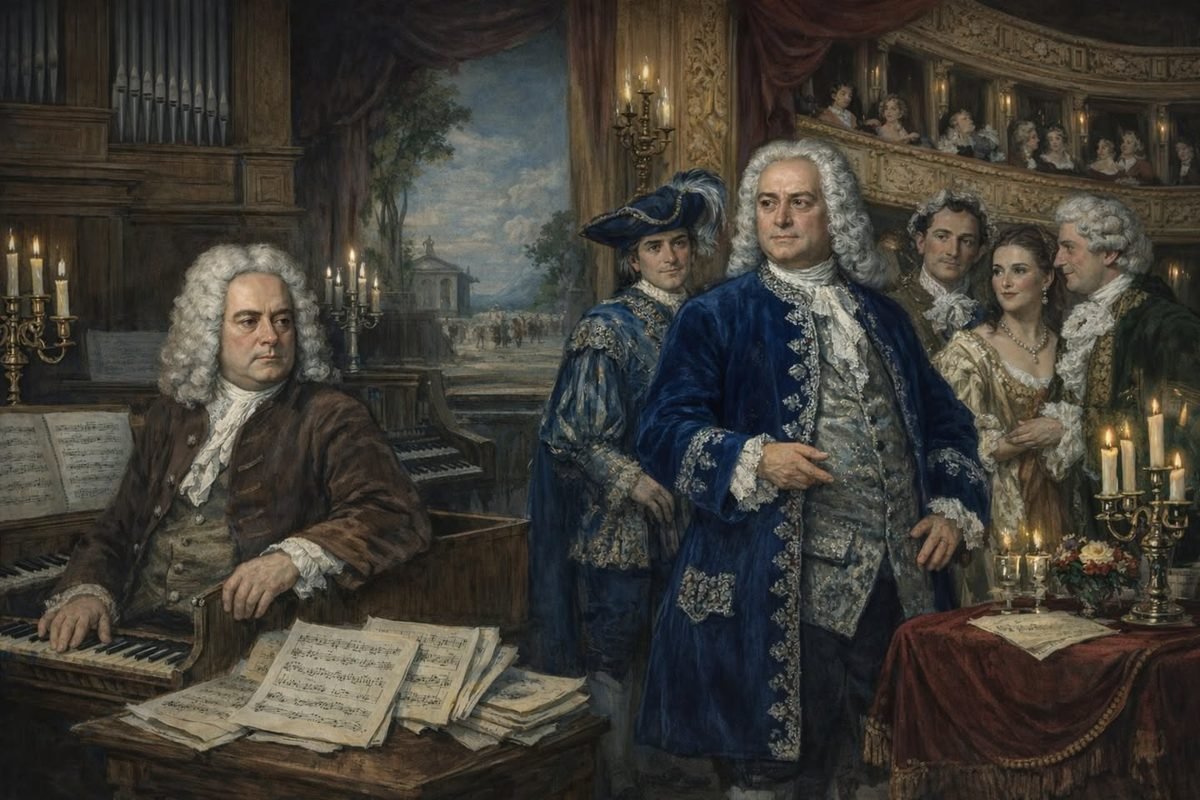
The Duel of Giants: Porpora and Handel in London
London in the 1730s: An Operatic Battleground
I. A City That Turned Opera into War
London in the 1730s was not merely a great musical capital. It was a city in which opera had become a matter of prestige, politics, fashion, and financial risk. Italian opera was no longer an imported luxury for a narrow aristocratic circle: it had become a public spectacle in which nobles, courtiers, impresarios, star singers, and composers all fought for influence. By this time Handel was already the commanding foreign genius of London’s operatic world, a composer who had made the city his base and whose authority seemed, for a moment, almost unshakable. Yet London society had a taste for division, and success nearly always invited opposition.
That opposition found its sharpest embodiment in the creation of the Opera of the Nobility, founded in 1733 by powerful aristocratic interests hostile to Handel’s position and, more broadly, to the cultural sphere associated with the court of George II. This rival company did not merely want to mount performances; it wanted to dethrone Handel. To do so, it needed an anti-Handel figure of equal prestige, and it found one in Nicola Porpora, one of the most admired Italian opera composers and the most celebrated singing teacher of his age. Porpora was not only a composer of serious reputation; he was the master of singers who could electrify Europe.
So the London operatic world divided into camps. This was not just Handel against another company. It became Handel versus Porpora, dramatic power against vocal seduction, theatrical architecture against aristocratic glamour, and one entire concept of opera against another.
II. Porpora Enters the Field
Porpora arrived in London not as a beginner seeking fortune but as a composer already crowned by continental fame. Born in Naples in 1686, he had become renowned above all as a supreme teacher of the human voice, the man who trained Farinelli and Caffarelli and who understood the Italian bel canto style at its most refined and demanding. In Porpora, the Opera of the Nobility acquired not merely a musical director but a symbol: the representative of the most polished, aristocratic, and vocally luxurious tradition in Italian opera.
The company’s first great move was brilliantly theatrical. It opened with Porpora’s Arianna in Nasso at Lincoln’s Inn Fields on 30 December 1733, with the mighty castrato Senesino and later the famous soprano Francesca Cuzzoni associated with the enterprise. This was already a direct affront to Handel, who was writing his own Arianna in Creta. The duel was therefore not hidden; it was staged openly, almost provocatively, as if London audiences were being invited to choose between two rival courts, two rival aesthetic systems, and two rival worlds.
Porpora’s art was ideally suited to this challenge. He excelled in writing music that flattered extraordinary singers, allowing them to unfurl long lines, brilliant ornamentation, and displays of control that astonished audiences. His operas often seemed to treat the voice as the true sovereign of the theatre. Handel, by contrast, although perfectly capable of writing ravishing vocal music, tended to create stronger musical drama, more compact characterization, and a firmer relation between voice, orchestra, and dramatic movement. Thus the rivalry quickly acquired a deeper meaning: Porpora represented vocal empire; Handel represented dramatic empire. This contrast is partly an inference from the repertory and the way contemporaries framed the companies, but it is strongly supported by the period’s emphasis on star singers in Porpora’s camp and by Handel’s increasingly inventive theatrical responses.
III. The Singers: The Real Artillery of the War
No operatic battle in the eighteenth century could be won by composers alone. The true weapons were singers. And in London, those singers were almost mythological figures. The defection of Senesino, who had quarreled with Handel, was a severe blow. He was one of the most celebrated operatic stars in Europe, and his move to the rival company carried symbolic force: it suggested that the anti-Handel camp could attract prestige, money, and fashionable support.
Then came the decisive sensation: Farinelli. Already famous on the continent and trained by Porpora, he reached London in 1734 and transformed the atmosphere. His arrival gave the Opera of the Nobility the kind of magnetic force that ordinary success cannot produce. He was not simply admired; he was adored. Audiences came as much to witness a marvel as to hear a performance. His vocal brilliance, breath control, embellishment, and sheer aura turned opera into public delirium. Contemporary and later accounts alike agree that his presence gave the rival company a dramatic financial and social boost, even if only temporarily.
Porpora, as Farinelli’s master, benefited enormously from this association. It gave his London enterprise glamour that Handel could not easily duplicate. The issue was no longer just whether a new opera was good, but which camp possessed the most astonishing voice on earth. In an age that idolized the castrato star, this mattered immensely. Handel still had major singers of his own, but the rival company had succeeded in making itself the house of sensation.
And yet Handel was not a man to retreat quietly. Faced with aristocratic hostility, defections, and the vocal splendor of his enemies, he responded with tenacity and invention. When he moved into Covent Garden, he benefited from a different theatrical environment and began to adapt. One of his most striking responses in the mid-1730s was the use of organ concertos as interludes, a move that seems closely tied to the competitive pressure of the moment. He could not out-Farinelli Farinelli, so he widened the theatrical experience and made his own presence as performer a new attraction.
IV. Two Visions of Opera
The fascination of this rivalry lies partly in the fact that neither man was a mere foil to the other. Both were formidable, but they embodied different strengths. Porpora stood for the supremacy of cultivated vocalism, for the Neapolitan ideal of the singer as monarch of the stage, for elegance, brilliance, and aristocratic refinement. His music could seem like a throne built for the voice itself. Handel, meanwhile, brought a wider dramaturgical force. His best operas do not only decorate emotion; they seize it, shape it, and drive it forward with orchestral color and structural command.
This is why the rivalry mattered so much historically. It was not just a contest between two successful composers. It dramatized a larger question within eighteenth-century opera: is opera above all the triumph of the voice, or is it a form of musical drama in which every element must serve the whole? Porpora leaned toward the first answer, Handel toward the second. That may simplify the richness of both men, but it captures the broad line of their opposition.
Even the repertory choices reveal this climate of combat. Porpora’s company deployed operas and singers as dazzling counters to Handel’s prestige; Handel answered not by surrendering his identity but by expanding it. Under pressure, he became more experimental, more resilient, and, in the long run, more capable of transformation. That would prove decisive.
V. Victory, Ruin, and the Irony of History
The most dramatic truth about the conflict is that it ruined nearly everyone. The rivalry was so costly, so inflated by fees for stars, so dependent on fashion and faction, that the struggle became destructive. The Opera of the Nobility eventually failed, despite Porpora’s gifts and despite the sensation created by Farinelli. But Handel’s company also suffered gravely. The war was not won in any simple financial sense. It exhausted the operatic system itself. By 1737 the competing ventures had collapsed into crisis, and even Handel’s health gave way under the strain; that year he suffered the serious illness often described as a stroke or paralytic attack.
Here lies one of the great ironies of eighteenth-century music history. In the short term, Porpora and his allies could claim spectacular moments of triumph. They had challenged Handel’s dominance, lured away singers, stirred London into frenzy, and shown that Handel was not invincible. But in the long term it was Handel who emerged as the larger historical victor, because he survived artistically by changing direction. As Italian opera in London became ever more unstable, he moved with increasing conviction toward English oratorio, the genre in which he would build his most lasting public monument. The very pressure created by rivals such as Porpora helped push him toward reinvention.
Porpora, for all his extraordinary gifts, did not secure the same durable place in the broader public imagination. He remained immensely respected, especially as a teacher and master of vocal writing, but history gave Handel the larger crown. Still, that outcome should not blind us to what London witnessed in the 1730s. For a few incandescent years, the city became the scene of a real duel between two giants: one the commanding dramatist-composer who would outlive the collapse of Italian opera in England, the other the supreme craftsman of the operatic voice, backed by aristocratic rebellion and by the most intoxicating singer of the age.
Conclusion
To speak of Porpora and Handel in London is to speak of more than a personal rivalry. It is to speak of a whole civilization of opera at the point of fever. London in the 1730s turned singers into idols, composers into political symbols, theatres into battlefields, and audiences into partisans. Porpora brought elegance, lineage, and the intoxicating prestige of bel canto at its most brilliant. Handel brought mastery, force, and a dramatic imagination strong enough to survive even when the system around him was collapsing. Their clash gave London one of the most electrifying episodes in operatic history, and it revealed with rare clarity that great art often arises not in peace, but in competition, pressure, and danger.