15 April 2026
The Childhood of Felix Mendelssohn (III): The Dawn of Genius (1822–1825)
On Classicapedia: Felix Mendelssohn, Carl Friedrich Zelter, Fanny Mendelssohn, Johann Wolfgang von Goethe, Eduard Rietz
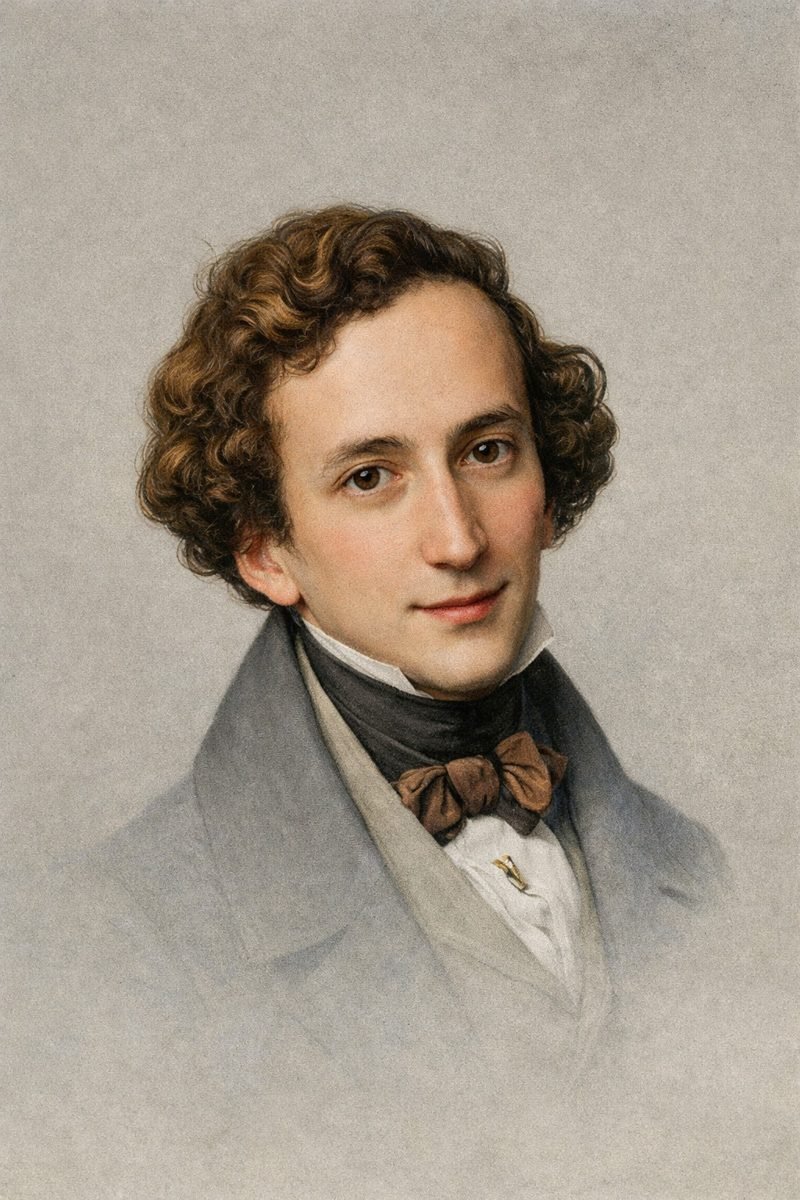
“The Dawn of Genius” (1822–1825)
Chapter 15: A City of Music
By 1822, Berlin had become one of the great musical centers of Europe, alive with the spirit of both classicism and romanticism. Its theatres performed Mozart and Weber, its salons debated Goethe and Schiller, and its orchestras played the new symphonies of Beethoven. In this environment of cultured seriousness, the young Felix Mendelssohn, now thirteen, stood at the center of a unique artistic household.
The Mendelssohn home on Leipziger Strasse had by now become almost an informal conservatory. Visitors could hear quartets by Haydn or Beethoven in one room, a piano sonata by Fanny in another, and children reading Greek poetry in a third. Every Sunday, the family’s “musicales” brought together leading thinkers, musicians, and poets — all eager to witness the flowering of two extraordinary talents.
In this atmosphere of refinement and discipline, Felix’s education entered a new phase. His father arranged for him to study orchestration, composition, and theory with Carl Friedrich Zelter, director of the Berlin Singakademie, who remained his principal mentor. But beyond Zelter’s guidance, the boy’s curiosity drove him toward independence of mind. His notebooks from this period overflow with sketches, fragments of quartets, symphonic ideas, and contrapuntal exercises.
Chapter 16: Discipline and Discovery
Zelter, though stern and rational, understood that his pupil’s intellect was extraordinary. Under his supervision, Felix studied the choral works of Bach, Handel, and Palestrina, as well as the orchestral scores of Mozart and Beethoven. The foundation of his art became craftsmanship — the mastery of musical architecture that would later allow him to unite classical clarity with Romantic expressiveness.
Each morning began with rigorous study: harmony exercises, score reading, and the analysis of fugues. Then came hours at the piano or the violin, followed by lessons in languages and history. Yet for Felix, study was never a burden. His enthusiasm was inexhaustible. He wrote to a friend:
“Work brings happiness, for every note seems to carry light within it.”
Zelter often tested his pupils by giving them strict tasks — composing fugues, rewriting melodies in different modes, or orchestrating chorales. Felix not only completed them swiftly but transformed them into works of poetry. His gift was not invention alone, but the ability to make structure sing.
Chapter 17: The Young Virtuoso
By 1823, Mendelssohn had already begun to perform publicly. His first concerts revealed not the fiery exhibitionism of a prodigy but poised artistry — command of the keyboard, subtle phrasing, and remarkable musical intelligence. His repertoire included Mozart’s concertos, Beethoven’s sonatas, and his own early compositions.
His reputation spread through Berlin’s salons. Observers marveled not at the spectacle of a child performer, but at the maturity of his musicianship. A critic wrote:
“He plays not as a child imitating his elders, but as one who speaks a language that has always belonged to him.”
At the same time, he was already conducting small ensembles, including his own family orchestra, and composing chamber works with astonishing fluency. His twelve string symphonies, written between ages eleven and fourteen, form a bridge between the clarity of Haydn and the emotional warmth of Schubert. Each demonstrates his understanding of proportion, texture, and thematic development far beyond his years.
Chapter 18: The Octet in E-flat Major, Op. 20 (1825)
In 1825, when Felix was just sixteen, he composed one of the most astonishing works in all of musical history — the Octet in E-flat major, Op. 20. Written as a birthday gift for his friend Eduard Rietz, the piece is both a miracle of youthful exuberance and a masterpiece of compositional mastery.
Scored for eight string instruments, the Octet blends chamber intimacy with symphonic ambition. Its opening movement bursts with vitality and contrapuntal brilliance, yet its form is perfectly balanced. The slow movement radiates lyricism tinged with melancholy, while the Scherzo — inspired by Goethe’s Walpurgisnachtstraum — seems to dissolve gravity itself, turning sound into motion and light.
Zelter, though seldom effusive, admitted that the Octet was “music beyond the reach of youth.” Later generations would recognize it as the first fully mature work of a teenage genius — a composition that stands beside Mozart’s early symphonies and Schubert’s youthful quartets as a landmark of precocity fulfilled.
For Mendelssohn himself, the Octet marked a turning point: it was his farewell to childhood, and the threshold of his mature voice. He would later call it “my favorite among my early works,” revising it only slightly in later years, as if afraid to disturb the freshness of inspiration that had produced it.
Chapter 19: The Overture to A Midsummer Night’s Dream
Only a year later, in 1826, came another miracle: the Overture to A Midsummer Night’s Dream, composed when Mendelssohn was seventeen. The piece would become one of the defining works of his entire career and one of the most beloved creations of the 19th century.
The idea for the overture arose from his lifelong passion for Shakespeare, whose works he read in translation with his sister Fanny. One evening, after discussing the play, Felix sat down at the piano and began sketching themes that captured its magical spirit — the lightness of fairy dances, the mystery of the forest, the tenderness of lovers’ dreams.
Completed in a matter of weeks, the Overture was nothing short of a revelation. It begins with shimmering chords that seem to open the gates of imagination, followed by fleet motifs that conjure the rustling of leaves, the laughter of sprites, and the rhythmic energy of youthful adventure.
Zelter, though deeply moved, was cautious. “It is beautiful,” he said, “but how will the world understand it?”
When Mendelssohn played the Overture for Goethe, now in his seventies, the old poet wept softly and murmured:
“My little David, who delights me with his music when I am weary of the world.”
In that phrase, Goethe captured the essence of Mendelssohn’s genius — art that restores innocence to experience, clarity to emotion, and grace to form.
Chapter 20: The Transition to Maturity
By 1825, the transformation was complete. The boy who had dazzled Berlin’s salons was now recognized across Germany as a composer of stature. His music combined the discipline of the Classical masters with the poetic imagination of the new Romantic age. Critics hailed him as the spiritual successor to Mozart — not because he imitated him, but because he shared the same harmony of intellect and emotion.
The Mendelssohn home continued to serve as a gathering place for artists and thinkers. Visitors still marveled at the refinement of the household, but the focus had shifted: the family no longer displayed prodigies — they presented an artist. Fanny, whose own musical genius was formidable, remained his confidante and collaborator. Their duet performances continued, now charged with mature emotional understanding.
Abraham and Lea Mendelssohn, proud yet modest, watched their son’s rise with quiet satisfaction. Abraham once wrote to a friend:
“We sought to educate him as a man, not as a phenomenon — and thus, perhaps, he has become both.”
Epilogue: The End of Childhood
In 1825, at sixteen, Felix Mendelssohn stood on the threshold of greatness. The years of domestic study, of quiet discipline and family harmony, had forged in him a unique balance — intellect without arrogance, emotion without chaos. His art had already reached heights that many composers never attain in a lifetime.
The Octet and the Midsummer Night’s Dream Overture announced a new voice in European music: lucid, lyrical, and full of spiritual light. The child of Enlightenment and Romanticism, Mendelssohn had achieved what few ever do — he had made youth eternal in sound.
Soon he would travel beyond Berlin — to Weimar, to London, to Italy — carrying with him the radiance of those formative years. But in spirit, the world would forever remember him as he was then: a young man at his piano, smiling gently, as if listening to a melody that belonged to the air itself.