31 May 2026
Sir Simon Rattle And The Berliner Philharmoniker
On Classicapedia: Sir Simon Rattle, Claudio Abbado, Thomas Adès, Gustav Mahler, Peter Sellars
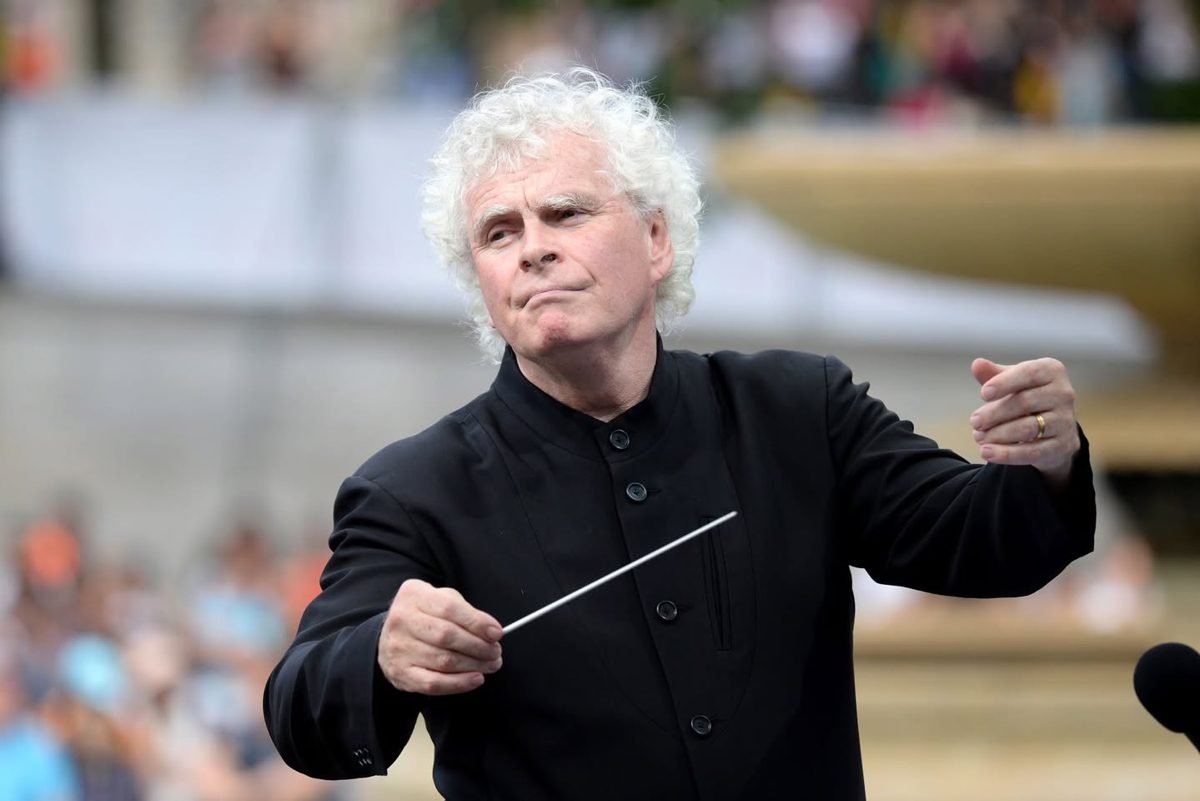
The orchestra of the 21st century
Transparency, education, contemporary music and digital reinvention
Chief conductor and artistic director, 2002–2018
From Abbado to Rattle: a new question for a new century
When Claudio Abbado announced in 1998 that he would leave the chief conductorship of the Berliner Philharmoniker at the end of his contract, the orchestra faced a question unlike any it had previously confronted. It was no longer merely searching for a conductor capable of maintaining a glorious inherited tradition. It needed a leader able to redefine what one of the world’s greatest orchestras could mean in the twenty-first century.
Each of the orchestra’s great eras had responded to a particular historical need. Hans von Bülow had transformed a young independent ensemble into a disciplined artistic force. Arthur Nikisch had given it Romantic flexibility, sonorous warmth and international fame. Wilhelm Furtwängler had made it an instrument of immense spiritual and dramatic intensity, while also standing within the most painful moral contradictions of German history. Leo Borchard and Sergiu Celibidache had helped the orchestra speak again after war and destruction. Herbert von Karajan had created its most powerful global image through sound, recording, technology and institutional prestige. Claudio Abbado, following the fall of the Berlin Wall, had opened its musical world toward transparency, dialogue, Mahler, modernity and a more humane relationship between conductor and musicians.
Now the orchestra needed to consider not only its sound, but its place in society. Who was allowed to feel that the Philharmonie belonged to them? Should a world-famous orchestra remain primarily the guardian of canonical masterworks, or should it also become an active creator of new music? How could the Philharmoniker engage with historically informed performance, contemporary composition, young people, multicultural Berlin and new digital audiences across the world?
The musicians chose Sir Simon Rattle, then artistic director of the City of Birmingham Symphony Orchestra, an ensemble whose international rise had been closely identified with his imagination, energy and conviction. He did not arrive in Berlin with the intention of restoring a past age of magnificence. He came with an ambition at once musical and cultural: to shape the Berliner Philharmoniker into a “quintessentially European orchestra.”
That phrase contained the direction of his tenure. For Rattle, Europe did not mean only the great classical and Romantic repertory handed down from Vienna, Berlin and Leipzig. It meant openness: to different national traditions, different centuries, different performance practices, living composers, different social groups and a democratic idea of culture.
With Simon Rattle, the Berliner Philharmoniker did not abandon its great tradition. It began to ask how that tradition could remain alive, responsive and publicly meaningful in a new century.
A British conductor who had already grown with the orchestra
Simon Rattle was not an outsider suddenly imposed upon the Berliner Philharmoniker. Like Abbado before him, he had developed a long and increasingly close relationship with the orchestra before accepting its leadership.
Born in Liverpool on 19 January 1955, Rattle had begun his musical life as a percussionist before turning toward conducting. From an early age, he possessed a voracious curiosity for music beyond conventional repertory boundaries. He was interested not only in Beethoven, Brahms and Mahler, but in neglected works, twentieth-century music, early music, opera, choral repertory and living composers.
His decisive institutional achievement before Berlin was his work with the City of Birmingham Symphony Orchestra. Over many years, he helped transform that ensemble into an internationally admired orchestra, demonstrating not only conducting talent but the ability to build a musical culture: to raise standards, engage audiences, programme adventurously and create a collective artistic identity.
Rattle made his debut with the Berliner Philharmoniker on 14 November 1987, conducting Gustav Mahler’s Symphony No. 6. This was an extraordinarily demanding first encounter. Mahler’s Sixth is one of the most powerful, severe and emotionally devastating works in the symphonic repertory: a score that demands both large-scale architectural control and the capacity to make extreme expressive contrasts sound inevitable.
Years later, Rattle recalled of that debut: “I felt that I was finding my voice on that day.”
The choice of Mahler was prophetic. Mahler had stood at the centre of Abbado’s Berlin world, and he would remain central during the Rattle years. Yet Rattle’s relationship with Mahler was not merely inherited from his predecessor. The Sixth Symphony, with its uncompromising intensity and enormous orchestral complexity, became a personal thread linking his first Berlin appearance to his final concert as chief conductor more than thirty years later.
Between his debut in 1987 and his assumption of office in 2002, Rattle conducted the orchestra fifty-eight times. The musicians therefore knew his qualities at close range: his enthusiasm, intellectual openness, rhythmic vitality, commitment to unfamiliar works, instinct for orchestral colour and capacity to bring a different kind of energy to familiar repertory.
When he was chosen as Abbado’s successor, the election did not signify an experiment with an unknown personality. It represented the orchestra’s decision to entrust its future to a conductor whose artistic curiosity and relationship with the musicians had already matured over many years.
The first great work through which Rattle spoke to the Berliner Philharmoniker was Mahler’s Sixth; the last work he chose as its chief conductor was the same symphony. His Berlin era was framed by a work of struggle, power and profound human uncertainty.
The beginning of his tenure: Adès and Mahler
On 7 September 2002, Simon Rattle gave his inaugural concert as chief conductor and artistic director of the Berliner Philharmoniker. The programme declared immediately what kind of artistic direction he intended to pursue:
Thomas Adès — Asyla, Op. 17
Gustav Mahler — Symphony No. 5 in C-sharp minor
The juxtaposition was revealing. Rattle did not begin with an uncontroversial monument of the German canon designed merely to reassure the public that the orchestra’s inherited splendour would remain intact. He placed a major contemporary British orchestral work beside one of the most demanding symphonic journeys of the twentieth century.
Thomas Adès’s Asyla had been written for Rattle and first performed by him with the City of Birmingham Symphony Orchestra in 1997. Its title carries an ambiguity: asyla may mean sanctuaries or places of refuge, but also evokes psychological instability and enclosed worlds. The work moves through brilliant, disorienting, often violent orchestral sound; its ecstatic central movement transforms the energy of modern club music into an overwhelming symphonic experience. For the Berliner Philharmoniker to encounter it at the opening of a new chief conductor’s era was a clear statement: living music would not be peripheral under Rattle; it would stand at the centre of the institution’s public identity.
Mahler’s Fifth Symphony, after the interval, established continuity with the orchestra’s great traditions while also conveying transformation. The work begins with a funeral march, passes through conflict, solitude and the suspended inwardness of the celebrated Adagietto, and ends in contrapuntal radiance and renewed life. It was an ideal symphony with which to inaugurate an era committed to the coexistence of historical memory and contemporary energy.
The programme also revealed something essential about Rattle’s understanding of tradition. For him, Mahler and Adès did not belong to separate worlds — one consecrated by history, the other requiring dutiful promotion because it was new. They were both part of a living orchestral imagination: music capable of testing the full intellectual, emotional and physical resources of a great ensemble.
Rattle’s first programme as chief conductor was a manifesto: the Berliner Philharmoniker would continue to speak with the great voices of the past, but it would also take seriously the music being created in its own time.
A more transparent orchestral sound
Rattle inherited an orchestra already transformed by Claudio Abbado’s pursuit of flexibility, openness and clarity. He did not reverse that movement. In many respects, he pushed it still further.
The classic image of the Karajan-era Berliner Philharmoniker had been one of extraordinary blending: long legato lines, glowing strings, rich harmonic saturation and a sound in which individual instrumental identities were often absorbed into a magnificently unified whole. Abbado had begun to expose more air between the voices, bringing greater chamber-music responsiveness and transparency into the orchestral fabric.
Rattle favoured an even more differentiated sound. He was deeply interested in the expressive possibilities of articulation, instrumental colour and rhythmic definition. He wanted a modern symphony orchestra capable not only of grand Romantic sonority, but also of the rhetorical agility demanded by Haydn and Mozart, the sharply profiled textures of twentieth-century music and the unpredictable colours of new compositions.
This did not mean that the famous Berlin richness vanished. Under Rattle, the orchestra could still produce extraordinary depth and splendour in Brahms, Wagner, Bruckner, Mahler or Richard Strauss. But the sound could change its character more radically from one repertory to another. It could become leaner, more sharply articulated and more rhythmically spring-loaded in Classical music; dense and fractured in modern scores; luminous and sensuous in French repertory; violent, transparent or ironic when contemporary works required it.
Part of this development involved opening the orchestra to the influence of conductors and musicians associated with historically informed performance practice. For an orchestra so deeply rooted in the nineteenth- and twentieth-century tradition, the encounter was significant. It encouraged new attention to articulation, phrasing, vibrato, tempo, orchestral balance and the expressive language of earlier repertory.
Rattle was not attempting to turn the Berliner Philharmoniker into a period-instrument ensemble. Rather, he sought to ensure that the orchestra’s enormous technical resources did not imprison it in one permanent sound ideal. A truly modern orchestra, in his conception, must be capable of changing its speech according to the music before it.
Under Rattle, the Berliner Philharmoniker was asked not only to preserve a legendary sound, but to become an orchestra capable of many sounds — each one responding to the particular language of the composer.
Viennese classicism, Brahms, Sibelius and Mahler
Rattle’s programming was notable for contemporary music, but the established symphonic repertory remained essential to his work. He approached it, however, with an interest in clarity, structure and renewal rather than with a desire simply to reproduce the orchestra’s earlier traditions.
He strengthened the orchestra’s engagement with Viennese classicism: the world of Haydn, Mozart and Beethoven, in which rhythmic vitality, articulation, balance and rhetorical precision matter as much as beauty of tone. For a Philharmoniker long celebrated for its Romantic sonority, this focus helped reveal a lighter, more animated and more alert dimension of its playing.
His interpretations of Johannes Brahms attracted particular admiration. Brahms had always belonged to the orchestra’s core identity, from Bülow and Nikisch through Furtwängler, Karajan and Abbado. Rattle’s Brahms joined warmth and weight to textual detail, rhythmic life and openness of texture. His symphonic cycle demonstrated that the traditional Berlin association with Brahms could remain powerful without simply returning to the tonal massiveness of earlier generations.
His work on the symphonies of Jean Sibelius was equally significant. Sibelius offered a repertory particularly suited to Rattle’s ear for structure, atmosphere and transformation: music in which orchestral events appear to grow organically from fragments, silence, landscape and gradually intensifying energy. The Philharmoniker’s tonal resources could reveal the darkness and grandeur of these works, while Rattle’s structural alertness prevented them from becoming merely atmospheric.
Above all, Gustav Mahler remained a fundamental composer of his Berlin life. Rattle’s relationship with the orchestra had begun with Mahler’s Sixth Symphony; his inaugural concert as chief conductor included the Fifth; and his farewell returned to the Sixth. In Mahler’s scores, Rattle found music capable of containing multiple worlds: popular memory and catastrophe, chamber delicacy and explosive orchestral violence, grotesque parody and overwhelming longing.
Rattle’s Mahler continued and transformed the great Mahler tradition established under Abbado. Where Abbado’s Mahler could seem weightlessly poetic, transparent and profoundly inward, Rattle often emphasised the modernity, theatrical contrast, eruptive energy and sonic extremity of these enormous scores.
For Rattle, the great symphonic canon was not a monument to be guarded from change. It was a living laboratory in which a great orchestra could rediscover its own possibilities.
An orchestra for living composers
One of the clearest marks of the Rattle era was its commitment to contemporary music. The Berliner Philharmoniker had never been entirely detached from modern creation: under Furtwängler it had premiered Schoenberg’s Variations for Orchestra; Abbado had made the Second Viennese School and twentieth-century repertory central to his intellectual programming. Rattle expanded this commitment with special energy.
The composers associated with his Berlin years included Hans Werner Henze, Thomas Adès, Jörg Widmann, Sofia Gubaidulina and Heiner Goebbels. Such names represented radically different musical languages: lyricism and political intensity, postmodern brilliance, instrumental imagination, spiritual concentration and theatrical experiment.
His relationship with Thomas Adès was especially emblematic. By selecting Asyla for his inaugural Berlin concert, Rattle identified a living composer with the beginning of his leadership. Later, the Berliner Philharmoniker Foundation commissioned Adès’s orchestral work Tevót, which Rattle premiered with the orchestra in 2007. In these choices, contemporary music was not treated as an obligation to be placed discreetly beside more popular classics; it was presented as an event worthy of the orchestra’s full prestige and resources.
In the later years of his tenure, Rattle also initiated the Tapas series, commissioning short works from prominent contemporary composers. The title suggested an approachable, varied manner of encountering new music: concise pieces that might surprise, disturb or delight audiences without requiring a conventional large-scale concert frame.
This was part of Rattle’s broader mission. A leading orchestra could not claim to represent musical greatness while ignoring the composers writing in its own present. Beethoven, Brahms, Mahler and Sibelius had once been living composers, often challenging the expectations of their audiences. To honour their legacy truly meant making space for new works that might become the future memory of the orchestra.
Rattle believed that a great orchestra must not only preserve musical history. It must also help create it.
Bach’s St Matthew Passion: a performance that became a spiritual event
Among all the artistic achievements of Rattle’s Berlin tenure, none carried greater personal significance for him than the collaboration with the American theatre director Peter Sellars on Johann Sebastian Bach’s St Matthew Passion.
Bach’s Passion is not opera. It is a sacred musical meditation on betrayal, fear, suffering, compassion and death. Yet Sellars’s conception did not attempt to convert it into conventional theatrical spectacle. His approach was often described as a ritualisation: singers, chorus and musicians were not simply presenting the narrative from a safe distance, but participating physically and emotionally in its meaning.
Under Rattle, the Berliner Philharmoniker brought to Bach not only its refined orchestral skill but a new kind of dramatic and human attention. The performance placed the orchestra within an experience of listening and empathy that reached beyond the normal boundaries of symphonic concert life. The musicians were not hidden behind a detached idea of technical perfection; they were part of a collective act of contemplation.
For Rattle, the result was decisive. He called this production “The most important thing we’ve ever done here.”
The statement is revealing. It was not a Beethoven or Mahler cycle, not a virtuoso orchestral triumph and not a technological innovation that he placed above all else. It was a performance in which music, theatre, spirituality and shared human vulnerability became inseparable.
Rattle’s later projects with Sellars continued this path, including semi-staged presentations of Claude Debussy’s Pelléas et Mélisande and György Ligeti’s Le Grand Macabre. These projects demonstrated that the Philharmoniker could become not only a symphonic body, but an intensely dramatic institution capable of bringing complex musical theatre to life in new forms.
In the St Matthew Passion, Rattle and Sellars created a moment in which the Berliner Philharmoniker could no longer be heard only as a great orchestra. It was experienced as a community of human feeling.
The Education Programme: opening the doors of the Philharmonie
Rattle’s transformation of the Berliner Philharmoniker was not confined to the sound made on stage. One of his most lasting achievements was the founding of the orchestra’s Education Programme in 2002, with the support of Deutsche Bank.
The idea was both simple and radical: classical music should not remain enclosed within a social or cultural elite. An orchestra supported by public esteem and occupying a central place in the city had a responsibility to reach people who might otherwise never enter the Philharmonie, particularly children and young people.
This did not mean merely presenting simplified school concerts or asking students to receive music passively. The Education Programme encouraged participants to discover their own creative capacities through movement, rhythm, singing, composition, collaboration and direct encounter with orchestral musicians.
Its most famous early achievement was the dance project built around Igor Stravinsky’s Le Sacre du printemps — The Rite of Spring — in 2003. Working with the choreographer Royston Maldoom, Rattle and the Berliner Philharmoniker joined hundreds of young people from Berlin in preparing a public performance of one of the most rhythmically explosive works in twentieth-century music.
The young participants did not need to arrive with elite musical training or prior access to concert culture. The project demanded discipline, cooperation, physical commitment and courage. Stravinsky’s music became not an inaccessible modernist masterpiece admired from a distance, but a force they had to inhabit with their bodies and their collective energy.
The documentary film Rhythm Is It! recorded the development of the project and brought its message to a wide public. It demonstrated that contact with great music could transform confidence, attention, cooperation and self-perception. The Philharmoniker was no longer only an orchestra performing for audiences; it had become a partner in the creative lives of young Berliners.
In 2007, during the orchestra’s 125th anniversary year, the Berliner Philharmoniker and Sir Simon Rattle were appointed International UNICEF Goodwill Ambassadors, recognising the significance of this cultural and social engagement.
The Education Programme was one of the most profound changes in the orchestra’s modern history: the Philharmoniker no longer saw its public role as simply performing at the highest level. It also accepted the responsibility of bringing music into lives that it had not previously reached.
The Berlin Philharmonic Foundation: a new institutional identity
The year 2002 marked not only the beginning of Rattle’s chief conductorship but an important institutional transformation. Until then, the Berlin Philharmonic Orchestra had been part of the Berlin Senate administration, while a separate organisation handled media rights.
In the year Rattle took office, these structures were united within the Berlin Philharmonic Foundation.
This change represented a modernised public identity for the orchestra. The ensemble was not merely the inheritor of a glorious concert tradition; it was an institution capable of organising artistic work, media activity, educational projects and public responsibility within a coherent framework.
The transformation also corresponded to Rattle’s conception of the Philharmoniker. His tenure was never only about his own concerts. It was about the orchestra as a living organism with a role in the city, in the international musical world, in education and in the technological future of classical music.
The relationship between artistic renewal and institutional renewal is important. A conductor may influence tempo, phrasing and repertory; but an artistic era becomes historically significant when it changes the way an orchestra understands its entire purpose. Under Rattle, the Berliner Philharmoniker increasingly defined itself not simply as a supreme performing ensemble, but as a cultural foundation acting in multiple public spaces.
The Digital Concert Hall: Berlin to the world
If Karajan had understood the power of the recording studio, television and filmed concert performance, Rattle’s era confronted the next revolution: the internet.
In 2009, the Berliner Philharmoniker launched its Digital Concert Hall, an innovative platform that made it possible for listeners throughout the world to experience the orchestra’s concerts online in high-quality sound and image. As with the Education Programme, the project was made possible through the support of Deutsche Bank.
The importance of this innovation extends far beyond convenience. For most of its history, access to the Berliner Philharmoniker depended on physical presence in Berlin, on the opportunity to hear it during a tour, or on commercial recordings that captured a limited selection of repertory. The Digital Concert Hall transformed that relationship. Concerts could now be transmitted from the Philharmonie to listeners in distant countries; an archive could preserve not only carefully selected studio projects but the living development of seasons, guest artists, premieres and changes in orchestral style.
This digital transformation did not diminish the unique value of being present in the Philharmonie. Rather, it enlarged the public community surrounding the orchestra. A listener in Tokyo, Barcelona, Buenos Aires or New York could follow Berlin’s musical life with unprecedented immediacy.
There is a clear historical line here. Karajan had made the orchestra a global presence through recordings and film; Rattle helped make it a global presence in real time through digital transmission. Both understood that musical institutions cannot ignore the technologies through which future audiences encounter art.
The Digital Concert Hall was one of the defining legacies of the Rattle era: the Philharmonie was no longer only a hall in Berlin, but a concert space able to open its doors to the world.
Tours, Baden-Baden and new horizons
International touring had formed part of the Philharmoniker’s identity since the nineteenth century. Under Rattle, the orchestra continued to travel widely, but also expanded its geographical and institutional horizons.
In 2010, the Berliner Philharmoniker travelled to Abu Dhabi for the first time. Such journeys reflected the global cultural landscape of the new century: major orchestras were no longer addressing only the traditional musical capitals of Europe, North America and Japan, but audiences in newly developing international centres of concert life.
A further major change occurred in 2013, when the orchestra’s Easter Festival moved from Salzburg to Baden-Baden. Salzburg had been intimately connected with Karajan, who founded the Easter Festival there in 1967 and established the Philharmoniker’s identity as an opera orchestra within that festival environment. The move to Baden-Baden therefore signalled a genuine institutional transition.
In Baden-Baden, the orchestra continued its engagement with large-scale staged opera. Among the culminating projects of the Rattle years was Richard Wagner’s Parsifal at the 2018 Easter Festival. The work, with its themes of suffering, compassion, community and redemption, was an appropriate final operatic landmark for a conductor whose most treasured Berlin achievement had been Bach’s St Matthew Passion with Peter Sellars.
Rattle and the human face of a great orchestra
Like Abbado, Rattle brought an accessible and communicative personality to an institution historically associated with enormous prestige. Yet the two conductors were not the same.
Abbado’s authority was quiet, elegant and inwardly poetic. His musicianship often seemed to invite the orchestra into a shared listening process in which music became transparent, vulnerable and almost weightless. Rattle was more verbally energetic, more demonstrative, more overtly engaged in explaining musical and institutional projects to the public. His personality was animated by curiosity and enthusiasm; his belief in culture as a public force was expressed not only in performances, but in programmes, education, interviews and advocacy.
He was also leading an orchestra that continued to change generationally. The renewal already under way during Abbado’s period continued through the Rattle years. Younger musicians entered the ensemble, bringing with them new experiences and new responses to repertory and performance practice.
This transition was not always simple. Any chief conductor of the Berliner Philharmoniker confronts one of the most self-aware and independently minded communities of musicians in the world. Rattle’s programming choices, his pursuit of transparency and his desire to stretch the ensemble toward different styles inevitably produced debates and occasional resistance. Yet the scale of the projects realised during his tenure indicates a partnership capable of remarkable trust and ambition.
His era expanded the very definition of Philharmonic excellence. Excellence could no longer mean only a magnificent performance of Brahms or Bruckner. It could mean a young person dancing Stravinsky for the first time; a new Adès score entering the repertory; Bach transformed into an unforgettable ritual experience; or a listener on another continent entering the Philharmonie through a digital screen.
Rattle’s achievement was to make the idea of a great orchestra larger: not less demanding in artistic standards, but far more open in who could participate in its musical world.
2013: the decision to depart
In January 2013, Simon Rattle announced that he would not extend his contract beyond its conclusion in 2018. The announcement gave both conductor and orchestra a long period in which to bring important projects to completion and prepare for the next transition in the Philharmoniker’s history.
The years that followed did not resemble an exhausted closing chapter. Rattle continued to pursue major artistic ambitions. With Peter Sellars, he realised semi-staged performances of Debussy’s Pelléas et Mélisande and Ligeti’s Le Grand Macabre. He developed the Tapas series for short contemporary commissions. He continued major symphonic and operatic projects, and in Baden-Baden conducted the new production of Wagner’s Parsifal in 2018.
This final phase demonstrated an important aspect of Rattle’s personality: his unwillingness to allow an institution to retreat into repetition once a departure had been announced. The final years remained a time of invention, experiment and artistic risk.
Mahler’s Sixth: the circle is complete
For his final concert in the Philharmonie as chief conductor, Simon Rattle returned to the work with which his entire artistic history with the Berliner Philharmoniker had begun: Gustav Mahler’s Symphony No. 6.
The gesture was deeply meaningful. In 1987, the young British conductor had stood before the Philharmoniker for the first time and felt, in his own words, that he was finding his voice. In 2018, after sixteen years as chief conductor and more than three decades of association with the orchestra, he returned to the same symphony as a mature artist looking back upon a completed era.
Mahler’s Sixth is not a conventional work of celebratory farewell. Its emotional trajectory is severe; its ending is catastrophic rather than triumphant. Yet perhaps this made it especially truthful. A significant artistic relationship is not summed up by easy applause or comfortable retrospective pride. It contains struggle, tension, ambition, disappointment, achievement, affection and the knowledge that all eras must come to an end.
By choosing the Sixth, Rattle did not offer a self-congratulatory monument. He returned to the music through which he had first discovered his Berlin voice. The symphony became a frame around his life with the orchestra: from the promise of youth to the gravity of farewell.
Rattle’s final Mahler Sixth was more than a programme choice. It was a return to the moment in which he had first recognised himself before the Berliner Philharmoniker — and a final acknowledgement of how profoundly the orchestra had shaped his musical life.
The historical meaning of the Rattle era
Sir Simon Rattle’s Berlin years cannot be judged solely through the traditional measure of conductor and orchestra: the greatness of particular performances. Those performances mattered greatly — his Mahler, Brahms and Sibelius cycles; his Bach with Sellars; his engagement with opera and new music — but his contribution was also institutional and social.
He helped make the orchestra more open to the multiplicity of European musical culture. He extended the movement toward a more transparent and flexible sound. He gave living composers an important position within one of the world’s most prestigious orchestras. He encouraged encounters with historically informed performance practice and widened the expressive vocabulary of the ensemble.
Most visibly beyond the concert platform, he founded an Education Programme that brought the Philharmoniker into direct creative relationship with children and young people who might never otherwise have considered classical music part of their lives. He presided over the emergence of the Berlin Philharmonic Foundation. He led the orchestra into the digital age through the Digital Concert Hall, making the living concert culture of Berlin accessible across the world.
The eras of Karajan, Abbado and Rattle can be understood not as mutually exclusive models, but as successive transformations of the same great institution.
Karajan made the orchestra a worldwide symbol of sonic splendour, perfection and media power.
Abbado made it more transparent, questioning, human and intellectually open in the newly reunified Berlin.
Rattle carried that openness into public education, contemporary creation, digital access and a distinctly twenty-first-century idea of the orchestra’s responsibility.
Under him, the Berliner Philharmoniker did not cease to be an elite ensemble in the artistic sense: its standard remained among the highest imaginable. But he challenged the idea that artistic excellence must belong to an enclosed social world.
The great legacy of Sir Simon Rattle in Berlin was his conviction that an orchestra can be both supremely excellent and radically open: open to new music, open to new ways of hearing the past, open to children and young people, and open to a worldwide public through new technology.
In the history of the Berliner Philharmoniker, his was the era in which the great orchestra of Berlin decided that its future would not be secured by prestige alone, but by curiosity, renewal, inclusion and the courage to share its music beyond the walls of the Philharmonie.
Essential chronology
19 January 1955 — Simon Rattle is born in Liverpool.
14 November 1987 — He makes his debut with the Berliner Philharmoniker, conducting Mahler’s Sixth Symphony, the work that would remain symbolically connected with his entire Berlin career.
1998 — Claudio Abbado announces that he will step down as chief conductor in 2002, obliging the orchestra to seek a leader for the new century.
1987–2002 — Before taking office, Rattle conducts the Berliner Philharmoniker fifty-eight times, establishing a long-standing artistic relationship with the musicians.
7 September 2002 — Rattle gives his inaugural concert as chief conductor and artistic director, performing Thomas Adès’s Asyla and Mahler’s Fifth Symphony.
2002 — The Berliner Philharmoniker Education Programme is founded, opening new creative paths toward classical music especially for children and young people.
2002 — The orchestra and its media-rights organisation are consolidated into the Berlin Philharmonic Foundation, creating a new institutional structure for the twenty-first century.
2003 — The Education Programme’s dance project based on Stravinsky’s Le Sacre du printemps, developed with choreographer Royston Maldoom and young Berlin participants, becomes a major public event; its story is later preserved in the award-winning film Rhythm Is It!
2007 — During the orchestra’s 125th anniversary year, the Berliner Philharmoniker and Sir Simon Rattle are appointed International UNICEF Goodwill Ambassadors.
2007 — Rattle conducts the premiere of Thomas Adès’s Tevót, commissioned by the Berliner Philharmoniker Foundation.
2009 — The Digital Concert Hall begins operation, allowing audiences worldwide to follow the orchestra’s performances online.
2010 — The Berliner Philharmoniker makes its first visit to Abu Dhabi under Rattle.
2010 — Rattle and Peter Sellars present Bach’s St Matthew Passion in a deeply affecting ritualised form, later described by the conductor as the most important work they had done together in Berlin.
January 2013 — Rattle announces that he will not renew his Berlin contract beyond 2018.
2013 — The orchestra’s Easter Festival moves from Salzburg to Baden-Baden.
2018 — Rattle completes major final projects including Wagner’s Parsifal at the Baden-Baden Easter Festival.
June 2018 — In his last concert in the Philharmonie as chief conductor, Rattle returns to Mahler’s Sixth Symphony, bringing his Berlin tenure full circle with the work of his 1987 debut.
Key figures in this chapter
Sir Simon Rattle — British conductor, chief conductor and artistic director of the Berliner Philharmoniker from 2002 to 2018; advocate of transparent orchestral sound, contemporary creation, education and digital accessibility.
Claudio Abbado (1933–2014) — Rattle’s predecessor, whose pursuit of openness, Mahlerian depth and a more collaborative orchestral culture prepared important aspects of the artistic environment Rattle inherited.
Thomas Adès — British composer whose Asyla formed half of Rattle’s inaugural Berlin programme in 2002 and whose Tevót was premiered under him in 2007, symbolising his commitment to living composition.
Gustav Mahler (1860–1911) — Composer whose Sixth Symphony framed Rattle’s relationship with the orchestra, from his debut in 1987 to his final concert as chief conductor in 2018.
Peter Sellars — American theatre director whose collaboration with Rattle in Bach’s St Matthew Passion, Debussy’s Pelléas et Mélisande and Ligeti’s Le Grand Macabre expanded the orchestra’s dramatic and spiritual possibilities.
Royston Maldoom — Choreographer of the celebrated 2003 educational dance project centred on Stravinsky’s The Rite of Spring, documented in Rhythm Is It!