15 June 2026
Mozart in Vienna: The Stay of 1767–1768
On Classicapedia: Wolfgang Amadeus Mozart, Leopold Mozart, Michael Haydn, Anton Cajetan Adlgasser
CHAPTER 5
A VIENNA SOJOURN
════════════════════════════
I. A RETURN TO SALZBURG AFTER EUROPE
After the immense success of the Grand Journey, Leopold Mozart had reason to feel uncertain about the family’s return to Salzburg. He had been absent from his duties far longer than expected, and the journey had lasted three and a half years. He may also have feared that reports of the family’s considerable profits would irritate his superiors. Yet these anxieties proved, at least initially, unnecessary. The Mozart family had brought glory to Salzburg. Their appearances before the courts of Europe had reflected well on the prince-archbishop who had sponsored such gifted subjects.
The family returned not as ordinary servants of a provincial court, but as celebrities. Wolfgang, still only a child, had already become known in the great houses of Europe. Nannerl had also played an important role in the family’s reputation. Leopold, who had directed everything with tireless vigilance, could feel that his entire strategy had been vindicated. Salzburg had sent out a family of court musicians; Europe had received them as wonders.
But the triumph contained its own urgency. The children were growing older. Nannerl was now approaching adulthood, and Wolfgang was nearing twelve. Leopold understood that the spell of childhood could not last forever. The child prodigy’s power depended partly on youth, smallness, novelty, and astonishment. If the family delayed too long, the very quality that had dazzled Europe might begin to fade. Time was now an adversary.
Thus, even while the Mozarts were back in Salzburg, Leopold was already planning further travel. Rumours circulated that the family might again depart, perhaps even toward Scandinavia, Russia, or fantastically remote destinations. In reality, Leopold’s attention turned first to Vienna, and beyond Vienna to Italy. His mind remained fixed on opportunity. The family had returned home, but home was no longer enough.
════════════════════════════
II. WOLFGANG IN FAVOUR AT SALZBURG
During the months after the Grand Journey, Wolfgang was not idle. On the contrary, he received a series of important assignments that show how strongly Salzburg now valued him. He wrote the recitative and aria Tali e cotanti sono, K. 36, performed on 21 December 1766, the anniversary of the archbishop’s consecration. Soon afterward, he was invited to collaborate with the senior Salzburg court composers Michael Haydn and Anton Cajetan Adlgasser on the oratorio Die Schuldigkeit des ersten Gebots, K. 35, whose first part was performed on 12 March 1767.
This was a remarkable event. A boy who had only recently returned from being exhibited as a prodigy was now being placed alongside established Salzburg composers. For his contribution, he received a gold medal worth twelve ducats. The medal symbolized more than payment. It acknowledged that the child was not merely a performer of wonders, but a composer capable of public religious and dramatic work.
On 13 May 1767, his Latin comedy Apollo et Hyacinthus, K. 38, was performed at the Benedictine University graduation ceremony. Later that same day, Wolfgang played for an enthusiastic university audience, giving notable proof of his art at the harpsichord. The occasion is important because it joined two sides of his early reputation: composer and performer, theatrical craftsman and keyboard prodigy.
During this Salzburg period, he also wrote or was credited with other works: the Passion cantata Grabmusik, K. 42/35a; four keyboard concertos, K. 37 and K. 39–41, based on sonata movements by other composers; and a number of smaller pieces now lost but recorded in Leopold’s thematic catalogue of his son’s early works. These assignments show Wolfgang being drawn into increasingly formal compositional tasks. He was still young, still dependent, still under his father’s direction, but the artistic field was widening.
The child who had astonished Europe now had to demonstrate that astonishment could mature into craft.
════════════════════════════
III. LEOPOLD’S NEW URGENCY
Leopold Mozart saw the situation with cold clarity. Wolfgang’s future could not be secured by repeating the same miracle indefinitely. The cloth-covered keyboards, the games of guessing notes, the tricks of prodigy display, and the wonder of a child performer had carried the family through the great courts of Europe. But the child was growing. The audience would soon demand more. Musicians would demand proof. Theatres would demand works. Patrons would demand substance.
Leopold therefore needed a new strategy. He had to transform Wolfgang from prodigy into composer. The next arena would not be merely the salon or the royal chamber; it would be the theatre, the church, and the public world of serious composition.
Vienna seemed the obvious place. It was close enough to Salzburg, yet large enough to offer imperial patronage, aristocratic networks, opera, theatre, and public visibility. The family had already triumphed there in 1762. Leopold expected a renewed reception from the imperial family and the princely houses. He also looked beyond Vienna, toward the Italian journeys that he believed could no longer be delayed.
On 11 September 1767, the entire Mozart family left Salzburg again. They travelled in their own carriage with a servant named Bernhard, passing through Vöcklabruck, Lambach, Linz, Melk, and St. Pölten. At Melk, Wolfgang played the organ at the Benedictine abbey, once again linking travel, piety, musical display, and patronage. On 15 September they arrived in Vienna and took lodgings in the Weihburggasse, in a house owned by the goldsmith Johann Schmalecker.
Leopold was optimistic. He knew the costs would be high, but he believed that one successful day might repay everything. His mentality was again that of the gambler-impresario: prudent, calculating, anxious, but willing to risk large expenditure if the possible gain was large enough.
════════════════════════════
IV. VIENNA DELAYS ITS WELCOME
The Vienna that Leopold expected did not immediately appear. The imperial family was in no hurry to receive the Mozarts. While they waited, a smallpox epidemic broke out, and Archduchess Josepha died on 15 October. The city was suddenly a place not of triumph but of danger.
When the children of their landlord fell ill, Leopold removed his family from Vienna and took them to Brünn, now Brno, arriving on 23 October. There they visited Countess Herberstein and Count Franz Anton Schrattenbach, brother of Salzburg’s archbishop. Three days later they moved on to Olmütz, now Olomouc. But the danger had followed them. Wolfgang began to show symptoms of smallpox.
Leopold’s report is precise and anxious: Wolfgang complained of his eyes, his head was warm, his cheeks hot and red, his hands cold as ice, his pulse abnormal. The child was put to bed. The illness became severe. Later testimony from Nannerl added the detail that Wolfgang was temporarily blind for nine days and had to protect his eyes for weeks after recovery.
Then Nannerl herself fell ill with the same disease and suffered for almost three weeks. The family’s Vienna project collapsed into sickness, waiting, and fear. Nearly four months would be lost before the imperial audience finally took place.
This section of the chapter is essential because it reminds the reader that the prodigy’s career was constantly dependent on fragile bodies. Glory could be interrupted by fever. Plans could vanish in a sickroom. A child who seemed almost miraculous before audiences was still subject to disease, blindness, pain, and death.
The family’s ambition was immense, but its foundation remained vulnerable.
════════════════════════════
V. THE IMPERIAL AUDIENCE OF 19 JANUARY 1768
At last, on 19 January 1768, the Mozarts were received by the emperor and empress, together with Duke Albert of Saxony and the archduchesses. Leopold described the audience with pride. The empress conversed warmly with Anna Maria, speaking of the children’s smallpox and the events of the Grand Journey, stroking her cheeks and pressing her hands. The emperor spoke with Wolfgang and Leopold about music and other matters.
The scene had all the signs of courtly favour: intimacy, conversation, recognition, and benevolent attention. Yet the practical result disappointed Leopold. The family received only an inexpensive medal. The emperor’s gracious conversation did not become serious payment. Leopold complained that Joseph II disliked expenditure and seemed to believe that his words were sufficient reward.
This disappointment marked the beginning of a broader disillusionment. The family had spent heavily. They had been delayed by illness. They had received praise, but little money. Leopold began to fear that they would not recover their expenses.
More troubling still, Wolfgang was not creating the expected sensation in Vienna. Something had changed. Perhaps he was too old to be treated as the tiny wonder-child of 1762. Perhaps the novelty had faded. Perhaps the Viennese public wanted spectacle, farce, dance, magic, devils, clowns, witches, ghosts, and theatrical entertainment rather than serious musical display. Leopold interpreted the situation with characteristic bitterness, blaming the Viennese taste for foolishness and theatrical triviality.
But beneath the complaint lay an unavoidable fact: THE OLD PRODIGY FORMULA WAS NO LONGER ENOUGH.
════════════════════════════
VI. SKEPTICISM AND THE ENEMIES OF THE CHILD
In Vienna, opposition and skepticism began to gather around Wolfgang. According to Leopold, some Viennese musicians dismissed the whole affair as humbug. They suggested that the performances were prearranged, that Wolfgang was given music he already knew, and that the notion of his composing was ridiculous. These accusations struck at the very heart of the family myth.
For Leopold, such doubts were intolerable. Wolfgang’s genius was, in his eyes, not merely a matter of pride but almost a sacred truth. To deny it was to attack the family’s honour, his own pedagogical achievement, and the divine gift he believed had been entrusted to him. He saw skepticism not as ordinary professional caution, but as envy, slander, and persecution.
This reaction reveals one of Leopold’s defining patterns. When events went against him, he often imagined plots. Rivals became enemies; obstacles became conspiracies; theatrical difficulties became deliberate malice. His suspicion was not entirely invented—Vienna was indeed competitive, jealous, and politically complex—but his interpretation magnified every setback into moral warfare.
For Wolfgang, this atmosphere must have been formative. He was no longer merely applauded as a miracle. He was being challenged, doubted, and asked to prove himself in a more serious arena. The old childish displays could no longer silence musicians who wanted real evidence of compositional power.
Leopold therefore seized upon a new possibility.
════════════════════════════
VII. THE OPERA AS NEW STRATEGY
A chance question from the emperor changed everything. Joseph II asked whether Wolfgang would like to write an opera. For Leopold, the suggestion suddenly opened a new path. If the prodigy display was losing force, then perhaps the boy could astonish Vienna by doing something even more audacious: composing a full-scale opera for the theatre.
This was a bold strategic shift. Leopold imagined the effect with theatrical excitement. What turmoil would arise among composers when, after hearing Gluck, the public saw a boy of twelve seated at the harpsichord conducting his own opera? The idea was brilliant in conception, but dangerous in execution.
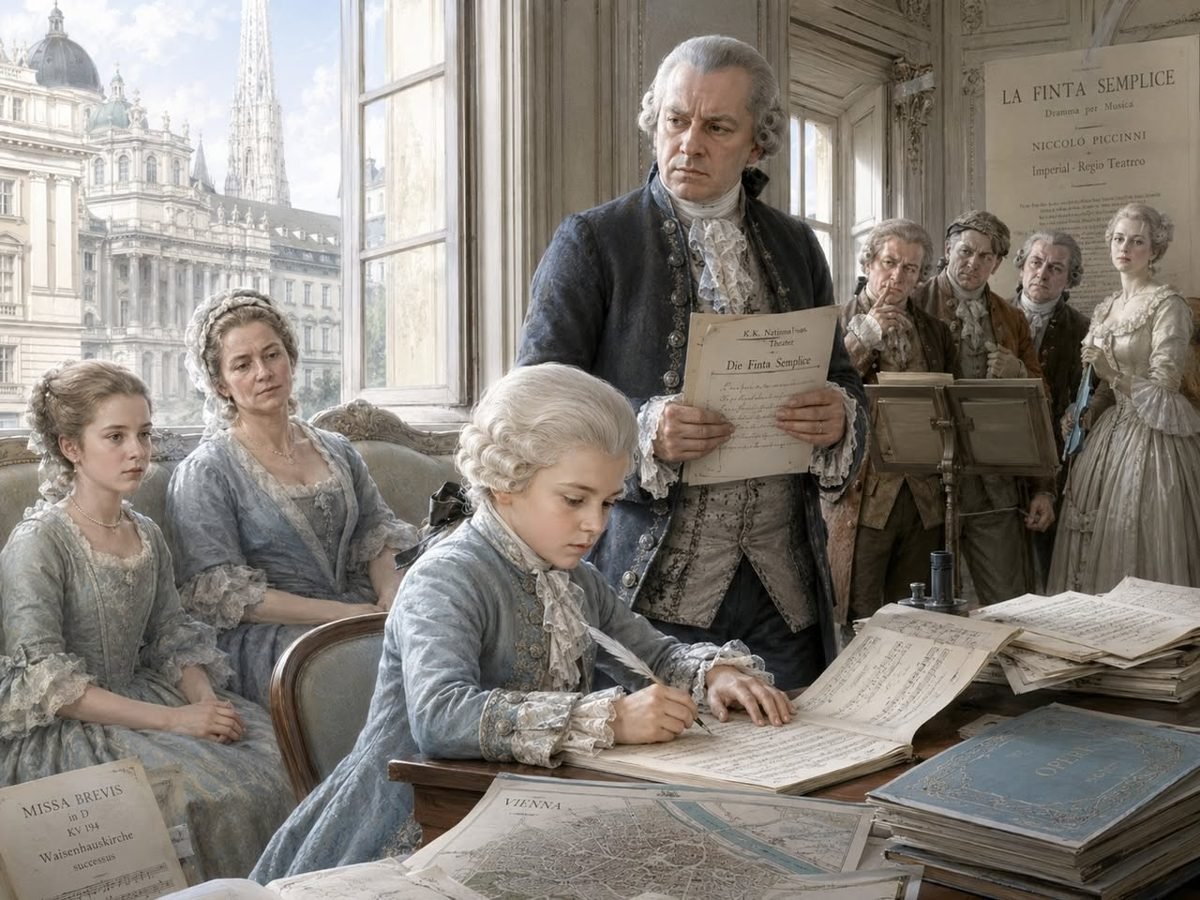
The chosen work was La finta semplice, based on a libretto by Marco Coltellini, itself derived from Carlo Goldoni. Wolfgang began the opera in late January 1768. By the end of March, Leopold reported that the work was progressing well and hoped it would be ready when the emperor returned from Hungary.
Yet the project rested on several miscalculations. Wolfgang was extremely young. He had not yet written a successful full-scale opera buffa. His command of Italian theatrical style, though already remarkable, could not be assumed to satisfy singers, orchestra, impresario, and court. Leopold’s faith in his son’s powers was boundless, but theatre is not only composition. It is singers, politics, rehearsal, contracts, jealousy, money, timing, and institutional power.
Here Leopold’s ambition exceeded his prudence.
════════════════════════════
VIII. THE FIASCO OF LA FINTA SEMPLICE
The first rehearsal was disastrous. Singers complained that the work was unsingable. Some orchestral players did not like the idea of being conducted by a boy. Rumours spread that the music was worthless, or that Leopold, rather than Wolfgang, had written it. The impresario Giuseppe Affligio, lessee of the Burgtheater and Kärntnertor Theater, first demanded revisions and then cancelled the proposed production altogether. He refused to pay Wolfgang any fee and condemned the work as untheatrical.
For Leopold, this was the most serious professional setback of his career as Wolfgang’s impresario. It was also a practical disaster. Despite his usual business caution, he had obtained neither a written contract nor advance payment. He was left trying to enforce an undocumented verbal agreement. His anger and humiliation were immense.
On 21 September 1768, he petitioned the emperor, accusing envious and dishonourable calumniators of trying to suppress an innocent child whom God had endowed with extraordinary talent and whom other nations had admired. The language reveals Leopold at his most intense. He did not frame the case merely as breach of contract. He framed it as a moral assault on genius.
The emperor was unmoved. After investigation by the general theatre director, Count Johann Wenzel Sporck, Leopold’s petition was denied. Whatever injustices had occurred, Leopold’s tendency to explain normal theatrical resistance as a vast conspiracy did not help him. In the world of opera, singers resist, impresarios calculate, orchestras complain, rival composers intrigue, and productions collapse. Leopold interpreted this normal theatrical chaos as persecution.
The failure wounded him deeply. It also damaged Wolfgang’s reputation, at least temporarily. The child who had conquered Europe through display had now encountered the adult world of theatre, and the theatre had refused him.
════════════════════════════
IX. SALZBURG LOSES PATIENCE
While Leopold struggled in Vienna, Salzburg began to lose patience. The journey had not been intended as another long absence. Illness had provided an explanation for part of the delay, but once the children recovered and had been received by the court, Leopold’s continued stay became harder to justify.
The Salzburg authorities increasingly saw that Leopold had a private agenda. He was not merely presenting his children or serving the glory of Salzburg. He seemed to be looking for a position in Vienna, perhaps attempting to detach himself from Salzburg altogether. Rumours circulated that he intended to settle in Vienna under high protection.
The archbishop acted. In March 1768, Leopold’s salary was withdrawn for any period in which he was absent from Salzburg. He would remain in service, but he would not be paid while away. This decision was practical, but also symbolic. Salzburg was reminding Leopold that his freedom had limits. His position at court did not exist merely to support his private ambitions.
Leopold responded with a mixture of injured dignity and strategic acceptance. He declared that he could not in fairness beg for a salary he was not earning. Yet he also saw an advantage: if his salary could be suspended during absence, then perhaps future leave—especially for Italy—would be easier to obtain. Even in setback, he looked for opportunity.
This moment marks another shift. Leopold’s ties to Salzburg were loosening, but not yet broken. He still depended on the court, but his imagination had moved beyond it. Wolfgang’s career required larger stages, and Leopold knew it.
════════════════════════════
X. A COSTLY VIENNA
The Vienna stay was expensive. The family’s daily costs were substantial, and the long delay caused by illness, waiting, and theatrical conflict consumed capital. Leopold’s letters are strangely silent about income, which suggests either that receipts were modest or that he preferred not to reveal them fully. Yet the Mozarts did not remain completely without patronage.
Wolfgang appeared in Olmütz and Brünn, and he performed portions of La finta semplice for members of the Viennese nobility. He gave a significant concert at the residence of the Russian ambassador, Prince Dmitri Galitzin. He also displayed his compositional skill in the houses of important musical and aristocratic figures, including Giuseppe Bonno, Metastasio, Johann Adolph Hasse, the Duke of Braganza, and Prince Kaunitz.
There was also the likely performance of Bastien und Bastienne, K. 50/46b, at the suburban mansion of Franz Anton Mesmer. The association is fascinating. Mesmer belonged to the enlightened, experimental, aristocratic-intellectual world of Vienna. For such a milieu, a pastoral singspiel based on Rousseau’s ideal of rustic simplicity was entirely appropriate. Wolfgang was already learning to compose for specific social settings.
This is one of the chapter’s major insights: Mozart’s youthful works often responded consciously to local taste. His Vienna symphonies absorbed elements from composers such as Vanhal, Dittersdorf, Hofmann, Haydn, and Gassmann. His opera buffa was aimed at the court theatrical audience. His singspiel served a different enlightened salon culture. At this stage, the issue was not yet Wolfgang’s fully personal style. The issue was adaptation, learning, imitation, and strategic fitness.
════════════════════════════
XI. THE SYMPHONIST IN VIENNA
During the Vienna sojourn, Wolfgang composed several symphonies, notably those in F major, K. 43, and in D major, K. 45 and K. 48. These works reveal his absorption of Viennese symphonic models. Compared with earlier Italianate examples, the Viennese style offered greater theatricality, broader formal development, more expansive rhetoric, and a freer use of contrapuntal textures.
This compositional growth is essential. Even amid illness, frustration, and the failure of La finta semplice, Wolfgang was learning rapidly. Vienna may have disappointed Leopold commercially, but artistically it exposed the boy to a more demanding instrumental language. The city’s musical culture required him to listen, absorb, imitate, and transform.
One should not imagine the young Mozart as already fully independent in style. The chapter emphasizes that his music at this point reflected influences encountered during travel, but not in a passive or merely involuntary way. Under Leopold’s expert guidance, Wolfgang consciously adapted himself to the musical taste of each city and patronage circle. He was learning how style functions socially.
Thus, the Vienna sojourn was not only a failure of theatrical ambition. It was a school of composition. The boy who had been tested at covered keyboards was now being tested by genres, institutions, and audiences.
════════════════════════════
XII. THE ORPHANAGE CHURCH: RESTORING THE NAME
Despite the fiasco of the opera, the Mozarts did not leave Vienna entirely defeated. Wolfgang received an important commission to provide music for the public dedication of the Orphanage Church, the Waisenhauskirche, on the Landstrasse. On 7 December 1768, the twelve-year-old boy conducted the service in the presence of the imperial court.
The event was a success. Contemporary reporting praised the newly composed music, the accuracy of Wolfgang’s conducting, his performance, and even his singing in the motets. For Leopold, the occasion was more than a musical achievement. It was a vindication. He believed that the success restored the reputation that enemies had tried to destroy by preventing the opera’s performance.
The empress sent a beautiful present, and Leopold could again feel that the court and public had seen the truth. The child’s reputation, damaged by theatrical intrigue, had been publicly repaired in a sacred setting. What opera had denied, church music restored.
This contrast is highly significant. The theatre had been unstable, political, competitive, and humiliating. The church dedication provided ceremonial clarity, public solemnity, and official recognition. Wolfgang’s talent could not yet conquer the theatre in Vienna, but it could command admiration in a public sacred ceremony.
The episode also foreshadows an important feature of Mozart’s development: his genius would repeatedly move between theatre, church, chamber, symphony, and keyboard, finding in each genre different forms of authority. In 1768, sacred music temporarily rescued the reputation that opera had endangered.
════════════════════════════
XIII. LEOPOLD LEARNS A NEW CAMPAIGN
By the end of the Vienna sojourn, Leopold had learned painful lessons. He now understood that Wolfgang would have to prove himself in more serious arenas. The old prodigy tricks could no longer serve as the centre of the campaign. There would be no more reliance on cloth-covered keyboards and marvel games alone. The boy’s future required serious composition, solo performance, and theatrical success.
Yet Leopold did not abandon spectacle altogether. His flair for drama remained. In the great musical houses of Vienna, he would ask someone to open the works of Metastasio and select a text at random; Wolfgang would then take up his pen and, in the presence of eminent observers, rapidly compose an aria with instrumental accompaniment. The demonstration was still theatrical, but now the miracle was not mere keyboard dexterity. It was composition itself.
This was Leopold’s new strategy: to transform astonishment into proof of creative authority. Wolfgang must be seen not merely as a child who could play, but as a child who could compose—quickly, intelligently, and before witnesses. The prodigy myth was being adjusted to the realities of adolescence.
The Vienna sojourn therefore ends not in simple failure, but in strategic evolution. Leopold’s first attempt to conquer the theatre had failed. His petition had failed. His hopes of easy Viennese profit had failed. But Wolfgang had composed, performed, conducted, absorbed Viennese symphonic style, and publicly restored his reputation at the Waisenhauskirche.
The campaign would continue, but it would now require new forms.
════════════════════════════
XIV. THE MEANING OF THE VIENNA SOJOURN
This chapter is one of the first great turning points in Mozart’s childhood biography. Until now, the family story had been dominated by triumph: discovery, travel, courtly admiration, miraculous display, gifts, money, and the glittering success of the Grand Journey. In Vienna, however, the miracle met resistance.
The resistance came in many forms: illness, delay, imperial caution, financial disappointment, public indifference, professional skepticism, theatrical intrigue, Salzburg’s impatience, and Leopold’s own miscalculations. Wolfgang survived smallpox, but the family plan itself also suffered an illness. It had to change or perish.
The Vienna sojourn shows that Mozart could no longer remain simply THE ETERNAL CHILD. The spectacle of infancy was passing. At twelve, he had to become something more demanding: a composer capable of opera, symphony, sacred music, and public conducting.
Leopold, for all his anger and conspiracy thinking, saw this. His methods were flawed, his temperament suspicious, and his business judgment in the opera affair surprisingly careless. Yet he understood the deeper problem: Wolfgang’s future depended on proving that childhood wonder could mature into artistic substance.
For Wolfgang, Vienna was therefore both humiliation and education. He encountered illness, doubt, theatrical hostility, and institutional power. But he also absorbed Viennese style, composed new works, tested himself in sacred ceremony, and began to move beyond the identity of travelling prodigy.
The chapter ends with Leopold already formulating the next campaign. The direction is clear: Italy. If Vienna had resisted the boy opera composer, Italy would become the place where Wolfgang would confront the central musical theatre of Europe on its own ground.
The child had stumbled, but he had not fallen. The prodigy was changing shape.