13 October 2026
Mahler Reinvents Opera: Roller, Vienna and the Obsession with Perfection
On Classicapedia: Gustav Mahler, Alfred Roller, Richard Wagner, Ludwig van Beethoven
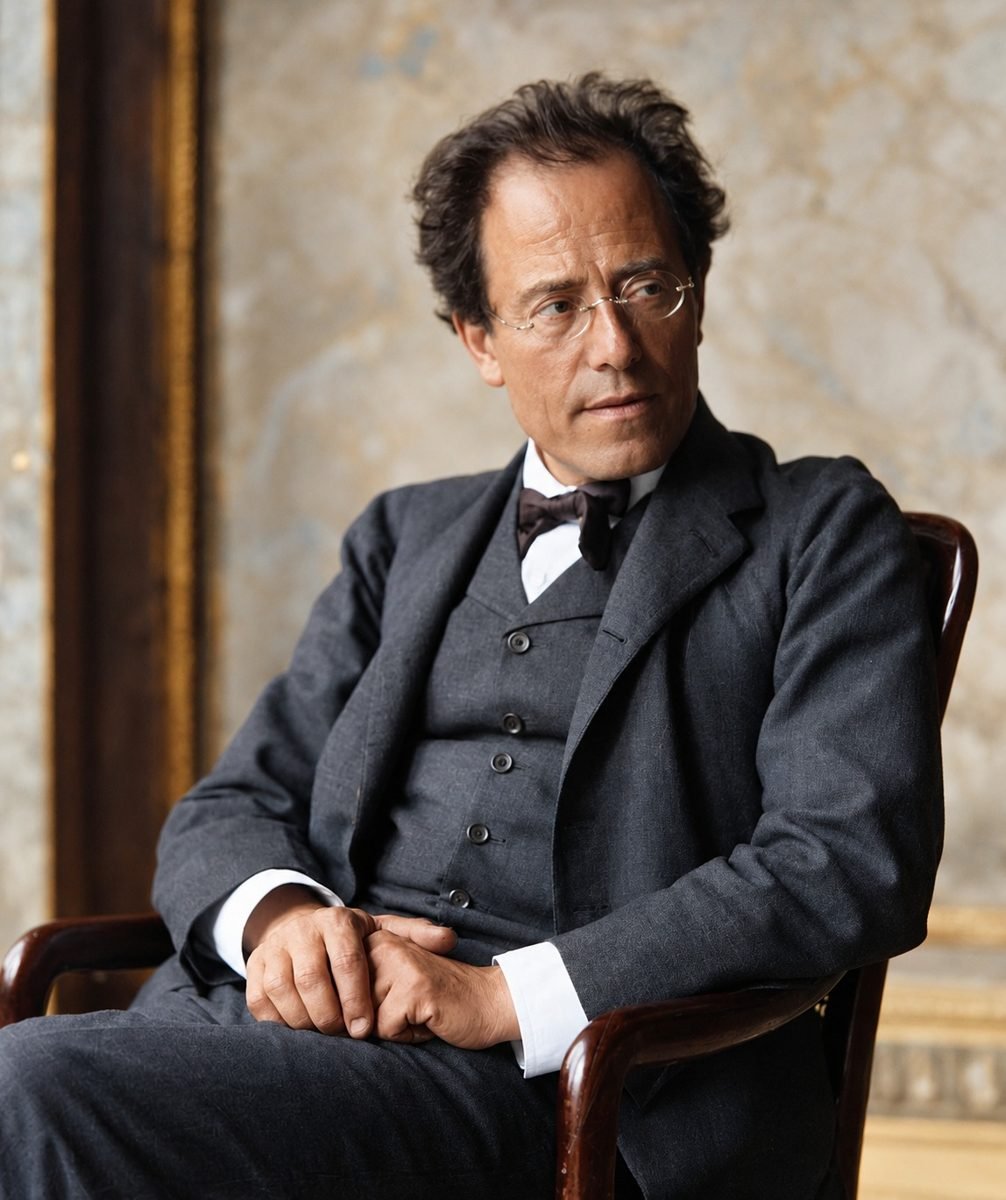
1903–1905
When Gustav Mahler arrived in Vienna in 1897, he already understood that the Court Opera was far more than a prestigious theatre. It was an imperial institution, one of the musical centres of Europe and, at the same time, a vast organism governed by traditions, hierarchies, habits, privileges and deeply rooted resistance to change. During his first years there, Mahler had progressively transformed the musical discipline of the house, tightened the relationship between conductor and orchestra, demanded a new level of preparation from the singers and altered the behaviour expected from the audience, but one major problem remained unresolved: what happened visually and dramatically on the stage still did not always correspond to the level of intensity, truth and precision that he demanded from the orchestra pit.
In the operatic world Mahler had inherited, even a first-rate production could still be regarded as successful if it combined famous voices, an excellent orchestra, impressive scenery and singers positioned so that they could see the conductor clearly. The psychological logic of the characters’ movements, the expressive function of light, the visual coherence of a production and the dramatic meaning of each gesture were not always treated as essential parts of the work. Mahler increasingly felt that this separation between music and stage action was intolerable, because for him opera could no longer be understood as a great score performed in front of attractive scenery. It had to become a single living organism in which everything, from the smallest movement of a singer to the colour of a wall or the intensity of a light, contributed to the same dramatic truth.
To achieve that, Mahler needed someone who could think in images with the same intensity with which he thought in sound, and he found that person in Alfred Roller.
ALFRED ROLLER: THE MAN MAHLER NEEDED
Roller came from the world of the visual arts and was closely associated with the Vienna Secession. Mahler knew his work and had been impressed by the way Roller organized colour, mass, line and space according to a modern visual logic that seemed completely different from the decorative theatrical tradition of painted backdrops and scenic ornament. Roller was not yet a great man of the theatre in the conventional sense, but Mahler instinctively recognized in him something more important: an imagination capable of thinking architecturally and symbolically.
A famous anecdote captures the beginning of their collaboration with unusual clarity. According to Alma’s recollection, Roller remarked in Mahler’s presence that he could endure a performance of Tristan und Isolde only if he turned his back on the stage. The provocation was obvious, because what Roller was really saying was that the visual realization of Wagner’s drama was so inadequate that it actively damaged the music. Mahler, rather than taking offence, asked him how the stage ought to look if it were to deserve the spectator’s attention. Roller then improvised an answer that was so close to Mahler’s own developing ideas about the theatre that Mahler immediately understood that he had found a collaborator who could transform those ideas into visible form.
Probably in May 1902, Mahler invited Roller to lunch, with Kolo Moser also present, and the conversation turned specifically to a new staging of Tristan und Isolde. Mahler was already prepared to displace the Court Opera’s regular scenic designers in order to give Roller the freedom he needed. Before attempting Tristan, however, Roller first worked on Carl Maria von Weber’s Euryanthe in January 1903, an experience that served as a practical introduction to the theatre. Only a few weeks later, Mahler and Roller would reveal the production that made their partnership historic.
TRISTAN UND ISOLDE — 21 FEBRUARY 1903
The new Tristan und Isolde opened on 21 February 1903 and immediately demonstrated that Mahler and Roller were not merely refreshing an old production, but redefining the relationship between sound, space and dramatic action. The cast itself was formidable: Anna von Mildenburg sang Isolde, the Danish tenor Erik Schmedes appeared as Tristan, Richard Mayr sang King Marke and Hermine Kittel was Brangäne, but the real novelty lay in the way every theatrical element was made to participate in the drama.
In the first act, the stage itself expressed emotional separation. Isolde and Brangäne occupied the lower foreground, while Tristan and Kurwenal appeared on a raised deck toward the rear, initially concealed by large red curtains, so that distance was not merely narrated by the libretto but built into the architecture of the scene. In the second act, Roller created a nocturnal garden whose low walls, stone benches, dark tree and starry sky were gradually transformed by the arrival of dawn, allowing light to become part of the emotional arc of the act. In the third act, Kareol was shown as a decaying place open toward the sea yet dominated by a huge white fortified tower, so that the environment seemed to embody the physical and spiritual exhaustion of the drama.
The scenery no longer existed merely to tell the audience where the action was taking place. It now attempted to tell the audience how that action felt, and this change was fundamental.
LIGHT BECOMES VISUAL MUSIC
One of the most important aspects of the Mahler-Roller collaboration was the new role assigned to light. In traditional theatre, illumination had largely served a practical purpose: it made the singers and scenery visible. Roller and Mahler wanted something more subtle and more ambitious. They wanted light to have expressive value, so that changes of intensity, direction and colour could alter the psychological atmosphere of a scene just as changes of dynamics, harmony or orchestral colour alter the emotional meaning of music.
Mahler grasped the idea immediately because it corresponded perfectly to his own sense of theatrical structure. He did not want crude visual effects designed merely to impress the public; what interested him was gradation, nuance and the controlled relationship between visibility and emotion. Light could suggest distance, oppression, intimacy, expectation, fear, night, dawn or liberation, and in this sense it had to become part of the theatrical score.
What seems almost self-evident in modern opera was, in 1903, part of a profound transformation in the way a performance could be conceived.
MAHLER WANTED TO UNITE ALL THE ARTS
The ideal behind Mahler’s reforms inevitably approached Wagner’s concept of the Gesamtkunstwerk, the total work of art, but Mahler did not simply wish to imitate Bayreuth. His ambition was to use the resources of the modern theatre so that scenery, architecture, painting, costume, lighting, gesture, movement, singing and orchestra would all contribute to a unified dramatic conception.
For that reason, he resisted any attempt to reduce his reforms to the style of the Secession. Modern art interested him, but not as decoration and not as fashion. What mattered was the integration of all the arts into a theatrical whole in which no element could remain autonomous or ornamental.
The stage, in his conception, had to become an organism in which everything depended on everything else, and this was precisely why Roller’s contribution became so decisive.
AFTER TRISTAN, ROLLER WAS NO LONGER AN EXPERIMENT
The success of Tristan convinced Mahler that Roller should not remain an occasional collaborator. Mahler was not a man given to extravagant praise, yet the letter he wrote after the first performances reveals genuine enthusiasm and gratitude. He had recognized in Roller someone who shared his absolute seriousness about art and who could accomplish visually what Mahler himself could not.
Within a few months, Roller was appointed head of the scenery workshop at the Court Opera, effective from 1 June 1903. At that point the collaboration ceased to be an isolated experiment and became part of the institution itself.
For Mahler, this mattered enormously, because he could now attempt not merely individual productions but a systematic reform of theatrical practice.
MAHLER EVEN ALTERS THE ORCHESTRA PIT
Mahler had long been dissatisfied with the visual presence of the orchestra. He knew the effect of Wagner’s concealed pit at Bayreuth, where the musicians disappeared from view and the sound seemed to rise mysteriously from an invisible source, but reproducing that arrangement in Vienna was impractical for a repertory theatre required to perform a wide variety of works.
He nevertheless moved in that direction by having the pit lowered by roughly twenty inches and enlarged substantially. The reason was not only acoustic. The lights used by the musicians to read their parts interfered with the visual atmosphere Roller was trying to create onstage, and if lighting was now to become part of the dramatic language, every competing source of light mattered.
Mahler was therefore willing to alter the physical structure of the theatre in order to protect the unity of a production. His perfectionism had expanded beyond conducting and beyond music itself; it now included architecture, sight lines, light and the physical relationship between stage and pit.
THE SINGER COULD NO LONGER MERELY SING
The singers faced perhaps the most demanding consequences of Mahler’s reform. During his years in Hamburg he had already discovered, especially through his work with Anna von Mildenburg, what could happen when a singer combined vocal mastery with genuine dramatic commitment. In Vienna he wanted this principle to become standard practice rather than an exceptional achievement.
The singer was still required to meet enormous musical demands, but that was no longer enough. The performer also had to become the character, which meant that every gesture, movement, entrance, silence and glance had to arise from the dramatic situation rather than from operatic habit.
This represented a direct attack on a tradition in which singers often moved according to vocal convenience. A performer might traditionally step forward to sing an aria, choose a position from which the voice projected well and remain visibly oriented toward the conductor. Mahler increasingly regarded such habits as theatrical falsehood whenever they contradicted the action.
Some singers found his demands inspiring because he forced them to discover new expressive possibilities; others found them exhausting or even tyrannical, but for Mahler the principle was simple: musical truth and dramatic truth could not be separated.
THE CONDUCTOR JUMPS FROM THE PIT ONTO THE STAGE
Mahler’s rehearsal methods revealed the intensity of this belief. When a singer failed to understand a movement, he did not always explain it from the pit; he would leave his position, rush onto the stage and physically demonstrate what he wanted. He repositioned performers, acted out the dramatic situation, indicated the direction of a gesture and then returned to the pit to judge the result from the audience’s perspective.
His whole body became part of the rehearsal process, and the distinction between conductor and stage director effectively disappeared. He was not content to supervise from a distance because he wanted to shape the entire performance as if it were one of his own scores.
The procedure could be exhausting for everyone involved, especially because Mahler repeated passages whenever he felt that the result was merely approximate. Yet those repetitions were not arbitrary manifestations of temperament; they grew out of his conviction that the smallest falsity could weaken the larger dramatic structure.
PERFECTION DID NOT MEAN BEAUTY
The word “perfection” can easily misrepresent Mahler’s aim if it suggests a preference for polished surfaces or conventional beauty. Mahler was not trying to make everything attractive. He wanted everything to be necessary.
A scene could be ugly, violent, oppressive or dark if that was what the music required. A singer might be asked to occupy an awkward or visually unflattering position if it made dramatic sense. Roller might reduce a setting to severe architectural forms if decorative detail distracted from the action.
Mahler’s purpose was therefore not to beautify opera, but to remove everything that stood between the work and the audience.
FIDELIO — 7 OCTOBER 1904
If Tristan und Isolde had demonstrated the potential of the new partnership, Fidelio allowed Mahler and Roller to develop their ideas in a work that Mahler loved with exceptional intensity. Beethoven’s opera had long been one of his favourite vehicles for important appearances because he believed it capable of producing an overwhelming dramatic and moral impact.
The new production opened on 7 October 1904, and here Mahler could intervene even more directly in the physical action because Fidelio contains choruses, collective movement and dramatic situations in which spatial relationships are central.
Roller responded with scenery characterized by simplification and monumentality. Instead of constructing a richly detailed prison environment, he created spaces whose very scale dominated the characters, so that architecture itself became a metaphor for oppression.
A PRISON THAT MADE THE WEIGHT OF TYRANNY FELT
The prison courtyard became one of Roller’s most memorable images. A massive architectural structure rose upward and seemed almost to continue beyond the visible limits of the stage, reducing the human figures to insignificance in comparison with the system that confined them.
Only a small fragment of blue sky appeared high above.
That tiny patch of colour was therefore no longer merely decorative. In the context of the prisoners’ world it became a visual symbol of freedom, visible but almost unreachable.
The scenery had ceased to function as background and had become a dramatic argument.
FLORESTAN’S DUNGEON HAD TO BE GENUINELY OPPRESSIVE
The same principle governed the second act. Traditionally, Florestan’s dungeon could be represented as a relatively spacious cellar that gave the tenor sufficient room to move and sing comfortably. Roller reduced the space dramatically and transformed it into a genuinely claustrophobic place whose darkness and confinement corresponded to the atmosphere already created by Beethoven’s orchestral introduction.
For Mahler and Roller, it would have been dramatically false for the orchestra to evoke imprisonment while the stage presented physical spaciousness. What the ear heard and what the eye saw had to belong to the same emotional world.
This insistence on correspondence between sound and image was one of the essential foundations of their reform.
MAHLER DID NOT HESITATE TO CUT IF HE BELIEVED THE DRAMA REQUIRED IT
Mahler’s reverence for Beethoven did not imply literal submission to every bar of the score. In Fidelio he removed Rocco’s Gold Aria because he believed that it interrupted the dramatic tension and trivialized the action.
From a modern perspective, especially one shaped by ideals of textual fidelity, such a decision can seem surprising. Mahler’s concept of fidelity was different. He believed that the performer’s responsibility was not simply to reproduce transmitted details mechanically, but to realize the work’s essential dramatic and musical truth.
If he thought that a cut, an alteration or a change of tempo brought the performance closer to the effect the composer had intended, he was prepared to intervene.
He did not see himself as an archaeologist preserving a monument.
He saw himself as an interpreter responsible for making the work live.
LEONORE NO. 3 ENTERS FIDELIO
One of Mahler’s most famous interventions was the insertion of the Leonore Overture No. 3 between the dungeon scene and the final scene of Fidelio. A substantial scenic transformation was required at that point, and Mahler refused to leave the audience sitting in silence while the stage was reconstructed.
The overture solved the practical problem of time, but it also acquired a powerful dramatic function. While the scenery was being changed, Beethoven’s symphonic music seemed to reflect retrospectively on everything that had just occurred, creating a vast emotional bridge between darkness and liberation.
The decision was not part of Beethoven’s original conception, yet it proved so theatrically effective that it became closely associated with the work in subsequent performance tradition.
THE PRISONERS’ CHORUS CHANGES FOREVER
Perhaps no scene better illustrates the Mahler-Roller revolution than the Prisoners’ Chorus. Before their intervention, the chorus would typically enter rapidly, arrange itself attractively onstage and sing with the full sonority expected from a trained operatic ensemble.
Mahler saw the contradiction immediately. These characters were not members of a concert society; they were people who had been confined in terrible conditions and were emerging into daylight after long imprisonment. The staging therefore had to express that reality.
Under Mahler and Roller, the prisoners appeared gradually, one after another, feeling their way out of their cells, weakened, dazzled by the light and barely able to stand.
To a modern audience this kind of realism may seem obvious, but in 1904 it represented a radical change in operatic acting. The singers were no longer expected to display themselves as a chorus; they were expected to make the audience forget that they were singers at all.
They had to become prisoners.
FROM DARKNESS TO LIGHT
The ending of Fidelio gave Roller an ideal opportunity to express in visual terms one of the work’s deepest musical oppositions: the contrast between imprisonment and freedom. After the oppressive darkness of Florestan’s dungeon, the final scene had to open into brightness, creating a physical sense of liberation.
The transformation was therefore more than scenic. It became the visual equivalent of the music’s moral trajectory.
Darkness belonged to oppression, while light belonged to freedom, and Mahler wanted the spectator to feel that contrast not merely intellectually but almost bodily.
In this way, the stage did not simply illustrate what the orchestra expressed; it gave the same idea another form of existence.
THE CRITICS DID NOT KNOW WHETHER TO ADMIRE OR CONDEMN HIM
The reactions were inevitably divided. Some critics immediately understood that Roller’s scenery could no longer be judged as independent pictorial decoration because it had entered into a symbolic and emotional relationship with both action and music. Others felt that Mahler was imposing modern theatrical ideas on older masterpieces and feared that such interventions distorted their original character.
As so often during Mahler’s Viennese years, artistic criticism also became entangled with German nationalism and anti-Semitism. Decisions that should have belonged entirely to theatrical interpretation could become weapons in ideological attacks on a Jewish-born conductor who had converted to Catholicism and who was accused by hostile critics of violating the supposed German purity of the repertory.
For Mahler, this kind of conflict was increasingly part of everyday life. Almost every significant reform gained him admirers and enemies at the same time.
MAHLER’S PROBLEM WAS THAT HE COULD NOT WORK BY HALVES
Mahler had never possessed the temperament required to accept results that were merely good enough. If a phrase could be improved, he repeated it; if a gesture appeared false, he corrected it; if lighting weakened the dramatic atmosphere, he demanded changes; and if a singer reproduced inherited habits without understanding their dramatic purpose, Mahler attempted to dismantle those habits and rebuild the interpretation from the beginning.
For artists willing to follow him, this could be profoundly stimulating because he forced them to discover possibilities they had not suspected. For others, it could be exhausting and even intolerable.
The deeper problem was that Mahler applied to the whole theatre the standard he applied to his own compositions. Yet an opera house depended on hundreds of people, from singers and orchestral musicians to stagehands, technicians, administrators, costumiers and scenic artists. To make such an institution behave as though it were the extension of one artistic consciousness required an extraordinary amount of energy.
MAHLER DID NOT WANT A STAR-DRIVEN OPERA
Much of nineteenth-century operatic culture had been organized around famous singers, and Mahler certainly valued exceptional voices, but he rejected the idea that the needs of a star should determine the structure of a performance.
No singer stood above the work.
A performer who prolonged a note merely to provoke applause, altered a tempo for personal comfort or chose a dramatically absurd stage position because the voice projected better from there was, in Mahler’s view, damaging the integrity of the whole.
This was a remarkably modern concept of opera. The performance did not belong to the tenor, nor to the soprano, nor even to the conductor.
It belonged to the work.
THE ORCHESTRA BECOMES PART OF THE DRAMA
Mahler had at his disposal in Vienna an extraordinary orchestra, largely formed by the same musicians who constituted the Vienna Philharmonic, and he had been impressed from the beginning by their ability to grasp his intentions quickly and turn them into sound.
Between 1903 and 1905, however, he demanded something more. The orchestra pit could no longer function independently from the stage because a singer’s breathing, the movement of a character, a shift in lighting or the timing of a scenic transition all affected the musical flow.
Mahler therefore conducted opera as a total dramatic structure in which tempo was not merely an abstract musical decision. It had to participate in the rhythm of the action, and this made the conductor’s role inseparable from the stage.
DON GIOVANNI AND THE CHALLENGE OF MOZART
By the end of 1905, Mahler and Roller faced a very different challenge. After the monumental worlds of Wagner and Beethoven came Mozart, whose operas demanded a lighter scale, faster transitions and a far more flexible relationship with space.
A Mozart cycle began with Così fan tutte in November, and in December a new production of Don Giovanni appeared. The enormous stage of the Court Opera, so effective for French grand opera or Wagnerian music drama, could easily overwhelm the more human proportions of Mozart’s theatre.
Roller responded by creating a highly flexible system of movable towers that could define different spaces and incorporate windows, balconies, entrances and exits according to the needs of each scene. Instead of replacing the entire set repeatedly, the stage could be transformed rapidly, with changes reduced to a matter of seconds.
Architecture itself had become rhythmic.
THE STAGE MOVES CLOSER TO THE AUDIENCE
Mahler particularly valued the fact that these towers could be moved toward the front of the stage, reducing the enormous depth of the Court Opera and bringing the performers much closer to the audience.
The psychological effect was considerable. Don Giovanni no longer had to unfold across an empty monumental space in which singers exaggerated their gestures merely to fill the stage. The action regained intimacy and human scale.
When monumentality was needed, however, as in the great Ball Scene, the full depth of the theatre could again be employed.
The scenery therefore ceased to be fixed.
It breathed with the music.
THE COLOUR OF DON GIOVANNI
Roller also used colour with unusual boldness. Red carpets and golden tableware shaped the atmosphere of Don Giovanni’s banqueting hall, black cypresses framed the nocturnal scenes and a blue sky could hang with almost indifferent calm over the graveyard where the protagonist challenged the dead Commendatore.
None of these choices was merely decorative. Colour had become expressive material, and Mahler and Roller treated it almost as one might treat orchestration.
Not every colour could dominate at once, just as not every instrument could sound with maximum intensity at the same moment. One had to know when red should blaze, when everything should recede into grey, when a small fragment of blue should acquire symbolic force and when darkness should prevail.
OPERA BECOMES ARCHITECTURE IN TIME
The deepest innovation of Mahler and Roller was not simply the modernization of scenic design. They understood that an operatic production was an architecture unfolding in time.
The stage had to evolve at the same speed as the music. A scene change that took too long could destroy a tension created by the orchestra, a singer who moved too early could reveal something before the music was ready, and excessive lighting could flatten an atmosphere that had been constructed through sound.
Everything was connected, and this explains why Mahler could become obsessed with details that others regarded as trivial. For him they were not isolated details, but parts of a single structure.
THE PRICE OF PERFECTION
This way of working demanded an enormous personal price. Mahler was simultaneously administering one of Europe’s greatest opera houses, selecting casts, hiring singers, managing budgets, dealing with the court, confronting critics, rehearsing new productions, conducting performances and trying to protect his summers for the composition of his own music.
His energy often appeared limitless, but his body did not share that illusion indefinitely. During a Lohengrin rehearsal in 1904, Roller noticed Mahler discreetly clutching at his heart after one of his physical exertions.
At the time this had no obvious connection with the diagnosis that would arrive in 1907, but retrospectively it seems ominous. Mahler’s physical organism was beginning to register the cost of the pace at which he lived.
MAHLER LIVED AT A PACE OTHERS COULD NOT FOLLOW
Even his way of walking became a kind of metaphor for his temperament. Mahler moved extraordinarily quickly and could leave younger companions behind during mountain excursions; Roller himself, four years younger, sometimes struggled to keep up with him.
The same relentless forward drive characterized his work in the theatre. What a singer considered an excellent performance might seem to Mahler merely the beginning of the process. What a designer regarded as complete could still contain, in Mahler’s eyes, a flaw in balance or lighting. What an orchestra thought polished might still need another adjustment of phrasing.
That refusal to stop pushed the Vienna Opera toward unprecedented standards.
It also turned Mahler’s existence into a continuing race against exhaustion.
ROLLER WAS FAR MORE THAN MAHLER’S SCENE DESIGNER
The partnership between Mahler and Roller succeeded precisely because Roller was not a passive servant of Mahler’s ideas. He brought independent visual concepts that Mahler could not have invented himself, while Mahler forced Roller to think in terms of time, rhythm, drama and music.
Roller began from image; Mahler began from sound.
They met in drama.
Mahler could discuss colour as though he were discussing harmony, and Roller could shape a scenic transformation with the logic of a musical modulation. Their best productions therefore cannot be attributed completely to either man, because they were genuinely collaborative creations.
THE VIENNA REFORM CHANGED WHAT AUDIENCES EXPECTED FROM OPERA
Many of the principles introduced during those years later became so normal that their revolutionary character became difficult to perceive. Modern audiences now expect singers to act as well as sing, expect lighting to express psychological atmosphere, expect a chorus to behave like the people it represents, expect scenery to do more than decorate the stage and expect scene changes to participate in dramatic rhythm.
They also take for granted that all visual elements of a production should belong to a coherent concept.
That these expectations now seem obvious is itself one of the clearest measures of how influential the reform was.
VIENNA STOPS SEEING OPERA AS A SUCCESSION OF NUMBERS
Between 1903 and 1905, Mahler brought to maturity an idea he had been developing throughout his conducting career: an opera was not merely a sequence of arias, duets, choruses and dramatic episodes linked by a plot, but a continuous structure in which tension had to be maintained even when no one was singing.
A scene change could become part of the drama, a silence could carry as much weight as a chord, a door could matter as much as a melody and a beam of light could complete an idea begun by the orchestra.
Music no longer stopped at the edge of the pit.
It continued across the stage.
MAHLER’S PARADOX: TO REVOLUTIONIZE IN ORDER TO BE FAITHFUL
Mahler could alter inherited cuts, change stage movement, modify tempi, redesign scenery and even insert music at points where the composer had not originally placed it. On the surface, such behaviour may appear incompatible with his profound admiration for Beethoven, Mozart and Wagner.
Mahler understood the matter differently. He believed that tradition could become a barrier between a work and its original force. Repeating what had been done for decades did not necessarily mean respecting the composer; sometimes it meant respecting only the habits of earlier performers.
Mahler therefore changed tradition in order to recover what he believed to be the truth of the work.
That was the paradox at the heart of his reform.
He transformed in order to remain faithful.
THE OBSESSION WITH PERFECTION
Behind all these changes stood the same trait that had marked Mahler since his earliest provincial appointments: his inability to settle for approximation.
Now, however, he possessed the means to turn that personal obsession into an institutional force. He had one of the finest orchestras in the world, access to outstanding singers, control of one of Europe’s major opera houses and, in Roller, a collaborator capable of transforming the stage itself.
For perhaps the first time in his life, the distance between what Mahler imagined and what he had the power to realize had become relatively small.
That made possible some of his greatest theatrical achievements.
It also made every remaining imperfection almost unbearable.
BETWEEN 1903 AND 1905, MAHLER DID NOT MERELY DIRECT THE OPERA: HE CHANGED WHAT IT MEANT
The significance of these years lies not simply in the fact that Mahler created remarkable productions of Tristan und Isolde, Fidelio or Don Giovanni. His achievement was deeper because he changed the fundamental question by which music theatre could be judged.
It was no longer enough to ask whether the orchestra had played well or whether the singers had sung beautifully. One now had to ask whether everything taking place inside the theatre belonged to the same artistic conception.
The light, the space, the movement, the silence, the colour, the position of a character, the entrance of a chorus, the timing of a scene change and even the relationship between a singer and a wall could all carry meaning.
Everything had to answer to one central idea.
Mahler had arrived in Vienna in 1897 as an extraordinary conductor determined to reform a great institution from within. By 1905 he had become something more than that: he had become a creator of theatre.
Together with Alfred Roller, he demonstrated that an operatic performance could be shaped with the same unity, precision and inner necessity as a great symphonic score, and although his obsession with perfection exhausted those around him, multiplied his enemies and gradually consumed his own strength, it was also changing forever what it meant to put an opera on the stage.