12 May 2026
Ludwig II and Wagner: The Portrait Affair
On Classicapedia: Richard Wagner, Ludwig Schnorr von Carolsfeld
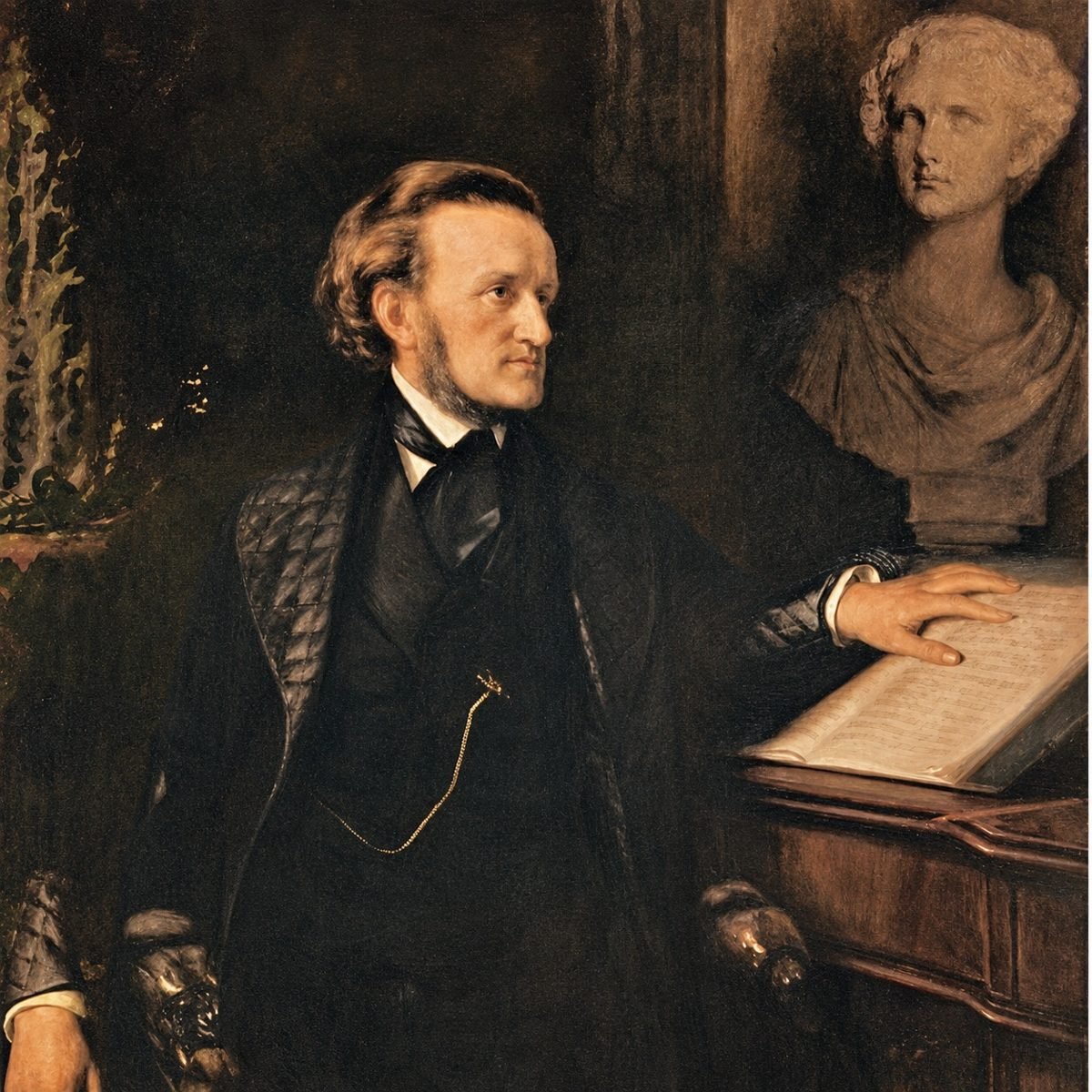
Louis II and Wagner: The Affair of the Portrait
August Friedrich Pecht, oil on canvas, 131.4 x 117.5 cm, Metropolitan Museum of Art, donated by Frederick Loeser in 1889.
This portrait was painted by Friedrich Pecht, 1814–1903, an artist whom Richard Wagner had known both in Paris and in Dresden. Wagner is represented with his hand resting on a musical score, standing before a bust of the young king. This oil painting belongs to the collections of the Metropolitan Museum of Art in New York.
The painting must date from late 1864, or at the very latest from early January 1865, since the king sent Wagner his thanks for this portrait in a letter dated 30 January 1865:
"My dearest friend! Having just returned from my walk, I find the splendid picture! What a surprise for me! How enchantingly well it has succeeded! Receive my warmest, most heartfelt thanks! [...] Thanks, heartfelt thanks. Until death, Ludwig. 30 January 1865."
The payment for this painting became the source of a misunderstanding, which the press immediately seized upon in order to launch attacks against Wagner. The singer Ludwig Schnorr von Carolsfeld referred to the affair in a letter to his mother:
"King Ludwig gave Wagner an oil painting of himself and, on that occasion, expressed the wish that Wagner might sit for the painter Joseph Bernhardt for a portrait intended for him, the king. But Wagner wished to be excused from this, since it was impossible for him to sit for a painter whom he did not know and who did not know him either.
Some time later Wagner saw, at Pecht's house — Pecht being someone he knew — a portrait that pleased him, and he agreed with Pecht that the latter should paint his portrait, so that, if it succeeded, they might surprise the king with it.
One day the king found this picture displayed in his room and was so delighted by the likeness that Wagner received, within the hour, a short letter in which the king thanked him and told him that he had hung the portrait in his cabinet.
Eight days later Pfistermeister went to Wagner and asked him how matters stood regarding payment for the portrait. Wagner remarked that he would not dare to thank the king with a return gift, since by doing so he would be placing himself on an equal footing with him. They therefore decided that Pfistermeister should come to an arrangement with Pecht.
Meanwhile, however, Pfistermeister went to the king and reported that Wagner wanted 1,000 gulden for the picture. The king, however, had understood the portrait to be a gift from Wagner, as Pfistermeister knew, and he was greatly shocked by this turn of events."
The press took possession of the affair, as can be seen from a caricature that appeared in the Munich press in 1865:
A portrait of Wagner by Pecht. 1,000 fl. — meaning 1,000 florins.
On the same affair, one may also read this short item in the Münchener Punsch of 19 February 1865:
"If Richard Wagner sends his oil portrait to the King of Bavaria for 1,000 gulden without having been asked to do so, he is, in a manner of speaking, arranging for His Majesty himself to hang him on the nail."
This was undoubtedly a play on words, because the German expression an den Nagel hängen can mean both to hang something on a nail, as one would do with a painting, and also to give up or abandon something one had intended to do. In this case, the implication was that Louis II might abandon his support of Wagner.
In the same issue, the Münchner Punsch published the famous caricature in which the Münchner Kindl points out to Wagner, who is skating on the ice, the hole into which he is about to fall. Wagner, however, holds his head too high and therefore cannot see the hole of disgrace lying only a metre in front of him.
The episode was more than a simple dispute over money. It revealed the fragility of Wagner's position in Munich in early 1865. The king was fascinated by Wagner, but the Bavarian public, the press, and the court bureaucracy were already deeply suspicious of the composer's influence, his debts, his theatrical ambitions, and his privileged access to Louis II.
Thus, the affair of Pecht's portrait became one of those apparently minor incidents that acquired a symbolic dimension. Wagner's enemies could present him as a man who not only enjoyed the king's favour, but also profited from it. What may have begun as a gesture of admiration and gratitude was turned, in the satirical press, into evidence of arrogance, manipulation, and financial opportunism.
In that sense, the portrait was not merely a portrait. It became a political and social object, a visual emblem of the dangerous closeness between Richard Wagner and King Louis II of Bavaria.