9 June 2026
Haydn in Vienna (1750–1760): The Former Chorister Who Became a Composer
On Classicapedia: Joseph Haydn, Carl Philipp Emanuel Bach, Pietro Metastasio, Marianne von Martínez
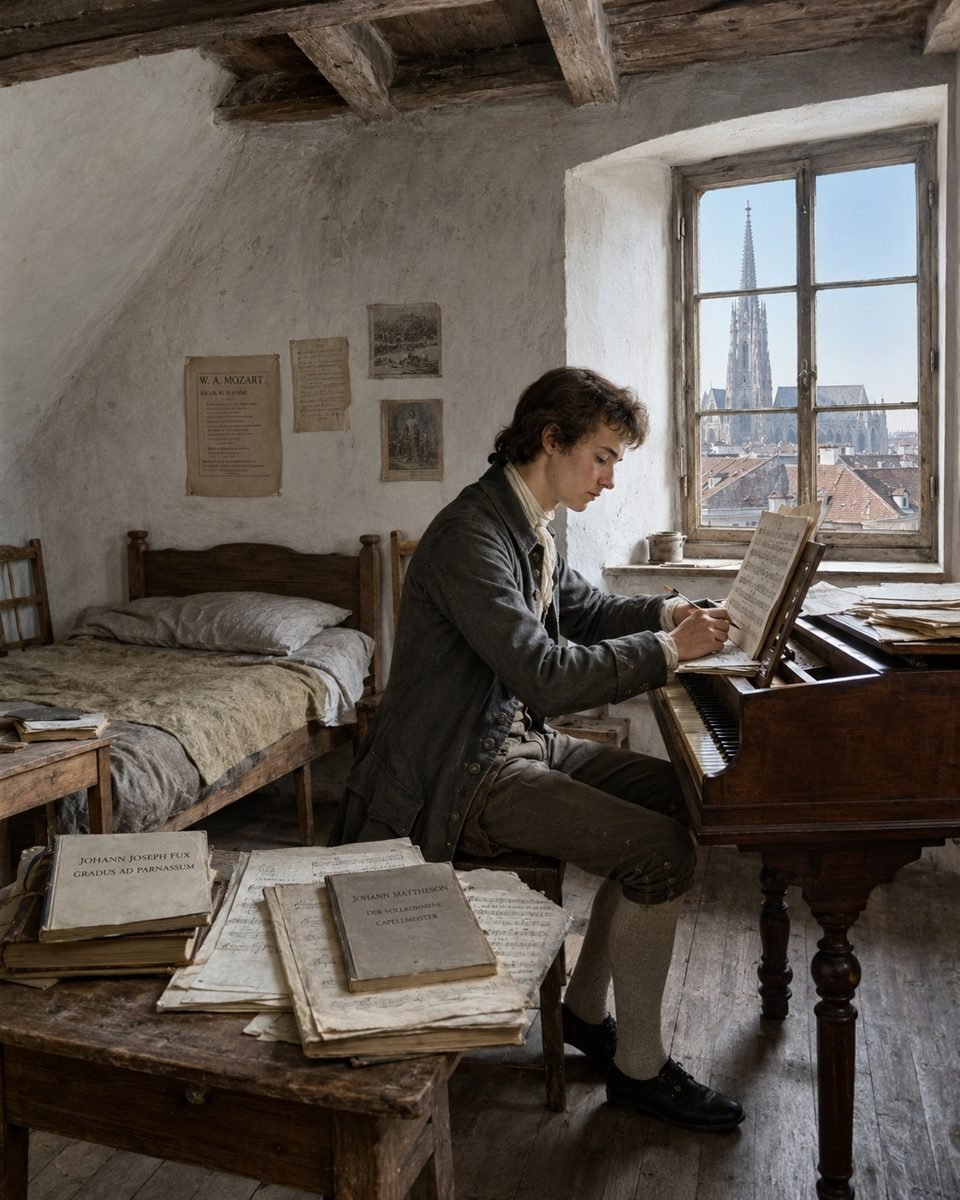
VIENNA — 1750–1760
THE FORLORN EX-CHORISTER WHO BECAME A COMPOSER
THE STREETS OF VIENNA: A BOY WITHOUT A VOICE, WITHOUT MONEY, BUT NOT WITHOUT A FUTURE
When Joseph Haydn was expelled from the choir of St Stephen’s in November 1749, he was not yet the serene master whom Europe would later honour. He was a poor, threadbare, broken-voiced youth of seventeen, turned loose into the streets of Vienna with no money, no position, no protector, and no secure idea of where the next meal would come from. His childhood had ended abruptly. The institution that had used his treble voice for years had no further need of him once that voice failed. He had been trained, disciplined, neglected, punished, and finally dismissed.
The city into which he was thrown was brilliant, pleasure-loving, aristocratic, and socially unequal. Vienna was full of palaces, wealthy noble families, theatres, entertainments, church music, processions, domestic concerts, and fashionable taste. It was also a city in which a poor musician could easily disappear. The nobility had their pleasures; the middle class had its prosperity; the lower classes endured their silence. A disgraced choirboy with worn clothes and an empty purse could expect little attention from such a world.
Yet this humiliating beginning was one of the most decisive moments in Haydn’s life. For the first time, he was no longer protected by an institution, however harsh. He was no longer merely a singer in someone else’s choir. He was forced to become a working musician, a survivor, a self-teacher, and eventually a composer. The catastrophe of dismissal became the beginning of independence.
He might have returned to Rohrau. His parents would almost certainly have received him with affection. But going home would have meant admitting failure, becoming a burden on a poor family, and perhaps surrendering to the old hope that he might enter the priesthood. Haydn had already made an inward decision: he would be a musician. More than that, he wanted to become a composer. He therefore remained in Vienna, hungry and uncertain, because the city that threatened to crush him was also the only city in which his ambition might one day be fulfilled.
SPANGLER: THE POOR MAN WHO SAVED HAYDN FROM THE STREET
In this first moment of despair, Haydn was saved not by a prince, a patron, a nobleman, or a famous master, but by another poor musician. Wandering through Vienna, weary and hungry, he met Spangler, a tenor singer whom he knew and who earned a modest living at the church of St Michael. Spangler had little enough for himself, but he did what the poor so often do for one another: he made room.
He invited Haydn to share his garret rooms with his wife and child. It was an act of simple charity, but its consequences were immense. Without Spangler’s kindness, the young musician might have been forced back to Rohrau, or into some profession far removed from composition. History often remembers the names of princes and patrons, but sometimes a life is preserved by an obscure person whose generosity leaves almost no documentary trace. Spangler was one of those hidden benefactors.
The rooms were poor, cramped, and uncomfortable, but they gave Haydn shelter through the winter of 1749–1750. There, in a high garret, above the ordinary movement of the city, he began the next stage of his life. The image is almost symbolic: Haydn enskied, near the clouds, poor in money but rich in resolve. He had almost nothing, but he possessed health, good spirits, musical memory, and an extraordinary willingness to work.
THE GARRET YEARS: MUSIC AS BREAD, WORK, AND SURVIVAL
In those first Vienna years, Haydn accepted almost any musical work that would keep him alive. He tried to obtain pupils. He sang wherever his changed voice allowed him to sing. He played at balls, weddings, baptisms, and private gatherings. He arranged music for anyone willing to pay. He took part in serenades. He became one of the anonymous musical labourers who made Vienna sound alive long before they themselves became visible.
This was not romantic poverty in the comfortable sense. It was real insecurity. He knew hunger. He knew humiliation. He knew the exhausting necessity of turning every small musical skill into bread. But these years also taught him something that no formal school could have taught: music as practical life. He was not composing in isolation from society. He was learning the needs of singers, instrumentalists, dancers, churches, theatres, patrons, amateurs, and audiences.
The serenades were particularly important. In Vienna, serenading was not merely the romantic custom of a lover beneath a window. It could be a serious musical entertainment, involving vocal and instrumental music, sometimes even larger ensembles. For a young composer struggling to be heard, such occasions offered experience, visibility, and practice. Haydn learned to write and perform for real situations, not abstract ideals.
The poverty was harsh, but it strengthened his artistic practicality. He learned how music functioned in the world. He learned speed, adaptability, clarity, and usefulness. Later, when he entered aristocratic service, these qualities would prove essential. Haydn’s genius was never disembodied. It grew from the daily need to make music work.
MARIAZELL: THE PILGRIM, THE CHOIR, AND THE SOLO THAT OPENED A DOOR
One of the most vivid stories from this period concerns Haydn’s journey to Mariazell, the famous Austrian pilgrimage shrine in Styria. As a devout Catholic, Haydn would have understood the religious significance of the place, but the episode also belongs to the history of his survival. He joined a party of pilgrims and, upon arrival, presented himself to the local choirmaster, explaining his training at St Stephen’s and showing some of his compositions.
The choirmaster dismissed him rudely, apparently suspicious of lazy young men from Vienna. But Haydn did not withdraw. Having travelled so far, he found a way into the choir and tried to secure a chance to sing. When the solo singer refused to let him take his place, Haydn boldly seized the opportunity at the right moment and sang the solo himself. The effect was immediate. The choir listened in astonishment. His musical ability, previously rejected, became impossible to ignore.
After the service, the choirmaster apologized and invited him to his house. The invitation, first for a day, became a week. Haydn returned to Vienna with enough money, collected among the choir, to meet his immediate needs.
This episode reveals several elements of his character. He could be humble, but not passive. He respected institutions, but he also knew when to force a door open. He had the courage of need, and also the confidence of genuine ability. The young Haydn did not wait for fate to recognize him; when necessary, he sang his way into recognition.
BUCHHOLZ AND THE LOAN THAT GAVE HIM A ROOM OF HIS OWN
Slowly, people began to hear of the gifted young musician struggling in Vienna. Among his early benefactors was a tradesman named Buchholz, who lent him 150 florins without conditions. It was not a great fortune in the eyes of the wealthy, but for Haydn it was transformative. Decades later, he remembered the kindness in his will, leaving money to a descendant of the man who had helped him when he most needed help.
With this loan, Haydn could at last rent a room of his own. It was another attic, in the old Michaelerhaus in the Kohlmarkt. The room was small, poorly lit, and uncomfortable. It had no stove. The roof was in such bad condition that rain and snow entered freely, sometimes wetting his bed. In winter, the water in his jug froze during the night. His neighbours were not the sort to guarantee peace: a journeyman printer, a footman, a cook. But none of this mattered as much as the fact that he now had privacy.
For the first time, Haydn had a space in which he could study, practise, and compose without depending entirely on someone else’s household. He had his old, worn spinet, his books, his health, and his determination. He later remembered that, despite poverty, he was too happy to envy kings. That sentence is essential to understanding him. Haydn’s happiness was not based on comfort. It came from purpose.
The attic was miserable materially, but artistically it was fertile. There, in cold and discomfort, he was making himself. The garret became his conservatory, his monastery, his workshop, and his first realm of freedom.
AN EARLY MASS: THE FIRST SURVIVING SIGN OF THE COMPOSER
During these years Haydn composed a great deal, though much of what he wrote was later destroyed or discarded. One early work survived with particular significance: his first Mass in F. It was not a mature masterpiece. It showed immaturity, inexperience, and the limitations of his training. But it was a real attempt, a serious work by a young man still struggling to master the craft.
What is especially touching is that Haydn later returned to this youthful Mass in old age and revised it, adding wind parts. He did not treat it with contempt. He recognized in it something of his younger self — not perfection, but sincerity. For a composer of Haydn’s maturity to revisit an early work is a gesture of memory. It suggests that he did not despise the poor young man in the attic who had tried to compose before he fully knew how.
This first Mass stands as an emblem of continuity. The later composer of great sacred works did not appear suddenly. He began with modest attempts, imperfect but earnest. The master grew out of the apprentice; the late genius remembered the early struggle.
METASTASIO: THE POET WHO OPENED A DOOR
In the same Michaelerhaus lived one of the most famous literary figures of the age: Pietro Metastasio, the great poet and opera librettist. By then his reputation was European. He did not live in the freezing attic world of the young musician, but somehow he became aware of the poor, friendless youth above him and resolved to help.
This connection was decisive. Metastasio had been entrusted with the education of Marianne von Martinez, daughter of a Spanish gentleman connected with the Apostolic Nuncio. She needed a music teacher, and Metastasio engaged Haydn to teach her the harpsichord. In return, Haydn received board.
This changed his conditions profoundly. He was no longer merely surviving by odd jobs. He now had a connection with a cultivated household and a pupil of real ability. Marianne von Martinez would later become a respected musician, singer, and composer, admired in Viennese circles. Haydn taught her daily for three years, and some part of her later distinction must be credited to his instruction.
For Haydn, this post offered more than food. It brought him into a different social and artistic atmosphere. He encountered poetry, language, aristocratic manners, cultivated conversation, and the world of opera. The poor ex-chorister began to move, slowly and uncertainly, toward circles in which his talent could be noticed.
PORPORA: THE SEVERE MASTER OF SONG AND THE SOCIAL HUMILIATION OF A YOUNG MUSICIAN
Through Metastasio, Haydn was introduced to Niccolò Porpora, the celebrated singing teacher associated with the great Farinelli and with the operatic world that had once opposed Handel in London. Porpora was a formidable figure, a master of vocal art, and in Vienna he enjoyed great authority.
Haydn became his accompanist during singing lessons given to the mistress of Correr, the Venetian ambassador. The position was musically valuable, but socially humiliating. At the ambassador’s summer quarters at Mannersdorf, Haydn received six ducats a month and board, but he ate at the servants’ table. He also performed menial duties for Porpora: blackening boots, trimming wigs, brushing coats, running errands, and accompanying lessons.
To modern eyes this seems almost intolerable. But it reveals the social position of musicians in the mid-eighteenth century. They were not yet the revered independent artists of the Romantic age. They were often treated as servants, dependent on patrons, households, and practical employment. Haydn accepted this because he was poor and because Porpora could teach him what he needed. His own later explanation was direct: he improved in singing, composition, and Italian.
Here again, humiliation was transformed into education. Haydn’s pride did not prevent him from learning. He endured servile circumstances in order to gain artistic knowledge. He was proud enough to aspire, but humble enough to serve when service could become a school.
EMANUEL BACH: THE COMPOSER WHO SHOWED HIM THE WAY FORWARD
While earning his living and absorbing lessons from Porpora, Haydn continued his private studies with tireless seriousness. A major influence now entered his life: Carl Philipp Emanuel Bach, the son of Johann Sebastian Bach. Haydn studied the first six clavier sonatas of Emanuel Bach with intense admiration.
This influence was crucial because Emanuel Bach represented a path away from the older contrapuntal world toward a more modern instrumental language. Haydn needed models that could help him develop the kind of music that would later become the classical sonata, quartet, and symphony. The great contrapuntal tradition of Handel and Johann Sebastian Bach was magnificent, but it was not the direct road to Haydn’s own voice. Emanuel Bach’s music offered a different kind of freedom: expressive, formally clear, harmonically alive, and suitable for instrumental development.
Haydn later acknowledged his debt openly. He said that he did not leave the clavier until he had mastered those sonatas, and that he owed much to Emanuel Bach. This was not a minor influence. It helped him understand how small forms could be shaped, how harmonic motion could create drama, how instrumental music could speak with personality.
In Haydn’s later style, one can hear the fruit of this study: pauses, surprises, expressive turns, sudden modulations, rhythmic wit, and a sense that form itself can become dramatic. Emanuel Bach did not make Haydn a great composer, but he helped him recognize the direction in which his gift could grow.
VIOLIN STUDIES, FRIENDSHIPS, AND THE YOUNG COMPOSER’S HUMOUR
Although the clavier remained his principal instrument, Haydn also worked seriously at the violin. Tradition associates his violin studies with a celebrated virtuoso, often thought to have been Carl Ditters von Dittersdorf. Whether or not Dittersdorf was formally his teacher, the two musicians became friends, and stories of their companionship show Haydn’s humour and informality.
One anecdote tells of Haydn and Dittersdorf hearing a fiddler playing a minuet in a beer cellar. Haydn asked whose minuet it was. The fiddler answered that it was Haydn’s. Haydn replied that it was a bad minuet, whereupon the offended player nearly attacked him with the fiddle. Whether exact or embellished, the story captures Haydn’s wit, his lack of solemn vanity, and the lively musical world through which he moved.
These friendships and practical experiences mattered. Haydn was learning not only from books and masters, but from players, amateurs, theatres, taverns, salons, and streets. His later music would be aristocratic in polish but popular in vitality. It would speak both to cultivated listeners and to the instincts of dance, song, humour, and human movement.
FELIX KURZ AND THE TEMPEST ON THE KEYBOARD
Around 1751, Haydn’s serenading brought him into contact with Felix Kurz, a popular Viennese comedian and theatrical manager. Haydn directed a performance of one of his own quintets beneath Kurz’s window, and the comedian, pleased by the music, invited him inside.
Kurz then asked him to represent a storm at sea on the harpsichord. Haydn had never seen the sea and could not easily imagine its violence. He made several attempts, none of which satisfied the theatrical man. At last, impatient and amused, Haydn stretched his hands to the ends of the keyboard and rapidly brought them together, exclaiming something like a curse upon the tempest. Kurz was delighted. That was exactly the dramatic effect he wanted.
The episode is humorous, but it is also revealing. Haydn was being pushed toward programmatic imagination — the attempt to make music depict an external scene. He would later become a supreme master of abstract instrumental form, but his music always retained theatrical instinct. He knew how to surprise, how to gesture, how to make sound act.
Kurz soon asked more of him. He had written the libretto of an opera, Der Neue Krumme Teufel, and wanted Haydn to set it to music. The young composer accepted, encouraged by the promised payment of 24 ducats. The opera was produced in 1752 and enjoyed repeated performances not only in Vienna but elsewhere. The music has been lost, but the event is important. It was Haydn’s first real theatrical success, and it helped spread his name.
BARON FÜRNBERG AND THE BIRTH OF THE STRING QUARTET
By the mid-1750s, Haydn’s reputation was growing. Through aristocratic connections, especially those related to Porpora and other circles, he came to the attention of Baron von Fürnberg, a wealthy amateur who held concerts at his country house at Weinzierl, near Vienna. Haydn was invited to direct performances and compose music for them.
This invitation became one of the most important turning points in the history of chamber music. For Fürnberg, Haydn wrote his first string quartet. More followed rapidly. Between 1755 and 1756, he produced a series of works in the same genre. These early quartets were not yet the full mature achievements of his later years, but they opened a path that would become central to his legacy.
The string quartet suited Haydn’s deepest musical nature. It was intimate but disciplined, social but serious, conversational but architecturally clear. Four instruments could speak, answer, argue, support, surprise, and reconcile. In this medium, Haydn would eventually become one of the greatest creators in all music. The beginning was modest — music for a noble amateur’s gatherings — but the historical consequence was enormous.
The poor ex-chorister had begun to invent a new language of chamber music.
COUNTESS VON THUN: POVERTY, SUSPICION, AND RECOGNITION
As Haydn’s music circulated, it reached people who could help him. One of them was Countess von Thun, a figure later associated with important names in Viennese musical life. She encountered one of Haydn’s clavier sonatas in manuscript and asked to meet the composer.
When Haydn appeared before her, his shabby dress and awkward manners made such a poor impression that she suspected he might be an impostor. The contrast between the quality of the music and the appearance of the musician seemed too great. But Haydn spoke plainly of his humble origin and his struggles with poverty. His honesty convinced her. She became his pupil and one of his warmest friends.
This episode shows the social distance Haydn had to cross. His music could enter aristocratic rooms before his person was fully welcome there. He had talent, but not polish; genius, but not yet the manners of society. Slowly, through music, he earned trust. His art became his passport.
COUNT MORZIN: THE FIRST STABLE POSITION AND THE FIRST SYMPHONY
Haydn’s first authenticated fixed appointment came in 1759, when, through the influence of Baron Fürnberg, he became Capellmeister to the Bohemian Count Morzin. The count maintained a small but capable orchestra of about sixteen or eighteen players at his country house near Pilsen.
For Haydn, this was a breakthrough. After years of uncertainty, odd jobs, poverty, pupils, garrets, and humiliating dependence, he now had an official post. He could write for a regular ensemble. He could hear his instrumental ideas realized. This is essential. A composer of symphonies needs not only imagination, but players. Count Morzin gave Haydn a small orchestra, and for that orchestra he wrote his first Symphony in D.
Here again, a modest beginning opened into a vast future. The first symphony was not yet the full classical world of the later London Symphonies, but it marked the beginning of one of the most extraordinary symphonic careers in history. Haydn had found the medium through which he would shape the modern orchestra.
The path from the freezing attic to the first symphony had been long in suffering but short in years. Within a decade, the broken-voiced ex-chorister had become a composer with aristocratic pupils, chamber works, theatrical experience, and a post as Capellmeister.
LOVE, MISJUDGMENT, AND THE MARRIAGE THAT BROUGHT NO PEACE
At this point, Haydn made one of the most unfortunate decisions of his life. His salary from Count Morzin was modest, and the count did not normally keep married men in his service. Yet Haydn fell in love and decided to marry.
The woman he first loved was the younger daughter of Barber Keller, a family he had known from earlier years. Unfortunately, she entered a convent. Her father then proposed a practical substitute: Haydn should marry the elder sister, Anna Maria Keller. It was a disastrous arrangement. Haydn seems not to have truly wanted this marriage, but he accepted it.
The wedding took place at St Stephen’s on 26 November 1760. He was twenty-nine; she was thirty-two. There appears to have been little real affection at the beginning, and even less happiness afterward. Haydn later said that he had begun to like his wife and might have grown more attached to her had she behaved reasonably. But the marriage became a source of misery.
Anna Maria had no understanding of his artistic vocation. The most famous and painful detail is that she used his manuscript scores as curling papers or pastry underlays. Whether repeated with some exaggeration or not, the anecdote captures the essential truth of the relationship: his music meant nothing to her. She did not care whether he was a cobbler or an artist. For a composer whose whole life had been built through musical labour, this indifference was deeply wounding.
The marriage would remain one of the least happy elements in Haydn’s life. He was discreet about it and did not turn his private suffering into public complaint. But the union brought him no domestic consolation. In a decade that had lifted him professionally, he entered a personal relationship that would remain emotionally barren.
THE END OF THE VIENNA DECADE: A MAN READY FOR EISENSTADT
Soon after the marriage, Count Morzin fell into financial difficulty and had to dismiss his musical establishment. Once again, Haydn’s security disappeared. But this time the situation was different. He was no longer the helpless youth expelled from St Stephen’s. He had become known. He had written quartets, an opera, keyboard works, a Mass, and a symphony. He had taught aristocratic pupils, worked with Porpora, studied Emanuel Bach, and learned the practical mechanics of musical life.
Most importantly, his music had reached the ears of Prince Paul Anton Esterházy, who had heard some of Haydn’s compositions while visiting Morzin and had been favourably impressed. When Morzin could no longer keep his orchestra, an opportunity opened. Haydn was about to enter the service of the family with whom his name would be linked for the rest of his career.
Thus the decade 1750–1760 forms one of the most dramatic transformations in his biography. He begins it as a destitute ex-chorister wandering the streets of Vienna. He ends it as a recognized young composer, already connected with noble households and ready for the Esterházy world.
THE MEANING OF THE SECOND CHAPTER
This chapter of Haydn’s life is the story of self-creation. No single institution made him. St Stephen’s trained and expelled him. Reutter neglected him. Poverty tested him. Spangler sheltered him. Buchholz helped him. Metastasio opened a door. Porpora taught him through humiliation. Emanuel Bach guided him through scores. Fürnberg gave him chamber music. Count Morzin gave him an orchestra. Vienna gave him hunger, opportunity, cruelty, noise, theatre, aristocratic contact, and practical education.
The essential pattern is clear: Haydn turned every circumstance — even hardship, even servile work, even poverty — into a means of growth.
He was not yet the master of Esterháza, not yet the father of the symphony, not yet the honoured guest of London. But by 1760 he had crossed the most dangerous passage: from dependence to identity. He had discovered that he could survive, teach, compose, please patrons, write for instruments, and make his way through the world by music.
The boy who had been thrown into Vienna with a broken voice had found another voice — not the voice of a choirboy, but the voice of a composer.