24 June 2026
Haydn in England: The First Trip to London
On Classicapedia: Joseph Haydn, Johann Peter Salomon, Charles Burney, Sir William Herschel
TRIUMPH IN ENGLAND
THE FIRST LONDON JOURNEY
THE COMPOSER ARRIVES IN A NEW WORLD
When Joseph Haydn reached England at the beginning of 1791, he entered a world utterly different from Esterháza. The contrast could hardly have been greater. At Esterháza, music had belonged to a princely household, shaped by the tastes and commands of Prince Nicolaus. In London, music belonged to a vast public city: subscribers, critics, aristocrats, publishers, concert entrepreneurs, newspapers, rival factions, crowded rooms, and audiences eager to see the famous man whose music had already travelled before him.
Haydn had crossed the sea as an older master, not as a youthful adventurer. He was almost sixty. Behind him lay the long discipline of service, the immense practical schooling of the Esterházy orchestra, the years of isolation, the symphonies, quartets, baryton pieces, operas, sacred works, and court entertainments that had built his craft. He arrived in London not to learn whether he had genius, but to discover what would happen when that genius was placed before a free, enthusiastic, public audience.
London did not treat him as a minor foreign curiosity. It received him as a living master. His name was already famous; his presence made the fame visible. The music that had once served a remote palace now stood before the most commercially active musical city in Europe. The private composer became a public figure.
This was the great meaning of the first London journey. Haydn did not abandon his past; he brought it with him. The clarity, discipline, humour, orchestral command, and architectural mastery learned in aristocratic service now met the energy of a city that could applaud, pay, criticize, rival, compete, and celebrate. The result was triumph.
The man who had been “forced to become original” in isolation now discovered that his originality could conquer a public metropolis.
LONDON: NOISE, SOCIETY, AND THE SHOCK OF THE CITY
For Haydn, London was both exhilarating and overwhelming. He had known Vienna, but for decades his daily life had been largely provincial and courtly. London confronted him with scale: streets, crowds, carriages, commerce, public entertainments, dinners, invitations, noble houses, concert rooms, and the endless movement of metropolitan life.
He was fascinated, but he was also disturbed. The cries of street sellers and the noise of daily urban life irritated him deeply. A composer who had spent years refining the smallest orchestral effects could not easily ignore the uncontrolled sound of the city. London gave him fame, but it also assaulted his ear.
This is one of the most human details of the journey. The public world that honoured him also exhausted him. He loved admiration, but he needed quiet. He enjoyed society, but he required morning hours for composition. He could accept dinners and court invitations, but he soon realized that too much social attention damaged his health and interfered with work.
Eventually he withdrew from the bustle of Great Pulteney Street to Lisson Grove, where he lived more quietly, almost “as if in a monastery.” The phrase is revealing. Even in London, even amid triumph, Haydn remained the disciplined worker. He did not wish merely to be entertained. He wished to compose.
The city wanted to possess him socially. Haydn had to protect himself artistically. The London triumph began not only with applause, but with Haydn’s quiet struggle to preserve the inner order on which his music depended.
SOCIAL ATTENTION: THE MASTER AS CELEBRITY
London society quickly discovered that Haydn was not only a famous composer, but a fascinating guest. He was invited everywhere: dinners, noble houses, musical gatherings, clubs, royal events, and fashionable entertainments. He was admired not only for his music, but for his personality — modest, good-humoured, candid, devout, observant, and quietly witty.
This new social life was both flattering and dangerous. At Esterháza, Haydn had been valued because he was useful. In London, he was valued because he was famous. The difference was profound. He was no longer merely the servant of a prince, though he still carried the habits of service within him. He was now a man whom aristocrats wished to meet, whom societies wished to honour, and whom concert organizers wished to display.
The Anacreontic Society expressed admiration for him. The Prince of Wales took an interest in him. Royal and aristocratic circles opened their doors. Haydn, who had once eaten at servants’ tables and worn livery, now found himself treated as a celebrated European master.
Yet he remained practical. He observed, noted, compared, and judged. He was pleased by attention but not intoxicated by it. He could enjoy praise and still complain about late dinners. He could attend court and still think of composition. Fame did not dissolve the worker inside him.
This balance gives the London journey its special charm. Haydn was celebrated, but he did not become theatrical. He entered celebrity with the manners of a craftsman. He accepted honour with gratitude, but he never forgot that his real dignity lay in work.
ROYAL CIRCLES: THE GOOD, HONOURABLE GERMAN
Haydn’s reception in royal circles was one of the clearest signs of his extraordinary status. The Prince of Wales admired him and invited him repeatedly to Carlton House. At one concert at York House, the programme was entirely devoted to Haydn’s music. This was not ordinary hospitality. It was royal recognition of artistic authority.
Haydn was presented to King George III and Queen Charlotte. The King remarked that Haydn had written a great deal, to which Haydn replied with characteristic modest humour that he had written more than was good for him. The King disagreed. The Queen, for her part, wished him to settle in England and even imagined musical intimacy at Windsor. The King’s comment that he was “not jealous of Haydn” because Haydn was a good, honourable German produced one of the composer’s finest replies: that to preserve such a reputation was his greatest pride.
This exchange reveals much about Haydn. He understood honour not as vanity, but as moral character. The praise that mattered to him was not merely that he was clever, famous, or fashionable. It was that he was honourable. He had come from humble origins, lived through dependence, served princes, managed musicians, dealt with publishers, and now met kings. Through all these worlds, he wanted to remain upright.
His royal reception also shows the new place of the composer in European society. Haydn was not noble by birth, yet he could be received by royalty because his music had made him socially visible. Art crossed barriers that birth had fixed. The son of a wheelwright stood before kings because sound had carried his name.
London gave Haydn a public dignity that Esterháza had prepared, but never fully displayed.
RIVALRIES, JEALOUSIES, AND THE PUBLIC MARKET
The first London season was not free from difficulty. London’s musical world, for all its enthusiasm, was full of rivalries. Concert organizations competed; professional jealousy sharpened opinions; financial interests complicated artistic ones. Salomon’s concerts were delayed by theatrical and operatic disputes connected with the opening of the new Opera House and the availability of singers. The delay was awkward for both Salomon and Haydn.
For a moment, Haydn was temporarily eclipsed. He had been brought to London with great expectation, yet the first concerts were postponed. Rival parties tried to diminish the excitement surrounding him. Some public paragraphs sneered at him as a possible “nine days’ wonder,” implying that closer acquaintance might show him inferior to composers already known in England.
This is a valuable reminder that public fame is not pure admiration. It is also exposure. Esterháza had isolated Haydn from many such public attacks. London placed him in a world where reputation was contested, advertised, doubted, and defended. A composer now had to face not only patrons, but markets.
Haydn did not panic. His life had already taught him patience. He had known envy since youth, and he trusted both Providence and his own established credit with the English nation. The man who had endured Frankh, Reutter, poverty, Porpora, Werner, marriage, and court service was not likely to be destroyed by newspaper sarcasm.
The rivalry would later intensify with the arrival of Ignaz Pleyel, whom the Professional Concerts brought over to oppose him. Haydn’s reaction was beautifully characteristic. He did not hate Pleyel. He attended his concerts, praised his modesty, and even when critical remarks arose, he preserved affection. Haydn’s greatness was not only in his music, but in his capacity to remain generous in a world of rivalry.
THE SALOMON ORCHESTRA: A NEW INSTRUMENT FOR A NEW PUBLIC
The Salomon orchestra was not enormous by later standards, but in Haydn’s day it was considered substantial. It numbered roughly thirty-five to forty performers: strings, winds, trumpets, and drums. Compared with the smaller Esterházy forces, this gave Haydn a broader public sonority. It was still classical in scale, but larger in presence, more directly suited to the concert room, and capable of greater brilliance.
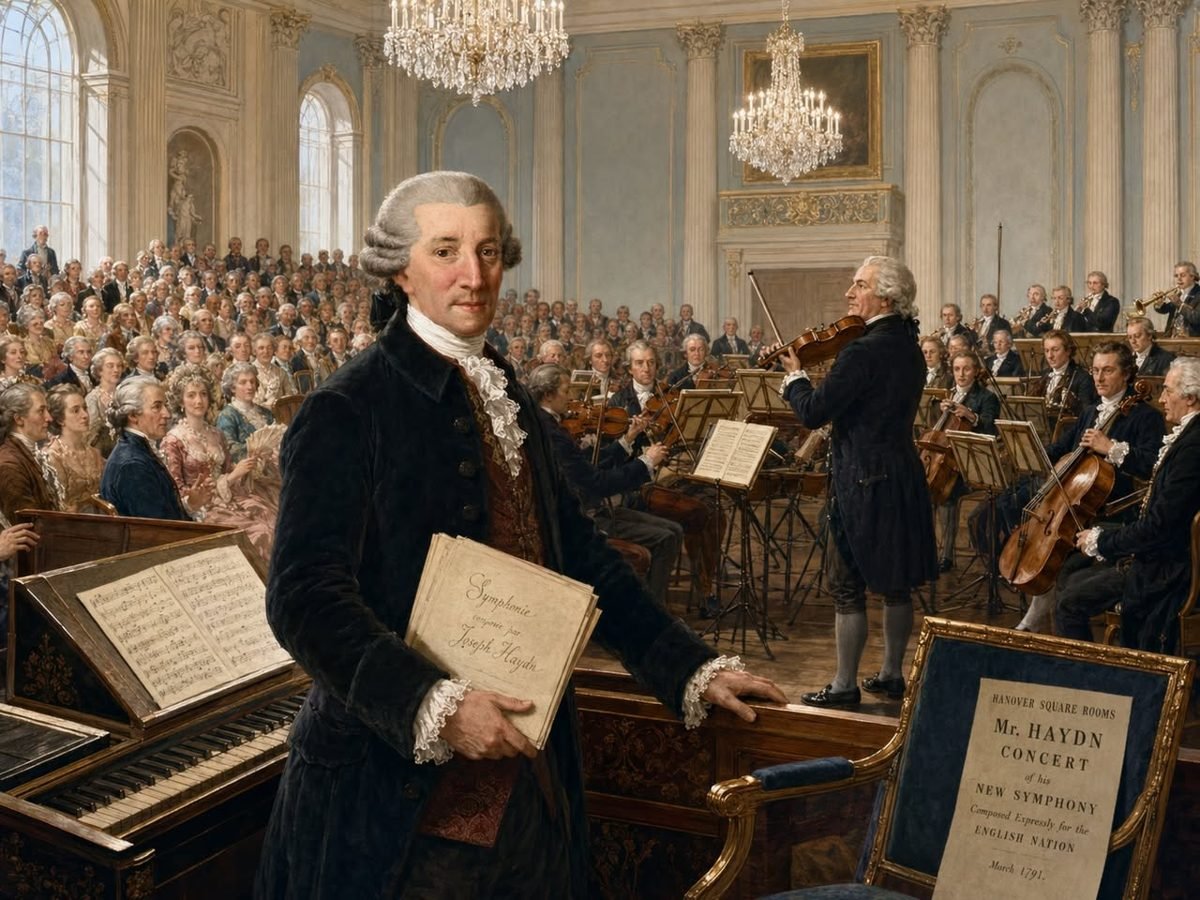
The method of direction also belonged to the period. Haydn did not stand before the orchestra with a baton in the modern manner. Salomon led from the first violin, while Haydn sat at the harpsichord, helping to keep the ensemble together with occasional chords. This arrangement places us firmly in the musical practice of the late eighteenth century. The composer was present, active, central, but not a conductor in the modern sense.
An anecdote from rehearsal reveals Haydn’s practical authority. When the orchestra played the opening notes of a symphony too loudly and failed to satisfy him after repeated requests, Haydn borrowed a violin and demonstrated exactly what he wanted. The players understood at once. This scene is important because it shows that Haydn’s authority was musical before it was verbal. His English was limited; his ear was absolute.
The difficulty of language did not disappear. He could say, beautifully, that the language of music was understood all over the world, but as the book wittily observes, one cannot speak to an orchestra entirely in crotchets and semibreves. Still, Haydn managed. He had a winning way with players. He knew how to obtain what he wanted without tyranny.
The Salomon orchestra became the public counterpart to the Esterházy laboratory. At Esterháza, he had learned how to write for known musicians in a private world. In London, he learned how that same mastery could command a public ensemble before a paying audience.
HANOVER SQUARE ROOMS: THE STAGE OF TRIUMPH
At last, after delays and rivalries, the first concert took place at the Hanover Square Rooms, then the principal concert hall in London. The audience was brilliant and filled the room. This was the decisive public moment. The famous composer was no longer a distant name. He was in the orchestra. He was visible. He was present before London.
The success was immense. Charles Burney recorded that Haydn’s appearance in the orchestra seemed to have an electrical effect on all present and that he remembered no performance marked by greater enthusiasm. This is one of the great scenes in Haydn’s life. The man who had once been a neglected choirboy, a poor attic student, a court servant, and a remote Kapellmeister now stood at the centre of an electrified public audience.
The Hanover Square Rooms themselves carried symbolic importance. They belonged to the rising public concert culture that would define much of modern musical life. In later years, many great musicians would appear there, but for Haydn, the place was already enough: a room where instrumental music could become a public event, not merely court entertainment.
The audience of the period added visual drama: hoops, swords, formal dress, ceremony, social rank, gendered ticket colours, aristocratic display, and the whole spectacle of late eighteenth-century concert life. The music was not heard in neutral space. It was heard in a social theatre of fashion and culture. Haydn’s symphonies had to speak across that environment and through it.
They did. The Hanover Square Rooms became the place where Haydn’s private mastery became public triumph.
THE LONDON SYMPHONIES: MUSIC FOR A PUBLIC CITY
The symphonies Haydn wrote for London were not simply continuations of his Esterházy style. They carried his mature craft into a new public scale. The audience was larger, the expectations different, the orchestra stronger, the publicity broader, and the stakes higher. Haydn responded by enlarging the expressive and architectural force of the symphony.
These works show what London gave him: a greater sense of public address. The symphony was no longer only the intelligent entertainment of a princely household. It became a conversation with a city. Openings had to seize attention. Slow movements had to deepen atmosphere. Finales had to generate excitement. Orchestral effects had to carry clearly in a public hall.
Yet Haydn did not betray himself. The London symphonies remain full of his characteristic virtues: wit, balance, surprise, economy, formal intelligence, rhythmic vitality, and humane warmth. What changes is the breadth of the address. He speaks more publicly, but remains unmistakably Haydn.
The audience understood. Slow movements and adagios could be encored. Listeners were carried away by admiration. Public applause interrupted even delicate passages, especially among excitable listeners. This could disturb musical continuity, but it also reveals the emotional power of Haydn’s presence. London did not receive him politely; it received him passionately.
The triumph of the London symphonies is one of the decisive moments in the history of the genre. The symphony, which Haydn had developed through decades of service and experiment, now became one of the great public forms of European music. In London, Haydn did not merely present symphonies; he showed what a symphony could mean before a public.
THE PLEYEL RIVALRY: THE TRIUMPH OF GENEROSITY
The arrival of Ignaz Pleyel as a rival figure in the London concert world could have produced bitterness. Pleyel had been Haydn’s pupil, and the Professional Concerts hoped to use him as a counterweight to the immense prestige of Salomon’s guest. The situation might have humiliated a lesser man. It might have provoked jealousy, anger, or public hostility.
Haydn responded with nobility. He did not deny the rivalry, but he refused to turn it into hatred. He attended Pleyel’s concerts. He spoke of him with affection. Even when he criticized presumption, he still said that he loved him. There is something deeply moving in this. Haydn had every right to feel threatened, but his inner security was too strong for pettiness.
This episode reveals the moral stability behind his public success. Haydn had spent his life being tested by envy, poverty, dependence, and misunderstanding. By 1791–1792, he knew who he was. Rivalry could not easily unsettle him because his reputation rested on decades of work.
The Pleyel affair also shows how London transformed music into competition. Public concerts required novelty, names, factions, comparisons, and commercial strategy. Haydn entered this world late in life, but he did not become corrupted by it. He remained generous where others might have become anxious.
Haydn’s triumph in England was not only musical; it was characterological. He succeeded without malice.
ST PAUL’S: THE CHILDREN’S VOICES
Among all the experiences of the London visit, one of the most touching was Haydn’s hearing of the Charity Children in St Paul’s Cathedral. Around four thousand children took part, and Haydn recorded that this innocent and reverent music touched him more than any he had ever heard.
The moment is profoundly revealing. Haydn, the master of symphonies, the celebrated guest of princes, the triumph of Hanover Square, was moved most deeply by children’s voices in sacred simplicity. Perhaps the scene recalled his own childhood: the choirboy of St Stephen’s, the boy trained in church music, the child who had sung masses at six, the poor boy whose life had been formed by sacred sound before he became a master of instrumental architecture.
The Charity Children awakened something deeper than professional admiration. They touched memory, faith, humility, and innocence. Haydn had known splendour at Esterháza and applause in London, but the children gave him a different kind of musical truth: reverent sound without vanity.
The detail also reminds us that Haydn’s art, for all its wit and public success, remained rooted in piety. His religious feeling was simple, sincere, and enduring. He did not separate music from gratitude. The experience at St Paul’s belongs to the spiritual thread that runs from Rohrau and St Stephen’s to The Creation and The Seasons.
The symphonist who conquered London was still the child who had once learned to sing in church.
HERSCHEL: THE COMPOSER AND THE ASTRONOMER
After the concert season, Haydn made excursions, including visits to Windsor, Ascot, and Slough. At Slough he met William Herschel, the great astronomer, who was himself musically trained. The encounter is one of the most beautiful intellectual episodes of the visit: the composer of musical order meeting the man who studied cosmic order.
Haydn was deeply impressed by Herschel’s telescope and by the idea of a man spending long hours under the cold sky observing the heavens. One can imagine how this encounter affected him. Haydn’s mind was naturally curious. He collected impressions everywhere: music, machines, ceremonies, cities, crowds, nature, science, and social customs.
The meeting with Herschel belongs to the same imaginative universe that would later make The Creation possible. Haydn had always possessed a sense of wonder, but London enlarged it. He saw not only audiences and courts, but also science, industry, and a wider world of knowledge.
The composer who had built musical universes now stood before the instruments used to observe the physical universe. The symbolism is irresistible. Herschel looked into space; Haydn organized time. Both sought order in vastness.
VAUXHALL, WINDSOR, ASCOT: THE CURIOUS OBSERVER
Haydn’s notebook from the London journey shows him as a keen observer of English life. He went to Vauxhall Gardens, where he found the music fairly good and the place unlike anything else in the world. He visited Windsor Castle. He went to Ascot to see the races. These details may seem peripheral, but they enrich the portrait.
Haydn was not a narrow man. He had lived for decades inside courtly routine, yet his mind remained open. London and England gave him a series of impressions: royal ceremony, public gardens, social amusements, scientific instruments, children’s singing, concert rivalries, street cries, large audiences, and the customs of a country very different from Austria.
This curiosity is important for understanding his late style. Haydn was old enough to be settled, but not old enough to be closed. He could still learn. He could still be surprised. He could still compare and enjoy. The London journey gave him not merely fame, but new sensations.
The world entered him, and he answered with music. Haydn’s London triumph was not only a triumph of a past mastery; it was also a renewal of imagination.
THE FIRST SEASON AND THE MEANING OF SUCCESS
By the end of the first London season, the success of Haydn’s visit was beyond doubt. Salomon’s concerts had ended brilliantly. Haydn’s works were received with admiration, enthusiasm, and repeated applause. His presence had electrified audiences; his symphonies had expanded his public reputation; his social standing had risen; his name had become one of the great musical possessions of London.
This success was not accidental. London did not make Haydn great; it recognized the greatness already formed. But recognition matters. For decades, Haydn had worked in comparative isolation. His music had travelled, but he himself had remained in service. In London, the man and the music were finally united before the public.
The triumph also altered the meaning of his own life. He had been a servant; now he was a public master. He had written for a prince; now he wrote for a city. He had lived in a palace; now he stood in a concert hall. He had been admired by aristocrats; now he was applauded by a broader audience.
The London journey gave him money, honour, independence, and confidence. It also gave him a new scale of symphonic ambition. The later London symphonies would become among the greatest achievements of his career, not because he abandoned his past, but because his past found a larger public form.
In England, Haydn did not become another composer.
He became more fully Haydn.
THE MEANING OF THE FOURTEENTH CHAPTER
This chapter marks the public flowering of Haydn’s long discipline. Everything in his earlier life had prepared him for London: the practical humility of Rohrau, the hardship of Hainburg, the discipline of St Stephen’s, the self-education of Vienna, the first orchestra under Morzin, the decades of service under the Esterházys, the isolation of Esterháza, the daily labour of composition, and the gradual circulation of his fame across Europe.
In England, all those hidden preparations became visible. The composer who had learned to write for a private court now discovered that his language could move a public audience. The master who had refined the symphony in relative isolation now made it a concert-room event of international importance. The man who had feared the sea and entered London late in life now found himself welcomed by princes, admired by critics, and applauded by crowds.
The triumph was musical, social, moral, and historical. It proved that instrumental music, in Haydn’s hands, had become a public art of the highest order. It proved that a composer formed in service could command a free audience. It proved that clarity, wit, balance, and humane intelligence could excite enthusiasm as surely as virtuosity or theatrical spectacle.
And it proved something deeply personal: Haydn’s long patience had not been wasted. His decades of duty had prepared him for liberty. His private discipline had prepared him for public glory.
The first London journey was not an escape from Haydn’s past.
It was the moment when that past finally spoke to the world.