21 September 2026
Handel's Floridante: The Story of a Forgotten Masterpiece (1721)
On Classicapedia: George Frideric Handel, Paolo Antonio Rolli, Francesco Silvani, Senesino, Anastasia Robinson
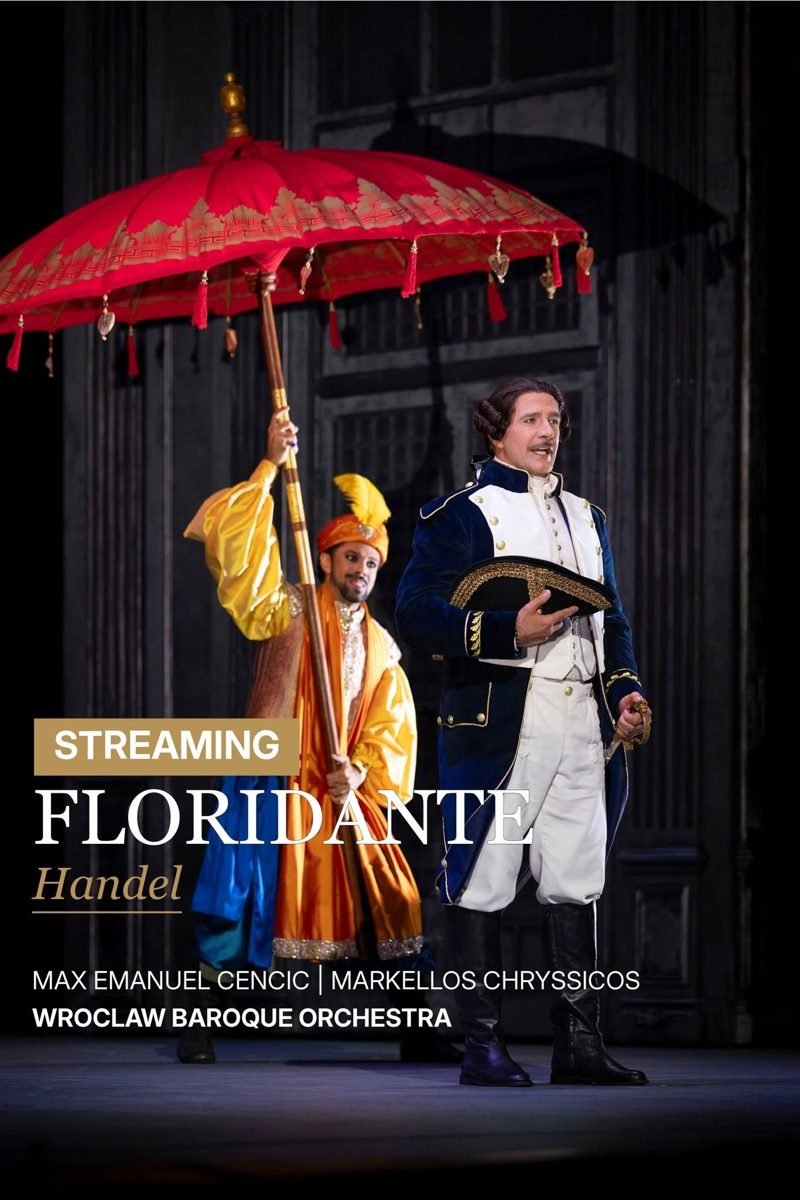
Opera seria in 3 acts, HWV 14 - London, 1721
Libretto: Paolo Antonio Rolli, after Francesco Silvani
Bruno de Sa, soprano — Timante
Eva Zalenga, soprano — Rossane
Sonja Runje, contralto — Elmira
Max Emanuel Cencic, alto — Floridante
Yannis Francois, bass — Coralbo
Gerrit Illenberger, bass — Oronte
Wroclaw Baroque Orchestra
MARKELLOS CHRYSSICOS, conductor
Recorded: September 4, 2026
Markgrafliches Opernhaus, Bayreut
BAYREUTH BAROQUE OPERA FESTIVAL 2026
HANDEL’S FLORIDANTE — THE HISTORY OF A NEGLECTED MASTERPIECE (1721)
George Frideric Handel’s Floridante, HWV 14, first performed in London on 9 December 1721, belongs to the fascinating first period of the Royal Academy of Music, the ambitious operatic company established to bring Italian opera seria to the London stage. Although today it is far less frequently performed than Giulio Cesare, Rodelinda or Tamerlano, Floridante was an important work in Handel’s development as a dramatic composer and enjoyed considerable success in its own time.
LONDON, 1721 — HANDEL AND THE ROYAL ACADEMY
When Handel composed Floridante, he was deeply involved with the Royal Academy of Music, not the later conservatoire of that name but a commercial opera enterprise supported by aristocratic subscribers. Handel had already provided the company with Radamisto (1720) and had contributed the third act of Muzio Scevola (1721).
The London operatic world was intensely competitive. One of Handel’s principal rivals within the Academy was Giovanni Bononcini, whose elegant and immediately attractive melodic style had proved extremely popular. Contemporary London even divided itself, at least rhetorically, into supporters of Handel and Bononcini.
Floridante, which opened the Academy's third season, appears partly to reflect this environment. Compared with the often imposing dramatic manner of Radamisto, much of its music makes use of shorter, graceful and immediately appealing melodic ideas, although Handel never abandoned his characteristic dramatic intensity.
THE LIBRETTO — PAOLO ANTONIO ROLLI
The libretto was prepared by Paolo Antonio Rolli, one of the important Italian literary figures working in London.
Rolli based his text on Francesco Silvani’s La costanza in trionfo, which had previously been set by Marc’Antonio Ziani in Venice in 1696.
The resulting three-act opera is nominally situated in ancient Persia, but, as was typical of opera seria, historical authenticity is secondary to love, political legitimacy, dynastic identity, loyalty, tyranny and constancy.
At the centre stands Floridante, Prince of Thrace, a victorious warrior who loves Elmira. She believes herself to be the daughter of the Persian ruler Oronte, but her true identity eventually becomes central to the political resolution of the drama.
Oronte is in fact a usurper. He had murdered the legitimate king Nino and raised Nino's surviving infant daughter as his own. That child is Elmira. The apparently private love story between Floridante and Elmira therefore gradually becomes a struggle involving the legitimate succession to the Persian throne.
A STAR CAST — SENESINO AS FLORIDANTE
Handel possessed one of the great operatic assets of eighteenth-century Europe: Francesco Bernardi, known as Senesino.
The celebrated alto castrato had arrived in London in 1720 and quickly became one of the Royal Academy's principal stars. Handel had already substantially rewritten Radamisto for him.
In Floridante, Senesino created the title role, beginning a succession of Handelian heroes that would eventually include some of the most famous roles written for him.
The original cast also included Anastasia Robinson as Elmira, Giuseppe Maria Boschi as Oronte, Benedetto Baldassari as Timante, and Maddalena Salvai as Rossane.
A CRISIS DURING COMPOSITION
The creation of Floridante was complicated by an unexpected problem.
Handel had originally intended the important role of Elmira for Margherita Durastanti, one of his longest-standing collaborators. Durastanti had worked with him since his Italian years and had created the title role in Agrippina in Venice in 1709.
Handel had already completed Act I and much of Act II when news arrived that Durastanti, who was in Italy, was ill and would be unable to reach London in time.
This was no minor inconvenience. Handel composed his operatic roles with particular singers in mind, exploiting their ranges, vocal personalities and dramatic abilities.
Durastanti's replacement as Elmira was Anastasia Robinson, originally intended to sing Rossane. Robinson was a contralto rather than the soprano for whom Handel had conceived Elmira, so Handel had to interrupt the composition and adapt the role to an entirely different voice.
Rossane then passed to soprano Maddalena Salvai, requiring further changes.
Remarkably, Handel did not simply abandon his original conception. The three Elmira arias already composed remained largely intact, with adjustments made to accommodate Robinson's lower range.
This episode gives us an unusually vivid glimpse into Handel's practical working methods: eighteenth-century opera was created not for abstract voice categories but for particular performers, and a last-minute cast change could require substantial recomposition.
COMPLETION — 28 NOVEMBER 1721
Despite these difficulties, Handel completed Floridante on 28 November 1721.
The final pages of Handel's autograph score are lost, so the completion date survives through a manuscript copy associated with Charles Jennens, later famous as the compiler of the text of Messiah.
Only eleven days later, the opera reached the stage.
THE PREMIERE — 9 DECEMBER 1721
Floridante was first performed on 9 December 1721 at the King's Theatre in the Haymarket, London.
It received 15 performances during its first season, a substantial run by the standards of the period and clear evidence that the work was successful with Handel's London audience.
Handel's score combines the conventions of opera seria with moments of considerable psychological intensity. Among its particularly admired numbers are Floridante's “Alma mia”, the intimate duet for Floridante and Elmira “Ah, mia cara”, and Elmira's expressive “Notte cara”.
The love between Floridante and Elmira gives the opera its emotional centre, but Handel constantly places that relationship against questions of power, imprisonment, identity and political legitimacy.
THE REVIVALS — 1722, 1727 AND 1733
Floridante did not disappear after its first season.
Handel revived it in 1722, when it received seven further performances. For this revival Margherita Durastanti finally appeared in the opera, now as Rossane. Handel supplied new music for her, including material connected with his cantata Crudel tiranno amor, HWV 97.
A short revival followed in 1727, with two performances, apparently mounted at short notice because the celebrated soprano Francesca Cuzzoni had fallen ill. The work returned once more in 1733 for another seven performances.
Thus Floridante was not an unsuccessful opera forgotten immediately after its premiere. Handel returned to it repeatedly over more than a decade.
BETWEEN RADAMISTO AND GIULIO CESARE
Historically, Floridante occupies a particularly interesting position.
It comes after Radamisto (1720) and immediately after Handel's contribution to Muzio Scevola (1721), but before Ottone (1723) and Flavio (1723). Within only a few years Handel would then produce the celebrated sequence of Giulio Cesare (1724), Tamerlano (1724) and Rodelinda (1725).
The extraordinary fame of those later masterpieces has tended to obscure Floridante. Yet the 1721 opera already displays essential characteristics of Handel's mature theatrical art: the transformation of the rigid conventions of opera seria into intensely human drama, the close relationship between music and individual singers, and an extraordinary ability to use melody to reveal emotional conflict.
Floridante therefore deserves to be heard not simply as a curiosity between Handel's better-known operas, but as an important stage in the remarkable development of Handel as one of the supreme dramatists of eighteenth-century opera.