12 April 2026
Great Encounters and Relationships Between Great Composers (II): From Gluck to Beethoven
On Classicapedia: Christoph Willibald, Ritter von Gluck, Ranieri Calzabigi, Joseph Haydn, Nicola Porpora
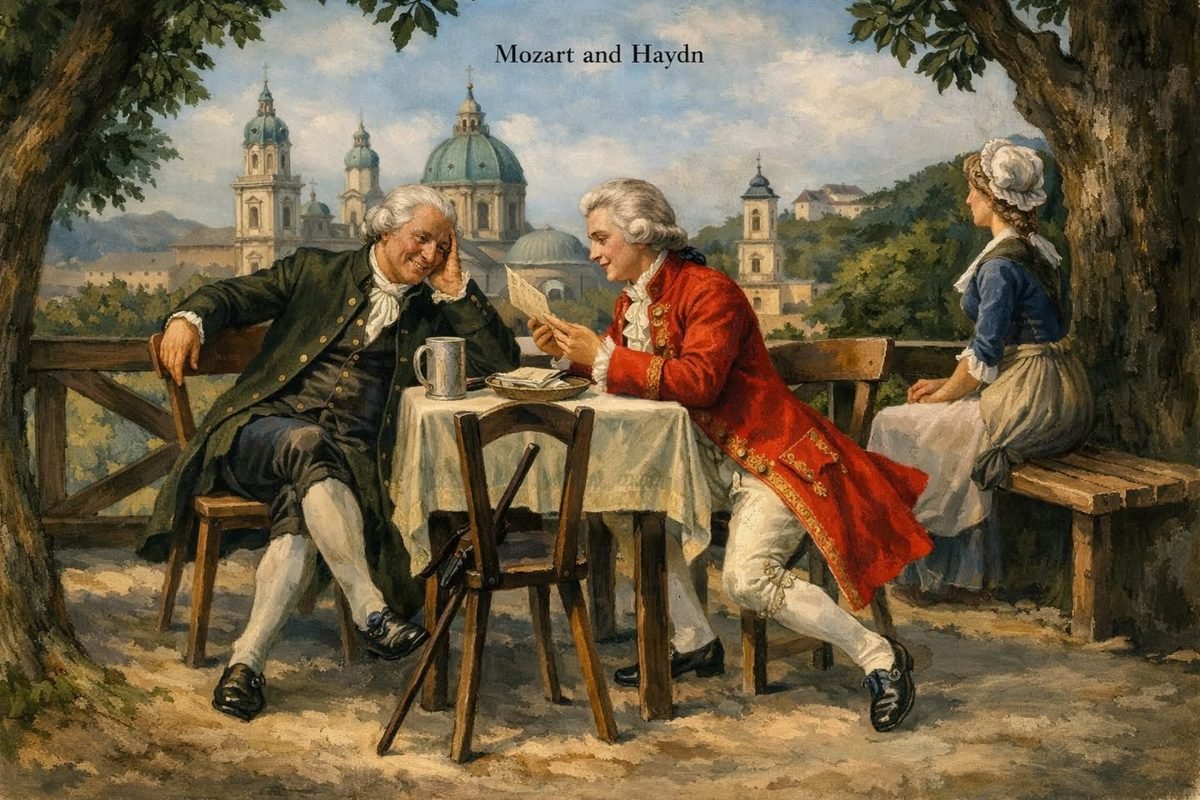
In this second great historical block, the center of gravity shifts from the mature Baroque world toward the age of operatic reform, Viennese Classicism, and the early heroic modernity of Beethoven. Here the relationships between composers become even more psychologically rich and historically decisive. We no longer see only the birth of styles, but also the emergence of artistic self-consciousness, rivalry before the public, aesthetic polemic, and the growing sense of the composer as a major intellectual force rather than merely a servant of church or court.
This was the era in which opera was transformed, instrumental music acquired new prestige, Vienna became the symbolic capital of musical Europe, and the balance between tradition and innovation became newly dramatic. The figures in this section are linked not simply by chronology, but by a common historical process: the transformation of music from aristocratic art into one of the great languages of modern European civilization.
CHRISTOPH WILLIBALD GLUCK AND RANIERI DE’ CALZABIGI
The partnership between Christoph Willibald Gluck (1714–1787) and Ranieri de’ Calzabigi (1714–1795) was one of the most consequential composer-librettist collaborations in the entire history of opera. Their association, especially in the 1760s, belongs to that rare category of artistic alliances in which two minds meet not merely to produce successful works, but to challenge and redirect the course of a whole genre.
By the middle of the eighteenth century, Italian opera seria had reached a point of great refinement but also of deep convention. Vocal brilliance often overshadowed dramatic truth. Formal symmetry, da capo arias, and star singer culture could fragment theatrical continuity. Gluck and Calzabigi were among those who believed that opera had lost contact with its own dramatic essence. Their aim was not to destroy beauty, but to restore truth, unity, expressive necessity, and dramatic coherence.
Calzabigi was crucial because he was far more than a librettist in the narrow sense. He shared Gluck’s reforming ambition and knew that musical reform required poetic reform as well. The text had to become more direct, more concentrated, less subservient to decorative convention. The collaboration reached its most famous embodiment in Orfeo ed Euridice (1762), followed by Alceste (1767) and Paride ed Elena (1770). These works rejected many older excesses and sought a new equilibrium between aria, chorus, orchestra, dance, and dramatic flow.
The consequences for Western music were immense. With Gluck and Calzabigi, opera moved toward a new ideal in which music served drama rather than vanity, and where expressive simplicity could have greater force than ornamental display. Their reforms did not eliminate all earlier practices, nor did later composers follow them slavishly. But they permanently altered expectations. Without them, the path to Mozart’s mature operas, to later French opera, and even to aspects of Wagnerian music drama would have been different. This was one of the great moments when a genre rediscovered its moral and dramatic center.
CHRISTOPH WILLIBALD GLUCK AND NICCOLÒ PICCINNI
The relationship between Gluck and Niccolò Piccinni (1728–1800) is one of the most revealing rivalries in eighteenth-century music, though it was in large part manufactured and intensified by factions, critics, and social camps rather than by simple personal hatred. In Paris during the 1770s, particularly after 1776, musical life became polarized between supporters of Gluck and supporters of Piccinni, producing one of the great aesthetic battles of the age.
The issue was much larger than two men. It concerned different conceptions of opera, different national sensibilities, and different understandings of dramatic music. Gluck represented, to his admirers, reform, nobility, severity, and expressive truth. Piccinni, though much subtler than his enemies allowed, became the figure around whom defenders of Italian melodic grace and older operatic pleasures could rally. The so-called Gluckists and Piccinnists turned musical taste into public combat.
What makes this rivalry historically important is that it shows opera becoming an arena of ideology. Musical style was no longer merely discussed within courts or among professionals; it became part of public cultural identity. Audiences, pamphleteers, aristocrats, and intellectuals treated opera almost as a battlefield of civilization. The composers themselves were in some sense drawn into a struggle larger than either had chosen.
The consequences were profound. Parisian opera in the late eighteenth century was forced to confront basic questions: Should music privilege declamatory truth or melodic charm? National dignity or cosmopolitan flexibility? Reform or continuity? In reality, the future absorbed elements of both camps. But the confrontation itself sharpened aesthetic awareness and gave opera criticism a new seriousness. In this sense, the Gluck–Piccinni rivalry helped create the modern idea of music as a subject of public intellectual debate.
JOSEPH HAYDN AND NICOLA PORPORA
Before Haydn became the great elder of Viennese Classicism, he was a struggling young musician trying to educate himself through practical contact with experienced masters. One of the most important of these figures was Nicola Porpora (1686–1768), the celebrated Italian composer and teacher, with whom Haydn worked in Vienna during the 1750s. This relationship is one of the clearest examples of how a future genius may be formed not only by inspiration, but by hard apprenticeship, service, and observation.
Haydn later recalled that he learned from Porpora the true foundations of composition. The relationship was not sentimental. Haydn served him as accompanist, assistant, and something close to a musical factotum. Yet precisely in this rather humble arrangement lay its importance. Porpora embodied the high Italian vocal tradition, and through contact with him Haydn deepened his understanding of singing line, formal clarity, style, and compositional discipline.
This mattered because Haydn’s greatness did not arise from isolated instinct alone. He had enormous originality, but he also possessed the practical intelligence to absorb what older masters could teach him. Porpora’s world was in many ways different from the one Haydn would later dominate, but it gave him tools that remained vital throughout his career: an understanding of how phrases breathe, how form supports expression, and how technique underlies freedom.
The long-term consequence is that one of the fathers of the symphony and string quartet was partly formed by a master rooted in earlier Italian vocal culture. This reminds us that musical revolutions are often built on unexpected continuities. Haydn’s later instrumental genius was nourished, at least in part, by lessons learned in the orbit of operatic tradition.
JOSEPH HAYDN AND WOLFGANG AMADEUS MOZART
The friendship between Joseph Haydn (1732–1809) and Wolfgang Amadeus Mozart (1756–1791) is one of the most beautiful and historically significant relationships in all music. In Vienna during the 1780s, two men of radically different temperament, age, and social disposition recognized one another as equals in genius. What emerged was not a myth of succession imposed later, but a genuine bond of admiration and artistic stimulation.
Haydn, older by nearly a quarter-century, had already transformed instrumental music through the symphony and the string quartet. Mozart, younger, more mercurial, more dramatic in temperament, arrived in Vienna and found before him not merely a famous elder, but a composer whose mastery of structure, wit, and developmental logic he deeply respected. Haydn, in turn, recognized in Mozart an extraordinary combination of beauty, depth, and expressive range. Their famous quartet evenings, in which they played chamber music together, have become emblematic because they express something rare in history: greatness recognizing greatness without envy destroying it.
The influence moved in both directions. Mozart learned immeasurably from Haydn’s treatment of thematic development, motivic economy, and quartet writing. The six quartets he dedicated to Haydn are among the supreme monuments of friendship in art: they are both homage and transformation. Yet Haydn also learned from Mozart, especially in matters of harmonic daring, emotional depth, lyric intensity, and the expansion of formal space through dramatic tension. After knowing Mozart, Haydn’s later works gained a new richness and seriousness.
The consequences for Western music were decisive. This relationship crystallized the high Classical style at its noblest level. Through their mutual influence, the symphony and string quartet became more profound, more flexible, and more humanly expressive. Their friendship stands as proof that artistic history is not driven only by rivalry or struggle, but also by mutual illumination. Few relationships did more to shape the inner character of Viennese Classicism.
WOLFGANG AMADEUS MOZART AND JOHANN CHRISTIAN BACH
Among the earliest and most decisive encounters in Mozart’s life was his contact in London, during 1764–1765, with Johann Christian Bach (1735–1782), the so-called “London Bach.” This relationship belongs to Mozart’s childhood, but its consequences lasted throughout his life. If Haydn became Mozart’s great mature counterpart, J.C. Bach was one of his earliest major models.
The significance of this encounter lies partly in chronology. Mozart was still a child, extraordinarily gifted but still absorbent, when he encountered J.C. Bach’s music and personality. Johann Christian represented a style very different from the learned contrapuntal density associated with his father, J.S. Bach. His music was elegant, lucid, melodically graceful, and socially polished. It embodied a modern galant world in which texture was lighter, phrases clearer, and expressive effect more immediately accessible.
Mozart responded deeply to this style. In J.C. Bach he encountered not only compositional grace, but also the figure of a cosmopolitan composer-pianist thriving in public life. The influence can be heard in Mozart’s early symphonies, concertos, and keyboard writing, and more generally in his instinct for melodic nobility combined with formal clarity. Yet Mozart did not remain simply a disciple. What he absorbed from J.C. Bach he later enriched with greater harmonic depth, contrapuntal command, and emotional complexity.
The consequence for Western music is that one of the supreme masters of the Classical style was shaped in part by one of its most elegant early representatives. Through this relationship, Mozart entered the mainstream of modern European taste while still a child. It was one of those formative encounters in which a future genius recognizes, almost instinctively, a language he can transform into something greater.
WOLFGANG AMADEUS MOZART AND MUZIO CLEMENTI
The meeting between Mozart and Muzio Clementi (1752–1832) in Vienna in 1781, at the court of Emperor Joseph II, has become one of the most famous keyboard encounters of the Classical era. It was, in essence, a public contest of virtuosity and invention, staged within an aristocratic context that delighted in comparing reputations. Yet beyond the anecdotal charm of a “duel,” the episode reveals much about the musical values and personalities of the time.
Mozart and Clementi represented two different but overlapping worlds of pianism. Clementi was a formidable virtuoso, brilliant, technically advanced, and strongly associated with keyboard display and craftsmanship. Mozart, though also a dazzling player, united virtuosity with a more fluid lyric instinct and a dramatic imagination that went beyond keyboard mechanics. Their contest therefore symbolized two ideals of performance: one more sharply technical and public, the other more all-embracing in expressive sophistication.
The relationship afterward was marked by mixed feelings. Mozart’s private comments on Clementi were often sharp, sometimes unfair, and tinged with competitiveness. Clementi, for his part, seems to have regarded Mozart with admiration. Yet their connection did not end with the contest. Certain thematic resemblances between their works later fed debates about influence and borrowing, though such issues must be handled carefully. What matters more historically is that they stood before Europe as two leading figures in the rise of the modern piano tradition.
The consequence was not a simple victory of one over the other. Rather, the encounter dramatized the growing prestige of the keyboard virtuoso in public life. It showed that by the 1780s, composers were increasingly judged not only by their scores but by their personal performance identities. In that sense, the Mozart–Clementi meeting belongs to the prehistory of the nineteenth-century cult of the virtuoso.
WOLFGANG AMADEUS MOZART AND ANTONIO SALIERI
Few relationships in music history have been so distorted by legend as that between Mozart and Antonio Salieri (1750–1825). Posterity, especially through literature and film, transformed their coexistence into a melodrama of murderous envy. The historical reality is more subtle, more human, and in many ways more interesting. They were professional contemporaries in Vienna during the 1780s and early 1790s, moving within the same operatic and courtly world, at times in competition, at times in mutual acknowledgment.
Salieri was not a mediocrity threatened by genius. He was a highly respected composer, especially in opera, with strong court position and international prestige. Mozart, younger and in many ways more volatile, found himself in a cultural environment where patronage, taste, and access to opportunities were shaped by complex social forces. It is unsurprising that he sometimes felt frustrated and suspicious. But the notion of a simple personal conspiracy against him is not supported by the evidence.
What makes this relationship historically important is precisely its complexity. Vienna was a crowded and competitive musical city. Composers did not exist in isolation; they navigated institutions, court favor, theatrical politics, singers, publishers, and public taste. Mozart and Salieri were sometimes rivals because the world made them so. Yet there were also signs of professional respect. Salieri later taught Mozart’s son and conducted or supported works connected with Mozart’s legacy. The simplistic myth collapses under scrutiny.
The consequence of examining this relationship properly is that it restores to history a more truthful picture of the Classical musical world. It reminds us that genius does not move through a vacuum of pure art, but through a dense field of ambition, prestige, misunderstanding, and occasional respect. Mozart and Salieri together illuminate the social reality of musical life in Vienna, which is far richer than the later myth.
WOLFGANG AMADEUS MOZART AND LORENZO DA PONTE
The collaboration between Mozart and Lorenzo Da Ponte (1749–1838) is one of the supreme composer-librettist partnerships in the history of opera. Their three great collaborations — Le nozze di Figaro (1786), Don Giovanni (1787), and Così fan tutte (1790) — are not merely masterpieces taken one by one. Together they represent one of the most astonishing convergences of music, theatre, psychology, wit, and social intelligence ever achieved.
Da Ponte was not simply a clever man of letters. He possessed an exceptional instinct for theatrical construction, characterization, and verbal fluidity. Mozart, in turn, had an unmatched power to transform text into living drama. The circumstances of their collaboration were ideal in one sense and precarious in another: they worked within the operatic institutions of Vienna and Prague, under conditions of negotiation, censorship, performance pressure, and the unpredictable realities of theatre. Yet from this environment they created works of extraordinary depth.
What made the partnership so fruitful was the complementarity of their gifts. Da Ponte provided plots and language of elasticity, irony, sensuality, and ambiguity. Mozart penetrated those texts and gave each character musical individuality of miraculous precision. The result was opera no longer as a sequence of beautiful numbers alone, but as a world of human beings made musically alive from within.
The consequence for Western music was immeasurable. With Mozart and Da Ponte, opera buffa and dramma giocoso reached a level of psychological and structural richness that became a permanent standard. Their works transformed the relation between comedy and seriousness, ensemble and individuality, theatrical movement and musical form. This was not just successful collaboration; it was one of the summits of civilization in music drama.
LUDWIG VAN BEETHOVEN AND WOLFGANG AMADEUS MOZART
The possible meeting between Ludwig van Beethoven (1770–1827) and Mozart in Vienna in 1787 belongs partly to history and partly to legend, yet it remains one of the most symbolically charged episodes in Western music. The evidence does not allow absolute certainty in every detail, but the tradition that Beethoven visited Vienna, played for Mozart, and made a deep impression is deeply rooted and historically plausible.
What makes this episode so important is not merely whether every anecdotal detail is exact, but what it represents. Beethoven, still a young man from Bonn, stood at the threshold of the greatest musical center in Europe. Mozart was already one of the leading creative spirits of the age. A meeting between them would have brought into contact two energies of different generations: the supreme lyrical-dramatic genius of Classical maturity and the future heroic transformer of musical form.
The story that Mozart, after hearing Beethoven, predicted a great future for him has become famous because it captures something essential, even if phrased later with embellishment. Beethoven’s early development plainly shows the impact of the Mozartian world, especially in piano concertos, chamber music, and certain aspects of operatic and dramatic instinct. But Beethoven would not remain within Mozart’s orbit. He would take Classical forms and invest them with unprecedented weight, conflict, and existential seriousness.
The consequence of this near-mythic encounter is therefore historical even beyond strict documentation. It has come to symbolize the handover from one era to another: Mozart as culmination, Beethoven as expansion and rupture. Whether brief or partly legendary, the episode expresses a truth about musical succession that Europe itself came to feel very strongly.
LUDWIG VAN BEETHOVEN AND JOSEPH HAYDN
The relationship between Beethoven and Haydn is one of the most important, tense, and historically productive teacher-pupil relationships in music. Their connection began when Beethoven met Haydn in 1790, and it took on full significance after Beethoven moved to Vienna in 1792 to study with him. On paper, this appears to be the perfect transmission of authority: the greatest living master of Viennese Classicism guiding the most promising young composer of the next generation. In reality, the relationship was more difficult, more ambivalent, and therefore more revealing.
Haydn brought to Beethoven incomparable prestige, experience, and formal mastery. To study with Haydn meant entering the highest lineage of the age. Yet Beethoven was not an easy pupil. Intensely self-willed, suspicious of condescension, and conscious of his own gifts, he could not simply submit. Haydn, for his part, was often traveling, heavily occupied, and perhaps not always ideally suited to Beethoven’s temperament or needs. Beethoven later complained that he had learned little from Haydn, though such statements must be read critically and in light of his pride.
The true importance of their relationship lies in the tension between inheritance and resistance. Beethoven unquestionably absorbed from Haydn essential lessons in form, thematic economy, wit, and structural logic. The very ground on which Beethoven later built his more explosive language was largely Classical, and Haydn was one of the chief architects of that ground. But Beethoven also defined himself partly against Haydn. He wanted greater weight, greater intensity, greater seriousness, and a more openly personal rhetoric.
The consequence for Western music was enormous. Through this relationship, the Classical tradition was both transmitted and transformed. Beethoven did not reject Haydn; he passed through him and beyond him. Their uneasy connection therefore marks one of the decisive moments in history: the point at which Classical balance begins to become heroic modern drama.
LUDWIG VAN BEETHOVEN AND JOHANN GEORG ALBRECHTSBERGER
If Haydn represented prestige and broad formal lineage, Johann Georg Albrechtsberger (1736–1809) gave Beethoven something more systematic: rigorous instruction in counterpoint. During the mid-1790s, especially after Beethoven’s dissatisfaction with aspects of his study under Haydn, Albrechtsberger became a crucial teacher.
This relationship is historically important because it shows Beethoven consciously strengthening his technical foundations. Already gifted, already forceful, he nonetheless understood that freedom requires discipline. Albrechtsberger was renowned as a learned teacher, and although Beethoven may not have felt spontaneous affection for every lesson, the training was invaluable. It deepened his grasp of fugal writing, voice-leading, and structural control.
The result was not that Beethoven became a mere academic contrapuntist. Rather, the opposite: by mastering severe technique, he became freer to use it for expressive and architectural ends on a grand scale. The later Beethoven of the great fugues, late sonatas, and Missa solemnis is unimaginable without such grounding.
The consequence is a crucial reminder that revolutionary genius often rests on painstaking study. Beethoven’s later boldness did not float above craft; it was fortified by it.
LUDWIG VAN BEETHOVEN AND ANTONIO SALIERI
Beethoven’s studies with Antonio Salieri during the 1790s, especially in vocal composition and Italian declamation, form another often overlooked but historically meaningful relationship. Salieri, so often remembered only through the shadow of Mozart mythology, was in fact an experienced and highly respected master of theatrical and vocal writing. Beethoven, for all his instrumental force, knew that the art of setting text and shaping vocal line required specialized guidance.
The importance of this connection lies in its practicality. Beethoven was not yet the monumental figure posterity would see; he was a young composer actively seeking instruction from multiple sources. From Salieri he could learn matters of vocal pacing, prosody, and dramatic accent that did not arise automatically from keyboard or symphonic writing. This was especially important in a musical culture where opera and vocal expression still defined artistic prestige.
The consequences can be felt not only in Beethoven’s songs and vocal ensembles but in his broader dramatic instinct. Even when Beethoven’s vocal writing later proved idiosyncratic or difficult, it remained animated by a strong sense that text setting mattered profoundly. The relationship also helps correct simplistic portraits of the Viennese world. Far from being isolated camps of heroes and villains, it was a network of pedagogy and exchange in which even figures later turned into rivals could be valued as teachers.
LUDWIG VAN BEETHOVEN AND JOHANN NEPOMUK HUMMEL
The relationship between Beethoven and Johann Nepomuk Hummel (1778–1837) belongs to that fascinating zone where friendship, rivalry, and mutual artistic awareness overlap. Hummel, a brilliant pianist and composer, had roots in the Mozartian world and represented a more polished, fluent, and socially graceful continuation of Classical pianism. Beethoven, by contrast, increasingly embodied force, originality, and the expansion of expressive scale.
Their relationship evolved over time and was not always free of tension. Yet it is historically important because it shows the piano becoming a central arena of identity in late eighteenth- and early nineteenth-century music. Hummel and Beethoven stood for two divergent but related possibilities: one preserving elegance and brilliance within Classical proportion, the other driving the language toward greater weight and drama.
The consequence is that Beethoven’s uniqueness becomes clearer when set beside figures like Hummel. He was not simply the only talented pianist-composer of his generation; he was the one who pushed beyond shared conventions toward something more disruptive and enduringly transformative.
BEETHOVEN AT THE THRESHOLD OF A NEW AGE
By the end of this second section, the world of music has changed profoundly. With Gluck and Calzabigi, opera seeks truth and reform. With Haydn and Mozart, instrumental music reaches its highest Classical poise and humanity. With Mozart and Da Ponte, opera becomes a living theatre of the soul. With Beethoven’s arrival in Vienna and his contact with Haydn, Salieri, Albrechtsberger, and the Mozartian legacy, music begins to acquire a new center of gravity: the composer as heroic individual, wrestling with inherited forms in order to enlarge them beyond precedent.
This is the point at which the Classical age, without ceasing to be itself, begins to open toward Romanticism. The old ideals of symmetry, decorum, and aristocratic elegance remain, but they are now confronted by stronger subjectivity, deeper conflict, and the growing idea that music can carry the weight of an entire inner world.