15 April 2026
Goethe's Favourite Composers
On Classicapedia: Johann Wolfgang von Goethe, Carl Philipp Emanuel Bach, Wolfgang Amadeus Mozart, Johann Friedrich Reichardt, Carl Friedrich Zelter
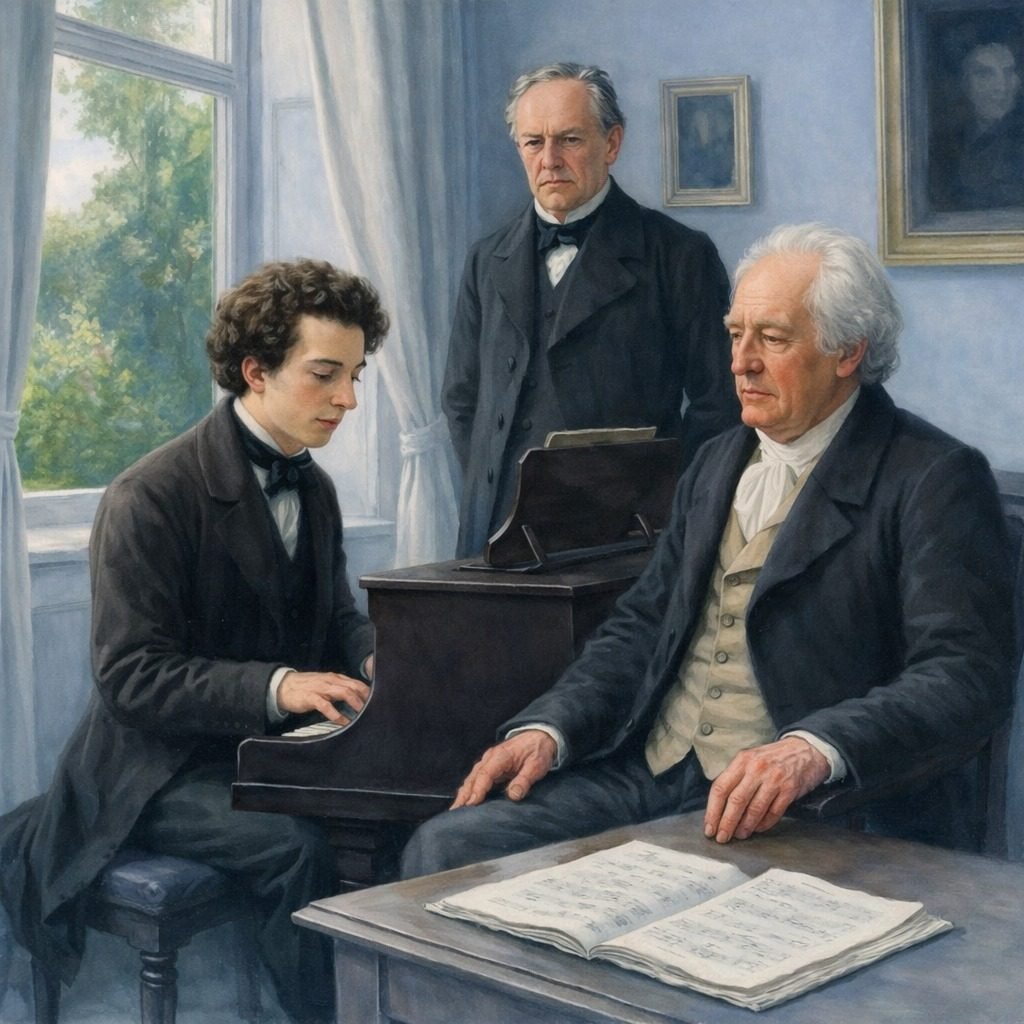
Goethe's Favorite Composers
Johann Wolfgang von Goethe (1749–1832), one of the foundational figures of German literature and a central figure of the Sturm und Drang and Weimar Classicism, was deeply influenced by music and maintained close contact with several leading composers of his time. Below is a detailed, narrative overview of his favorite composers, including dates, locations, and key encounters.
I. Carl Philipp Emanuel Bach (1714–1788)
Intellectual Admiration
Goethe never met C. P. E. Bach in person, but he held him in high intellectual and artistic esteem, especially during his formative years.
While living in Leipzig (1765–1768), Goethe became familiar with Bach’s emotionally charged Empfindsamer Stil, which matched the aesthetic of the early Sturm und Drang movement.
The rhetorical, almost literary expressiveness of C. P. E. Bach’s music deeply impressed the young Goethe and helped shape his own ideas on emotional expression.
II. Wolfgang Amadeus Mozart (1756–1791)
Reverence and Poetic Sympathy
Goethe greatly admired Mozart, whom he considered “a natural genius, like Shakespeare.”
In 1786, Mozart began working on music for Goethe’s drama Egmont, although this project was never completed and would later be famously realized by Beethoven.
Goethe once wrote:
“Mozart understood the German drama better than anyone. He could have elevated it to unimaginable heights.”
In a letter written in 1827, Goethe reflected:
“Mozart was the greatest of all. His music speaks to me as though it were mine.”
III. Johann Friedrich Reichardt (1752–1814)
Composer of Goethe’s Early Poems
Reichardt was among the first composers to set Goethe’s poems to music, including Heidenröslein and Der König in Thule.
They met in Weimar in 1780, and Goethe appreciated Reichardt’s clarity and fidelity to the poetic word.
In his conversations with Eckermann, Goethe acknowledged that Reichardt had captured the poetic spirit of his verses better than anyone else of that period.
IV. Carl Friedrich Zelter (1758–1832)
Goethe’s Closest Musical Confidant
Zelter was Goethe’s most intimate musical friend: they exchanged over 900 letters between 1796 and Goethe’s death in 1832.
Goethe valued Zelter’s classical restraint and critical attitude toward Romantic excesses.
Zelter was the director of the Sing-Akademie in Berlin and later introduced his pupil Felix Mendelssohn to Goethe in 1821, creating one of the most significant musical encounters of Goethe’s late life.
V. Ludwig van Beethoven (1770–1827)
A Complex Admiration and Personal Clash
Beethoven set Goethe’s drama Egmont to music in 1809–1810 (Op. 84), a composition that Goethe praised for its dramatic power.
The two met in Teplitz (Bohemia) in 1812, a meeting that became legendary for its tension:
Goethe was put off by Beethoven’s defiant and unrefined behavior.
Beethoven, in turn, criticized Goethe’s deference to aristocratic formality, writing:
“Goethe delights too much in court circles, more than befits a poet.”
Despite their personal differences, Beethoven revered Goethe as the greatest German poet, and Goethe continued to admire Beethoven’s genius—albeit with reservations.
VI. Felix Mendelssohn Bartholdy (1809–1847)
The Child Prodigy Who Enchanted Goethe
In 1821, Zelter brought the 12-year-old Felix Mendelssohn to visit Goethe in Weimar.
Goethe was astonished by the boy’s brilliance, comparing him to young Mozart:
“This boy is a miracle. What he already understands of music, others do not grasp in a lifetime.”
Mendelssohn played Bach, Mozart, and original compositions for Goethe over several days.
This encounter deeply moved the aging poet and reaffirmed his belief in the power of genius to renew itself across generations.
VII. Christoph Willibald Gluck (1714–1787)
Classical Ideal of Operatic Reform
Though he never met him, Goethe held Gluck in high esteem for his operatic reforms.
Gluck’s Orfeo ed Euridice and Iphigénie operas resonated with Goethe’s ideal of harmony between poetry and music.
Goethe had dreamed of Gluck setting Iphigenie auf Tauris to music, considering him the only composer truly capable of capturing classical drama in music.
VIII. Franz Schubert (1797–1828)
A Missed Opportunity
Goethe and Schubert never met, and Goethe likely never heard Schubert’s Lieder—even though Schubert set over 70 of Goethe’s poems to music.
Among these are Erlkönig, Gretchen am Spinnrade, and Heidenröslein, now considered iconic works of the Lied genre.
Goethe, loyal to Zelter and Reichardt, may have seen Schubert’s harmonic daring and Romantic sentimentality as overly florid, which could explain his silence.
Conclusion
Goethe’s favorite composers reflect his personal aesthetic ideals of clarity, restraint, and emotional nobility. While he respected the revolutionary genius of Mozart and Beethoven, he was far more comfortable with musicians like Zelter and Reichardt, who emphasized textual fidelity and classical proportion.
His final significant musical encounter, with Felix Mendelssohn, was filled with wonder and reverence—a symbolic passing of the torch from Enlightenment to Romanticism.
PAINTING AI: A scene in Weimar, summer 1821: Goethe, elderly and thoughtful, listens to the young Felix Mendelssohn playing piano inside the Goethehaus, with Carl Friedrich Zelter nearby. The room is lit with soft natural light, and a manuscript of poetry and music lies open on the table.