13 May 2026
Giovanni Battista Pergolesi (1710–1736): A Life Between Naples, Comic Opera, Sacred Pathos and an Early Death
On Classicapedia: Giovanni Battista Pergolesi, Alessandro Scarlatti, Francesco Durante, Nicola Porpora, Johann Sebastian Bach
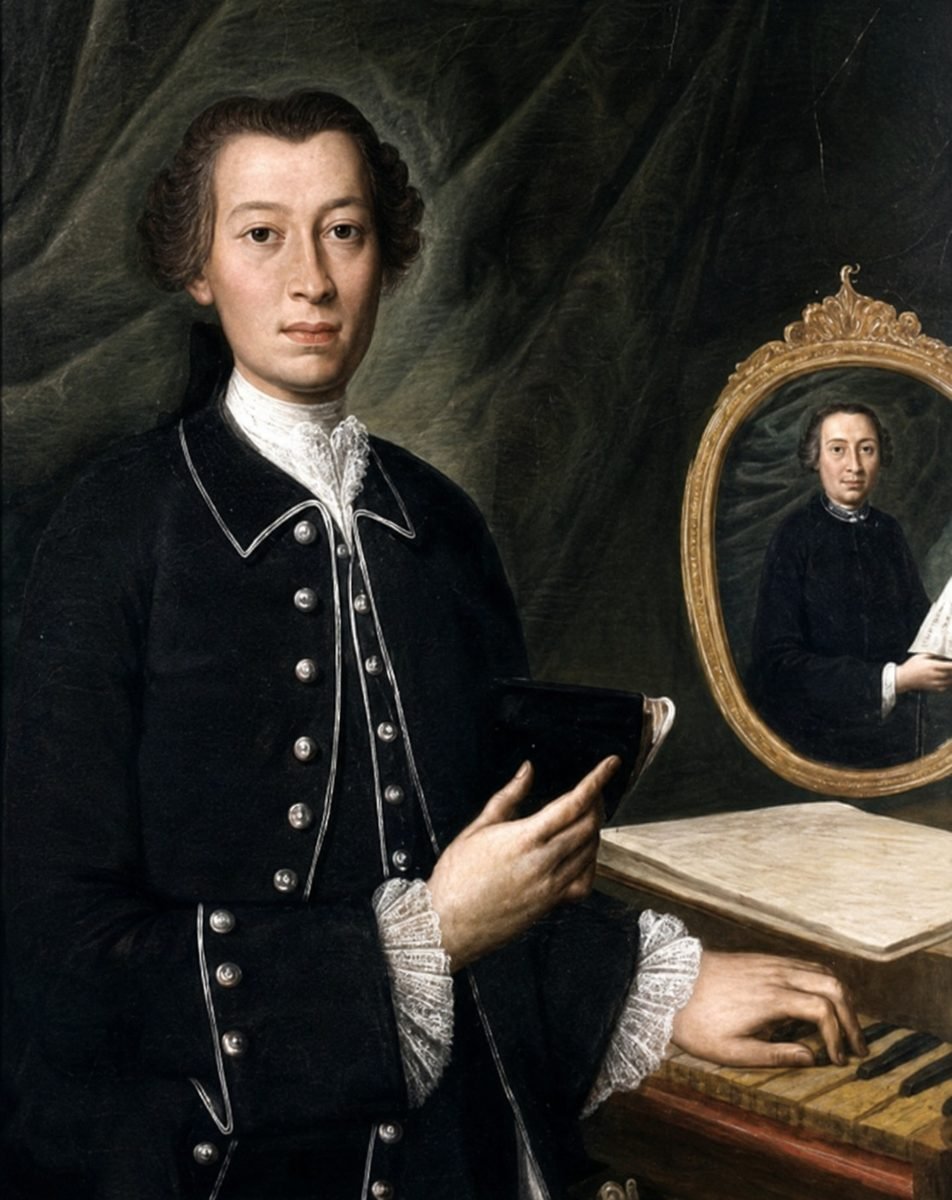
Giovanni Battista Pergolesi (1710–1736): A Life Between Naples, Opera Buffa, Sacred Pathos, and an Early Death
I. A Child of Jesi: 1710–1725
Giovanni Battista Pergolesi was born on 4 January 1710 in Jesi, in the Marche region of central Italy. His family name was originally Draghi, but the family came to be known as Pergolesi because of an ancestral connection with the town of Pergola. This was not unusual in early modern Italy, where family names, local origins, and civic identities often intertwined.
His childhood was marked by fragility. Pergolesi appears to have suffered from poor health from an early age, and later accounts suggest that he may have had a physical deformity or weakness, perhaps connected with tuberculosis or another chronic condition. The details are not always secure, but the broad outline is clear: he was a precocious and physically fragile musician whose life would be short, intense, and artistically decisive.
Jesi was not Naples, Rome, or Venice, but it was not culturally isolated. Italian towns of this period were full of churches, local academies, civic ceremonies, and amateur musical life. A gifted child could be noticed quickly, especially if his talent appeared useful to church and civic institutions. Pergolesi’s early aptitude for music was sufficiently remarkable that he received local support for further study.
His first musical formation probably included violin, composition, singing, and church music. Italy in the early eighteenth century was still a world in which a musician had to be practical. One needed to understand voices, instruments, counterpoint, liturgical function, theatrical style, and the expectations of patrons. Pergolesi would soon receive the kind of training that could turn natural talent into professional mastery.
II. The Neapolitan Training: 1725–1731
Around 1725, Pergolesi was sent to Naples, the city that would shape his entire artistic personality. He entered the Conservatorio dei Poveri di Gesù Cristo, one of the great Neapolitan conservatories. These institutions were not conservatories in the modern bourgeois sense. They were originally charitable establishments, often connected with orphaned or poor children, but by the eighteenth century they had become extraordinarily effective musical training centres.
Naples at this time was one of the most important musical cities in Europe. It was crowded, theatrical, noisy, devotional, aristocratic, popular, and intensely musical. It possessed churches, noble chapels, theatres, conservatories, and an audience hungry for both serious and comic opera. It was the city of Alessandro Scarlatti, Leonardo Leo, Francesco Durante, Nicola Porpora, and Leonardo Vinci. To study there was to enter the workshop of modern Italian opera.
Pergolesi studied under important teachers, including Gaetano Greco, Francesco Durante, and possibly Francesco Feo, though details vary in the sources. What matters most is that he absorbed the essential Neapolitan craft: clear melodic writing, strong bass foundations, vocal fluency, comic timing, sacred counterpoint, and the ability to move quickly between theatre and church.
The young Pergolesi learned not only rules, but dramatic instinct. In Naples, music was not abstract. It had to speak immediately. A comic servant had to sound alive; a noble heroine had to express pathos; a sacred text had to move the listener; an aria had to be memorable after one hearing. This Neapolitan gift for directness, grace, and emotional clarity would become the essence of his style.
By the end of his student years, Pergolesi had become a highly promising composer. He was still very young, but he had already absorbed a complete musical language. His genius lay in making that language seem natural, effortless, humane, and dramatically fresh.
III. The First Stage Works and Early Promise: 1731–1732
Pergolesi’s first important theatrical success came shortly after his training. In 1731, he composed La conversione e morte di San Guglielmo, a sacred drama that already showed his ability to handle religious and theatrical materials. It was probably performed in a student or semi-public context, but it revealed a young composer capable of dramatic structure and expressive vocal writing.
The same year, he completed his studies and entered the professional world. Naples offered opportunity, but also competition. The city was full of composers, singers, librettists, impresarios, churches, and patrons. A young musician had to be quick, adaptable, and socially useful. Pergolesi’s talent helped him gain attention, but his career would unfold under pressure and with little time.
In 1732, he achieved greater visibility with Lo frate ’nnamorato, a comic opera in Neapolitan dialect. This work was significant because it placed Pergolesi in the living world of local comic theatre. Unlike opera seria, with its kings, heroes, and moral dilemmas, comic opera dealt with recognisable people, social tension, disguise, misunderstanding, desire, servants, guardians, and domestic intrigue.
Lo frate ’nnamorato revealed Pergolesi’s natural gift for comedy. His music could make a character breathe. He understood the rhythm of dialogue, the sparkle of ensemble, and the affectionate absurdity of human behaviour. Comic figures in his hands are not merely caricatures; they have warmth, impulse, and musical identity.
This early success placed him among the rising composers of Naples. Yet his career was still precarious. He depended on commissions, patrons, theatrical openings, and the unstable fortunes of the Neapolitan stage. His genius was rapidly recognised, but his life was already moving faster than his body could sustain.
IV. The Earthquake and Sacred Music: 1731–1734
The early 1730s in Naples were marked by public anxiety, religious ceremonies, and civic devotion. After a severe earthquake in 1731, Naples turned strongly toward its patron saint, San Gennaro. Pergolesi was commissioned to write sacred music associated with thanksgiving and protection, including a Mass in D major, often connected with this context.
This sacred side of Pergolesi is essential. He was not merely a composer of light comic opera. Like nearly all major Italian composers of his age, he lived between stage and church. The same city that laughed at comic intermezzi also wept before sacred images, processed relics through the streets, and filled churches with music. Naples was theatrical even in devotion, and devotional even in theatre.
Pergolesi’s sacred music shows a different but related aspect of his genius. He could write with solemnity, clarity, and melodic tenderness. His sacred works are often less monumental than the grand polychoral traditions of earlier centuries, but they possess a direct emotional appeal. The divine is approached not only through splendour, but through touching humanity.
This ability to make sacred music sound intimate would culminate in his final masterpiece, the Stabat Mater. Already in the early 1730s, one senses in Pergolesi a particular relationship between religious expression and human vulnerability. He does not present suffering as distant dogma; he makes it sing in the voice of a fragile human being.
V. Il prigionier superbo and the Birth of a Revolution: 1733
The year 1733 is the most famous year in Pergolesi’s theatrical life. He composed the opera seria Il prigionier superbo, performed in Naples. As a serious opera, it followed the conventions of the time: noble characters, heroic conflicts, elevated emotions, and formal arias. Yet history remembers this production mainly because of the comic intermezzo performed between its acts: La serva padrona.
The intermezzo was a short comic piece inserted between the acts of a serious opera. In theory, it was secondary entertainment, a relief from the gravity of opera seria. In practice, it often became the most vivid and beloved part of the evening. La serva padrona would become one of the most influential comic works in European music.
Its plot is simple. Uberto, an older bachelor, is irritated by his clever servant Serpina, who dominates his household. Serpina wants to become mistress of the house not merely as servant, but as wife. With the help of the silent servant Vespone, she tricks Uberto into marriage. The story is domestic, comic, and socially suggestive: the servant becomes the mistress, intelligence overcomes authority, and household order is overturned by theatrical wit.
Pergolesi’s music makes this small plot irresistible. Serpina is not merely cunning; she is alive, quick, charming, assertive, and musically brilliant. Uberto is pompous but human. The dialogue has pace. The arias reveal personality immediately. The entire work seems to breathe with comic truth.
La serva padrona became a symbol of a new musical naturalness. It did not need gods, heroes, or royal conflicts. It needed only two singing characters, one silent actor, domestic manipulation, and perfect timing. In this small work, Pergolesi helped opera discover the music of everyday human comedy.
VI. The Comic Genius: La serva padrona and Its Musical Language
The greatness of La serva padrona lies not in complexity, but in precision. Pergolesi creates character through rhythm, phrase, register, contrast, and melodic gesture. Serpina’s music is agile, bright, teasing, and commanding. Uberto’s music is more formal, grumbling, and self-important, yet Pergolesi never makes him wholly foolish. The comedy works because both characters are musically convincing.
The score belongs to the emerging world of opera buffa, but it still has the elegance of the Neapolitan school. The melodies are clear, the forms are compact, and the dramatic effect is immediate. The music gives the illusion of speech becoming song naturally. This was one of the great achievements of eighteenth-century comic opera.
What later generations heard in Pergolesi was freshness. Compared with the elaborate conventions of opera seria, La serva padrona seemed direct, truthful, and modern. It suggested that opera could be about ordinary people, not only mythological or historical figures. It showed that laughter could possess musical refinement.
This work would have consequences far beyond Naples. When it was performed in Paris in 1752, long after Pergolesi’s death, it helped ignite the famous Querelle des Bouffons, the dispute between defenders of French opera and admirers of Italian comic opera. Jean-Jacques Rousseau and others praised the naturalness of Italian music against what they perceived as the artificiality of French tradition. Thus Pergolesi, dead for sixteen years, became a posthumous revolutionary in European aesthetics.
VII. The Opera Seria Composer: A More Complex Pergolesi
Because La serva padrona became so famous, Pergolesi is often remembered mainly as a comic composer. This is incomplete. He also wrote opera seria and sacred drama. His serious works reveal a composer deeply engaged with the conventions of noble expression, virtuoso singing, and emotional conflict.
His opera seria Il prigionier superbo, despite being overshadowed by its intermezzo, shows his ability to operate within the serious Neapolitan tradition. Later, in 1735, he composed L’Olimpiade, based on a libretto by Pietro Metastasio, the most influential opera seria librettist of the eighteenth century.
L’Olimpiade belongs to a world of friendship, identity, rivalry, sacrifice, and moral nobility. Pergolesi’s treatment of Metastasian drama reveals his lyrical sensitivity. His serious arias often favour clear melodic line over excessive complexity. He is not always monumental, but he is touching. His heroes and heroines sing with a directness that can make formal convention feel emotionally sincere.
Yet Pergolesi’s serious career did not achieve the lasting public success that might have been expected. His music sometimes seemed too delicate, too inward, or too personally lyrical for the competitive world of opera seria. He lacked the time to develop a long theatrical catalogue. Had he lived another thirty years, his serious operatic style might have evolved in unpredictable ways. Instead, it remains a fragment of promise.
Pergolesi is therefore not merely the composer of a comic masterpiece; he is also a lyrical dramatist of unfulfilled potential.
VIII. Patronage, Naples, and the Professional Young Master: 1733–1735
After his theatrical successes, Pergolesi continued to work in Naples and its surroundings. He served aristocratic patrons and composed for both public and private occasions. Among the important patrons connected with his career was the Prince of Stigliano. Patronage remained essential for a young composer. Public theatre could bring fame, but noble households and church commissions brought protection and income.
Naples in the 1730s was politically and culturally dynamic. In 1734, Charles of Bourbon entered Naples and became king, inaugurating a new period in the city’s history. The change of regime affected musical life, as court structures, celebrations, and patronage networks adapted to the new Bourbon monarchy.
Pergolesi lived through this transition but did not live long enough to benefit fully from the new royal order. The great Teatro di San Carlo, which would become one of the most famous opera houses in Europe, opened only in 1737, one year after his death. This is one of the ironies of his life: he belonged to Naples at the exact moment when its operatic prestige was about to explode across Europe.
His professional life was intense but brief. Commissions arrived, works were produced, and his name spread. But his health deteriorated. The familiar image of Pergolesi as a doomed young genius is partly romantic legend, but it is based on truth: he was indeed a young composer whose creative maturity came almost simultaneously with fatal illness.
IX. The Final Year: 1736
By 1736, Pergolesi’s health had become gravely weakened. He withdrew to Pozzuoli, near Naples, possibly seeking a milder environment and some relief from illness. He was only twenty-six years old. The disease traditionally associated with his death is tuberculosis, though precise medical certainty is impossible at this distance.
It was in this final period that he composed, or completed, his most famous sacred work: the Stabat Mater. The text is a medieval Latin hymn meditating on the suffering of the Virgin Mary at the foot of the Cross. It had been set by many composers, but Pergolesi’s version became one of the most beloved sacred compositions of the eighteenth century.
The circumstances of the commission are connected with a Neapolitan confraternity, the Confraternita dei Cavalieri di San Luigi di Palazzo, which had previously used a Stabat Mater by Alessandro Scarlatti. Pergolesi’s setting was intended to replace or renew that older work. The idea that a dying young composer wrote a meditation on the Mother’s grief has given the piece an almost legendary aura.
One must be careful not to turn biography into sentimental fiction. Yet the emotional proximity between the composer’s final illness and the subject of the Stabat Mater is difficult to ignore. The music does not sound grandly ecclesiastical in an impersonal way. It is tender, clear, sorrowful, and human. It turns theological grief into intimate song.
Pergolesi died on 16 March 1736 in Pozzuoli, aged only twenty-six. His life had lasted less than Mozart’s, less than Schubert’s, less than Bellini’s. Yet his posthumous influence was immense.
X. The Stabat Mater: Sacred Grief as Human Song
Pergolesi’s Stabat Mater is scored for soprano, alto, strings, and continuo. Its modest forces are crucial to its effect. This is not a vast public monument; it is a work of concentrated devotional emotion. The two voices often seem to embody not operatic characters, but states of compassion, prayer, and sorrow.
The opening, Stabat Mater dolorosa, is one of the most touching beginnings in eighteenth-century sacred music. Suspensions, sighing figures, and gentle dissonances create a world of restrained suffering. The grief is not theatrical in the vulgar sense; it is shaped, purified, and made luminous.
Pergolesi’s genius lies in emotional simplicity that is never simplistic. The melodic lines are direct, but they carry intense feeling. The harmonies are clear, but their dissonances wound gently. The texture is transparent, but never empty. The work is devotional, but it speaks to human sorrow beyond doctrine.
The Stabat Mater spread rapidly across Europe. It was copied, performed, adapted, and admired. Johann Sebastian Bach himself adapted music from it in his German paraphrase Tilge, Höchster, meine Sünden, BWV 1083. That a Lutheran master of Bach’s stature would rework Pergolesi’s Catholic devotional music shows the extraordinary reach of the piece.
In the eighteenth century, many listeners regarded Pergolesi’s Stabat Mater as the perfect union of piety and feeling. Later critics sometimes found it too operatic for church use, but that very quality explains its power. Pergolesi writes sacred music with the expressive immediacy of the theatre, but without losing reverence. He makes sacred pity sing in a human voice.
XI. The Posthumous Myth: Genius, Youth, and Attribution
Pergolesi’s early death created a powerful myth. Like Mozart, Schubert, Chopin, and Bellini after him, he became associated with the idea of brief life and pure genius. The combination of comic freshness, sacred tenderness, and death at twenty-six made him irresistible to later generations.
But fame brought a problem: many works were falsely attributed to him. Because his name became prestigious, publishers and copyists attached it to compositions he had not written. The so-called Pergolesi catalogue became inflated by doubtful and spurious pieces. This phenomenon was common in the eighteenth century, but especially strong in his case because his reputation grew after his death.
Modern scholarship has had to separate authentic works from false attributions. Some music once beloved as “Pergolesi” is no longer accepted as his. This does not diminish his stature; rather, it clarifies it. The authentic Pergolesi is not a vast composer like Alessandro Scarlatti or Handel. He is a concentrated one. His genuine legacy is relatively small, but its historical importance is enormous.
The myth of Pergolesi also affected style. He came to represent naturalness, melodic grace, and emotional truth. In France, especially after 1752, his name became a weapon in debates about music. For supporters of Italian opera, Pergolesi was proof that music should be simple, expressive, direct, and close to speech. For defenders of French tradition, he represented a dangerous foreign taste. Thus Pergolesi, who lived a short life in Italy, became a posthumous central figure in European aesthetic controversy.
XII. The Querelle des Bouffons: 1752 and the French Debate
In 1752, an Italian opera troupe performed La serva padrona in Paris. The work’s impact was explosive. It became the centre of the Querelle des Bouffons, a fierce dispute over the relative merits of Italian and French opera.
The argument was not merely musical. It touched language, national taste, social order, philosophy, and the meaning of nature in art. Supporters of Italian opera praised its melody, clarity, emotional immediacy, and comic vitality. They found in Pergolesi a music that seemed spontaneous and human. Supporters of French opera defended the grandeur, declamation, dance, and theatrical tradition of Lully and Rameau.
Jean-Jacques Rousseau became one of the most famous defenders of Italian musical naturalness. He admired music that appeared to follow speech, feeling, and melody rather than elaborate convention. Pergolesi’s little intermezzo thus became associated with Enlightenment ideas about nature, expression, and simplicity.
This was a remarkable destiny for a short comic work originally performed between the acts of a serious opera in Naples. In Paris, it became a cultural symbol. It helped prepare the way for later developments in opéra comique, comic opera, and debates about musical truth. Pergolesi’s art showed that lightness could be revolutionary.
XIII. Pergolesi’s Style: Clarity, Grace, and Expressive Truth
Pergolesi’s music stands at a delicate historical threshold. He belongs to the late Baroque and the early galant world. He inherited the Neapolitan tradition of recitative, aria, comic timing, and sacred pathos, but he brought to it a special clarity and tenderness.
His melodies are often short, memorable, and shaped with extraordinary naturalness. He does not overwhelm the listener with complexity. Instead, he creates phrases that seem inevitable. This quality is especially important in comic music, where timing and recognisability matter. A character must be understood immediately. Pergolesi achieves this through rhythm and contour.
His harmony is generally clear, but he uses dissonance with great sensitivity. In sacred music, suspensions and appoggiaturas become sighs. In comic music, rhythmic turns and repeated figures create personality. In serious music, expressive intervals and melodic curves intensify noble feeling.
His textures are transparent. This transparency allowed later listeners to hear him as “natural.” But naturalness in Pergolesi is an art, not an absence of art. It is the result of discipline, training, and theatrical instinct. He knew how to make a complex musical language sound as if it were simply the direct voice of feeling.
This is why he had such influence. His music seemed to open a path away from heavy formalism and toward immediacy. It anticipated aspects of the galant style, the expressive simplicity of mid-eighteenth-century vocal music, and the comic realism that would eventually nourish Mozart’s opera buffa.
XIV. Major Works and Genres
Pergolesi’s authentic catalogue is not very large, but it is historically rich. His best-known works belong to three main areas: comic theatre, serious opera, and sacred music.
In comic theatre, La serva padrona remains the central work. It is one of the foundational masterpieces of opera buffa and one of the most influential short operas ever written. Lo frate ’nnamorato also deserves attention as a fuller example of Neapolitan comic opera in dialect.
In serious opera, Il prigionier superbo and L’Olimpiade show Pergolesi’s relationship to opera seria. They reveal a composer of lyrical grace and dramatic promise, even if his serious operatic career was cut short before full maturity.
In sacred music, the Stabat Mater is his supreme achievement. Other sacred works, including masses, psalm settings, and devotional pieces, also show the breadth of his religious output. His sacred style combines Neapolitan clarity with emotional intimacy.
Some instrumental works and concertos have been attributed to him, though questions of authenticity remain in parts of the catalogue. The problem of spurious attribution is central to Pergolesi reception. Because his name became famous, music by others was often circulated under his name. Modern understanding of Pergolesi therefore depends on careful distinction between legend and evidence.
XV. A Final Portrait
Giovanni Battista Pergolesi lived only from 1710 to 1736, yet his historical presence is astonishingly large. He did not found a long school through decades of teaching. He did not produce a vast body of operas like Alessandro Scarlatti. He did not live to become an old master. Instead, he became something rarer: a composer whose few decisive works changed the direction of European taste.
He represents Naples at a moment of transformation. Through him, opera buffa gained new sharpness and charm. Through him, sacred music gained a voice of intimate tenderness. Through him, the galant style found one of its most persuasive early expressions.
There is a poignant contrast at the heart of Pergolesi’s life. His comic music is full of vitality, mischief, and social intelligence. His sacred music is full of sorrow, compassion, and mortality. One side laughs at human vanity; the other contemplates suffering at the foot of the Cross. Between Serpina’s clever triumph and the Virgin’s grief in the Stabat Mater, Pergolesi gives us two extremes of human experience: life as comedy, and life as pity.
He died before reaching twenty-seven. Yet after his death, Paris argued over him, Bach adapted him, copyists exploited his name, and generations of listeners heard in him a special purity of expression. His music is not large in scale, but it is unforgettable in profile.
Pergolesi remains one of the great young geniuses of music history: a composer who combined Neapolitan wit, Italian melody, sacred tenderness, and a delicate sense of human truth.