13 May 2026
Alessandro Scarlatti (1660–1725): Between Opera, Devotion, Naples, Rome and the Birth of a New Musical Language
On Classicapedia: Alessandro Scarlatti, Domenico Scarlatti, Pietro Ottoboni, Nicola Porpora
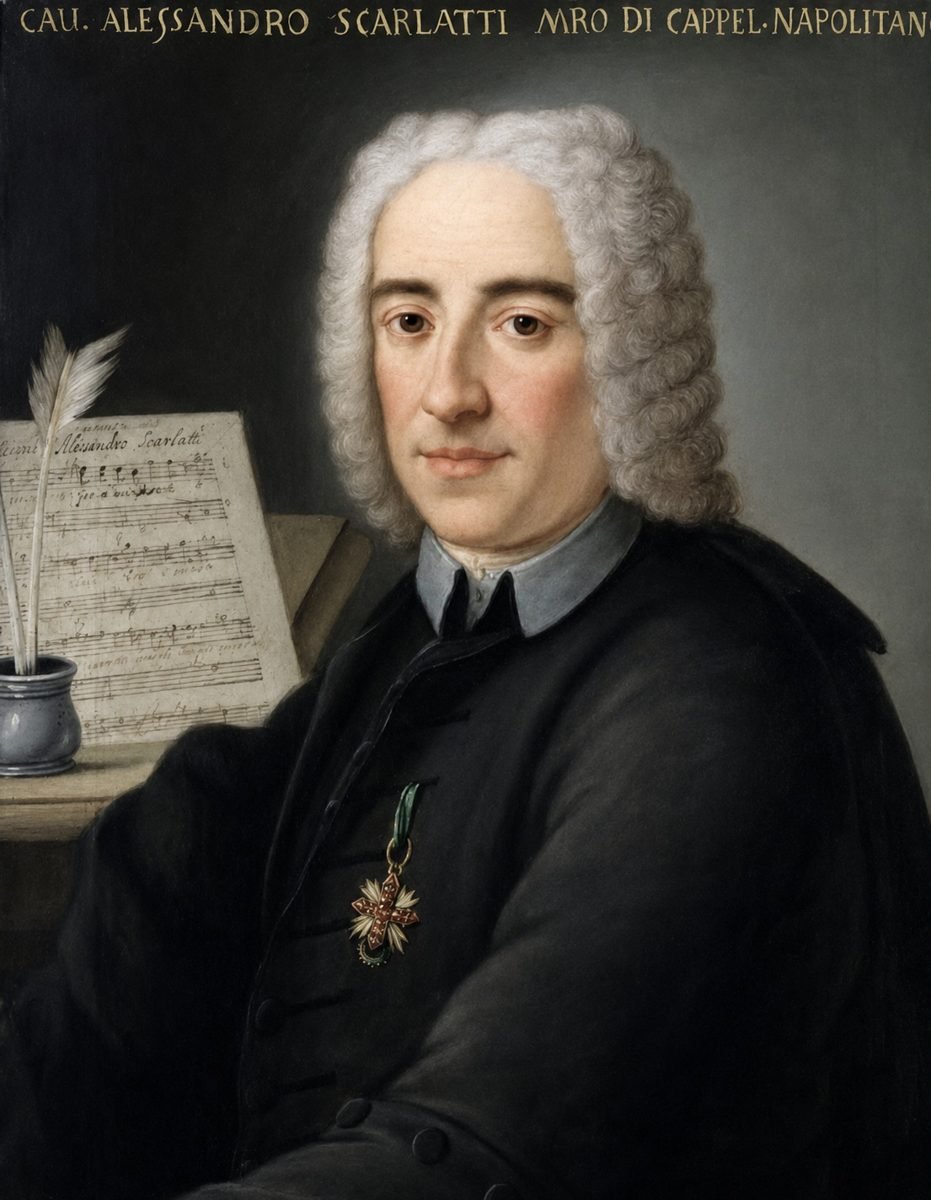
Alessandro Scarlatti (1660–1725): A Life Between Opera, Devotion, Naples, Rome, and the Birth of a New Musical Language
I. Origins in Sicily and the Young Composer: 1660–c.1678
Alessandro Scarlatti was born on 2 May 1660 in Palermo, Sicily, into a world still governed by Spanish power, Catholic ceremony, aristocratic patronage, and the theatrical splendour of the Italian Baroque. Sicily was not a marginal cultural territory: it was a crossroads of Mediterranean influences, Spanish administration, ecclesiastical magnificence, and Italian artistic tradition. Yet Scarlatti’s destiny would not be confined to Palermo. His musical life would unfold mainly in Rome and Naples, two of the most decisive centres of late seventeenth-century music.
The details of his earliest training remain uncertain, but the speed with which he entered the professional musical world suggests an exceptionally gifted youth. By his late teens he was already active in Rome, where his talent attracted attention among aristocratic and ecclesiastical patrons. This was the Rome of cardinals, academies, noble households, oratorios, cantatas, and theatrical restrictions. Public opera was frequently subject to moral and papal limitations, but musical drama found other forms: private performances, sacred dramas, serenatas, and chamber cantatas.
From the beginning, Scarlatti’s genius was connected with the human voice. He possessed an instinct for melodic declamation, dramatic pacing, and emotional contrast. His art would become one of the great foundations of the Neapolitan operatic school, but it was also nourished by Rome’s refined culture of sacred and chamber music. In him, Sicily gave way to Rome, Rome opened toward Naples, and Naples transformed him into one of the central architects of Italian opera.
II. Rome and the First Operatic Successes: c.1678–1684
Scarlatti’s first major period of activity was in Rome, where he was still very young when he began to achieve recognition. His early opera Gli equivoci nel sembiante, performed in 1679, is often considered the work that announced him as a composer of real dramatic promise. The opera was associated with the circle of Queen Christina of Sweden, the extraordinary former queen who had abdicated, converted to Catholicism, and settled in Rome as one of the great patrons of music, theatre, literature, and intellectual life.
Christina’s Roman court was one of the most fascinating artistic environments of the age. It was aristocratic, cosmopolitan, theatrical, and intellectually ambitious. To receive encouragement there was not merely a matter of employment; it meant entry into a world where music was cultivated as a noble art. Scarlatti’s association with this milieu helped shape his early career and gave him access to the kind of refined audience that valued expressive subtlety as much as spectacle.
In 1680, he became maestro di cappella at San Girolamo della Carità in Rome. This appointment placed him in a respected ecclesiastical context and confirmed the double nature of his career: Scarlatti was never only an opera composer. He was also a church musician, a composer of sacred works, and a master of devotional expression.
Rome taught him discipline. Its musical world required adaptability: one had to write for noble salons, churches, academies, private theatres, and religious institutions. From this environment Scarlatti developed the extraordinary flexibility that would characterize his mature style. He could write arias of elegant love, laments of grave nobility, sacred choruses, oratorios, cantatas, and theatrical scenes with equal assurance.
III. The Move to Naples: 1684 and the Beginning of a Great Career
The year 1684 was decisive. Scarlatti moved to Naples, where he became maestro di cappella to the Spanish viceroy. Naples was then one of the largest cities in Europe, a capital of enormous energy, wealth, poverty, theatrical appetite, religious intensity, and musical ambition. It was under Spanish rule, but culturally Italian and increasingly central to the development of opera.
Naples gave Scarlatti something that Rome could not always give him: a powerful operatic environment with sustained institutional support. The city’s theatres, churches, conservatories, and noble circles created the conditions for a new musical language. Over time, Naples would become the great engine of eighteenth-century Italian opera, and Scarlatti stands at the beginning of that transformation.
His appointment in Naples was a sign of prestige, but it also came with responsibilities. He had to compose for the court, supervise music, provide sacred works, and supply operas and occasional pieces. In this demanding environment, his style matured quickly. He became increasingly associated with a new clarity of dramatic form: sharply characterized recitative, arias that crystallized emotional states, orchestral introductions, and a growing preference for formal balance.
Scarlatti did not invent all these elements alone, but he organized them with exceptional authority. He helped establish the model of Italian opera seria before opera seria had fully become the codified genre of the eighteenth century. In Scarlatti, the Baroque drama begins to move toward the more ordered, aria-centred, vocally brilliant opera of the eighteenth century.
IV. Naples as a Musical Laboratory: 1684–1702
During his first long Neapolitan period, from 1684 to 1702, Scarlatti produced an extraordinary quantity of music. He composed operas, serenatas, cantatas, oratorios, sacred works, and court pieces. The exact number of his operas is difficult to determine, but he is traditionally credited with well over one hundred stage works, though not all survive complete. Even allowing for uncertainties, the scale of his output is astonishing.
The Neapolitan theatre demanded speed, practicality, and dramatic effectiveness. Scarlatti responded by refining musical forms that could carry emotion clearly. His recitatives became vehicles of narrative and psychological motion, while his arias often isolated a single affect—rage, tenderness, jealousy, triumph, grief, fidelity, or despair—and gave it a memorable musical shape.
One of the most important formal tendencies associated with Scarlatti is the development and consolidation of the da capo aria. This form, broadly structured as A–B–A, allowed the singer to present an initial emotional idea, contrast it with a middle section, and then return to the opening material, often with ornamentation. It became the central aria form of opera seria in the early eighteenth century. Scarlatti did not create the form from nothing, but he was one of the composers who gave it dramatic and expressive authority.
He also helped establish the importance of the Italian operatic sinfonia, the orchestral introduction that often preceded an opera. The later history of the symphony is not a simple straight line from Scarlatti to Haydn, but the Italian operatic sinfonia became one of the ancestors of later instrumental forms. In this sense, Scarlatti’s world helped prepare not only the future of opera, but also the future of orchestral music.
His Naples years also placed him within a larger family and pedagogical world. He was the father of Domenico Scarlatti, born in 1685, who would become one of the greatest keyboard composers of the eighteenth century. Alessandro’s influence on Domenico was profound, even though Domenico’s mature keyboard style would develop into something strikingly original, especially during his later years in Portugal and Spain.
V. The Voice as Drama: Scarlatti’s Operatic World
To understand Scarlatti’s importance, one must enter his world of voices. His operas were not built around continuous symphonic development in the later sense. They were built around recitative, aria, contrast, gesture, and affect. Characters reveal themselves by what they sing and by how they move between speech-like recitative and formal aria.
In recitative, Scarlatti could be direct, swift, and dramatically efficient. The plot advances, emotions sharpen, decisions are made, betrayals are discovered, and moral conflicts emerge. In aria, time often stops. A character turns inward and contemplates one ruling emotion. This alternation between dramatic movement and lyrical reflection would become one of the defining principles of eighteenth-century opera.
Scarlatti’s melodic style combines elegance with rhetorical clarity. He understood how a phrase could curve naturally around the Italian language, how a dissonance could intensify a word, how a suspension could prolong emotional pain, and how a rhythmic figure could suggest agitation or nobility. His music does not yet belong to the later galant world, but it already moves toward a clearer, more periodic style than much earlier seventeenth-century opera.
He also wrote for virtuoso singers. The rise of star singers, including castrati and prima donnas, was transforming opera. Scarlatti’s arias gave such performers opportunities for brilliance, but he was not merely interested in display. At his best, bravura becomes drama, and virtuosity becomes a language of passion.
VI. The Cantata: A Private Theatre of the Soul
Although Scarlatti is famous as an opera composer, one of his greatest achievements lies in the chamber cantata. He composed hundreds of Italian cantatas, usually for solo voice and continuo, sometimes with additional instruments. These works were performed in aristocratic salons, academies, and private gatherings, where cultivated listeners appreciated poetry, vocal refinement, and emotional nuance.
The cantata was, in many ways, a miniature opera without stage decoration. A shepherd laments, a lover complains, a soul struggles, a mythological figure reflects, or an abandoned woman sings of betrayal. Within a small musical frame, Scarlatti could create intense psychological worlds.
His cantatas often alternate recitative and aria, just like opera, but their intimacy allows for greater concentration. The listener is not distracted by scenery or public spectacle. Everything depends on the voice, the poetry, the harmonic turn, the expressive pause. In this genre Scarlatti refined the art of emotional rhetoric to a high degree.
The cantatas also show his connection with literary culture. The texts may seem conventional—love, fidelity, cruelty, pastoral suffering—but Scarlatti gives them musical seriousness. A sigh becomes a suspension; a word of pain bends the harmony; a declaration of constancy receives a noble melodic line. These works reveal the private side of his genius: not the court composer managing a public event, but the dramatist of interior feeling.
VII. Sacred Music, Oratorio, and Catholic Devotion
Scarlatti’s sacred music occupies a crucial place in his career. He wrote masses, motets, psalms, oratorios, and other devotional works for Roman and Neapolitan institutions. The sacred world was not secondary for him. In seventeenth-century Italy, sacred and theatrical styles constantly interacted, and Scarlatti was one of the masters of this interaction.
His oratorios often reveal the same dramatic instincts as his operas, but redirected toward biblical or moral themes. The oratorio did not require scenery, but it required vivid characterization, narrative clarity, and spiritual intensity. In Rome, where opera was sometimes restricted, the oratorio became a powerful alternative form of musical drama.
Scarlatti’s sacred writing can be solemn, contrapuntal, luminous, or theatrical depending on the context. He knew the older church style, but he also knew the newer expressive idiom. This gave his sacred works a flexible character: they could honour tradition while speaking in the emotionally direct language of the Baroque.
In this music, one hears a composer deeply aware of Catholic ritual and devotion. The sacred text is not merely set; it is interpreted. Joy, repentance, awe, mercy, judgement, and consolation are given musical shape. The same mind that could shape a lover’s aria could also shape a soul’s prayer.
VIII. Rome Again: 1702–1708
Around 1702, Scarlatti left Naples and returned to Rome. His departure was connected with political and professional uncertainty. The War of the Spanish Succession had unsettled the structures of power across Europe, and Naples, under Spanish Habsburg authority, was affected by these changes. Patronage could be unstable, and a composer of Scarlatti’s stature needed reliable support.
Rome offered him renewed aristocratic protection. He entered the orbit of powerful patrons, including Cardinal Pietro Ottoboni, one of the greatest musical patrons of late Baroque Rome. Ottoboni’s palace was a major centre of artistic life, associated with poets, composers, singers, and instrumentalists. In such circles, Scarlatti’s gifts as a composer of cantatas, oratorios, and refined dramatic works were highly valued.
This Roman period placed him near other major musicians of the time. Rome around 1700 was a brilliant musical city, home to figures such as Arcangelo Corelli and, for a time, the young Georg Frideric Handel. Scarlatti belonged to the older generation, but he was not artistically old-fashioned. His music remained a point of reference for younger composers learning the Italian style.
The Rome of Ottoboni and the academies demanded elegance, learning, and expressive control. Scarlatti responded with works that reveal maturity rather than youthful flamboyance. His style became more concentrated, more polished, and more conscious of structure. The public theatre may have been less available in Rome than in Naples, but the private theatre of aristocratic patronage gave him another kind of prestige.
IX. The Encounter with Handel and the Roman Musical World
One of the most interesting historical intersections in Scarlatti’s later life was the presence in Italy of the young Georg Frideric Handel, who arrived in Italy in 1706 and absorbed Italian vocal and dramatic style with astonishing speed. Handel encountered the Roman world in which Scarlatti was a major figure, and tradition places them in contact within aristocratic musical circles.
The most famous anecdotal connection involves a musical contest, often said to have included Handel and Domenico Scarlatti, Alessandro’s son. According to later tradition, Handel was judged superior on the organ, while Domenico was judged superior on the harpsichord. Whether every detail of the story is exact or embellished, it reflects a real truth: Rome around 1707–1708 was a magnetic centre for virtuosity, competition, and mutual influence.
Alessandro Scarlatti’s importance in this environment was that of a senior master. Handel learned from Italian opera, cantata, and oratorio; Scarlatti was one of the greatest living representatives of those genres. The younger German composer would eventually carry Italian operatic style to London and transform it into an international language. Scarlatti had helped shape that very language.
Thus, even when he was not directly teaching, Scarlatti influenced the European future. His formal clarity, da capo aria structures, dramatic recitatives, and vocal idiom became part of the common vocabulary of eighteenth-century opera. Through Handel, Hasse, Porpora, Vinci, Pergolesi, and many others, the world that Scarlatti helped form would spread far beyond Naples and Rome.
X. The Return to Naples: 1708–1725
In 1708, Scarlatti returned to Naples, which had passed under Austrian rule after the political upheavals of the War of the Spanish Succession. He resumed his position as a major musical figure in the city. Yet the Naples to which he returned was changing. A younger generation of composers was emerging, and the style of opera was moving rapidly toward the lighter, more brilliant, more formally standardized eighteenth-century idiom.
Scarlatti remained respected, but the musical world was beginning to move beyond him. This is one of the poignant features of his late career. He had helped create the language of the new opera, but by the 1710s and 1720s younger composers were adapting that language to new tastes. The very forms he had clarified were becoming the basis for a theatrical system in which vocal display, star singers, and formal expectation would dominate.
Still, Scarlatti continued to compose. He produced operas, sacred works, serenatas, cantatas, and instrumental pieces. His late music often shows dignity, craftsmanship, and refinement. It may not always possess the freshness of his earlier breakthroughs, but it displays the authority of a master who had spent decades shaping the voice of Italian drama.
Among the works associated with his later years are operas such as Telemaco, performed in Rome in 1718, and Griselda, produced in Rome in 1721. Griselda, based on the famous story of patient virtue and cruel testing, is often regarded as one of his late masterpieces. It shows how Scarlatti could still bring nobility and expressive force to the operatic stage even as fashions were changing around him.
XI. Griselda, 1721: A Late Masterpiece
Griselda, performed in 1721, occupies a special place in Scarlatti’s late output. The story, ultimately derived from Boccaccio and later treated by many writers and composers, concerns a woman of extreme patience and constancy, subjected to cruel tests by her husband. To modern sensibilities, the plot can seem morally disturbing, but for Baroque and early eighteenth-century audiences it offered a stage for exploring virtue, endurance, authority, obedience, and emotional suffering.
Scarlatti’s treatment of such a subject required psychological dignity. The heroine must not be merely passive; she must possess inward strength. This was precisely the kind of emotional situation Scarlatti understood. His music could create nobility in suffering without reducing it to sentimentality.
In late works such as Griselda, Scarlatti’s art reveals both its historical rootedness and its forward-looking clarity. The recitative-aria structure is well established, the vocal lines are elegant, and the dramatic architecture is clear. But beneath the formal surface there remains a genuine human seriousness. His late operas are not only musical documents; they are testimonies to a composer who still believed in the moral power of the singing stage.
XII. Father of Domenico Scarlatti: Family, Legacy, and Contrast
No portrait of Alessandro Scarlatti is complete without reference to his son Domenico Scarlatti, born in Naples on 26 October 1685. Domenico grew up in the shadow of a famous father, in a household where opera, sacred music, patronage, and professional ambition were daily realities.
Alessandro seems to have guided Domenico’s early career carefully. Domenico held posts in Naples and Rome before later moving to Portugal and Spain, where he created his extraordinary keyboard sonatas. The contrast between father and son is one of the most fascinating in music history. Alessandro was above all a master of vocal drama, operatic structure, cantata, and sacred music. Domenico became the poet of the harpsichord, a composer of compressed, brilliant, rhythmically daring sonatas full of Iberian colour, guitar-like figuration, hand-crossings, and unpredictable invention.
Yet the difference should not obscure the continuity. Domenico inherited from Alessandro a sense of theatrical gesture, clear phrase design, harmonic surprise, and disciplined craftsmanship. Even in Domenico’s keyboard sonatas, one may hear something theatrical: abrupt contrasts, dramatic pauses, flamboyant gestures, and a vocal sense of line transformed into instrumental idiom.
The Scarlatti family therefore represents not one achievement but two: Alessandro, the architect of Italian vocal drama, and Domenico, the revolutionary master of the keyboard.
XIII. Scarlatti’s Style: Order, Affect, and Dramatic Clarity
Alessandro Scarlatti’s style stands at a historical threshold. He belongs to the late Baroque, but he helps prepare the eighteenth century. His music still possesses the intensity and rhetorical force of the seventeenth century, yet it often seeks formal clarity, balanced phrasing, and sharply defined emotional states.
His most important contribution lies in the organization of dramatic time. Earlier opera could be fluid, irregular, and continuously changing. Scarlatti’s world moves toward a clearer separation between narrative recitative and reflective aria. This made opera more intelligible, more formally stable, and more responsive to the rising culture of virtuoso singing.
His arias often display a powerful sense of affect. The musical material is not merely decorative; it is tied to a state of feeling. A martial aria may use vigorous rhythms and trumpet-like gestures. A lament may unfold through descending lines, suspensions, and expressive dissonances. A pastoral aria may soften the rhythm and lighten the texture. A rage aria may employ rapid figuration, sharp intervals, and strong harmonic motion.
His orchestration, though not symphonic in the later sense, is highly effective. He understood how instruments could colour a dramatic situation, support the voice, or establish ceremonial atmosphere. The continuo remains central, but the orchestra increasingly contributes identity and energy.
In sacred music, his style can be more contrapuntal and solemn, yet he rarely loses dramatic instinct. The old and new styles coexist. This makes him an especially important transitional figure: he did not abandon tradition; he reorganized it for a new era of vocal expression.
XIV. The Neapolitan School and His Historical Place
Scarlatti is often described as one of the founders or great early masters of the Neapolitan school of opera. This phrase must be understood carefully. Naples had many institutions and composers, and the school developed over time through several generations. But Scarlatti’s role was foundational because he brought to Naples a level of dramatic discipline and formal authority that strongly influenced later practice.
After him came composers such as Nicola Porpora, Leonardo Vinci, Leonardo Leo, Francesco Durante, Johann Adolf Hasse, and Giovanni Battista Pergolesi. The operatic world they inherited was in large part shaped by the structures Scarlatti had helped consolidate.
The Neapolitan style would become an international language. Italian opera seria conquered Europe: Vienna, Dresden, London, Madrid, Lisbon, and beyond. Singers trained in the Italian style became international stars. Librettists such as Metastasio would bring literary order to the genre. Composers across Europe would learn to write da capo arias, secco recitative, accompagnato scenes, and expressive vocal numbers.
Scarlatti did not live to see the full international triumph of this system, but he helped create its foundation. He stands between Cavalli and Handel, between seventeenth-century Baroque drama and eighteenth-century opera seria.
XV. The Final Years and Death: 1721–1725
The final years of Alessandro Scarlatti’s life were spent largely in Naples. By then he was an elder statesman of Italian music. He had witnessed enormous changes: the decline of older seventeenth-century forms, the rise of the star singer, the codification of the da capo aria, the emergence of Naples as an operatic capital, and the spread of Italian musical style across Europe.
There is something moving in the image of Scarlatti in his last years. He was respected, but no longer entirely at the centre of modern taste. Younger composers were becoming more fashionable. The operatic world was moving toward greater brilliance, simplicity, and vocal display. Scarlatti’s art, with its seriousness and structural discipline, belonged partly to an earlier nobility of expression.
He died in Naples on 22 October 1725, aged sixty-five. His death came only a few decades before the full flowering of the classical style. Yet his influence continued in countless ways: through forms, habits of vocal writing, institutional traditions, and the operatic language that shaped Handel, Hasse, Vinci, Leo, Pergolesi, and many others.
The son, Domenico, would live until 1757 and carry the family name into a very different musical universe. But Alessandro remained the patriarch: the composer who gave the Scarlatti name its first European authority.
XVI. Major Works and Genres
Alessandro Scarlatti’s output is vast. It includes operas, oratorios, serenatas, cantatas, masses, motets, instrumental works, and sacred pieces. His surviving music represents only part of what he wrote, yet even that surviving body is immense.
Among his operas, important titles include Gli equivoci nel sembiante (1679), Pirro e Demetrio (1694), La caduta de’ Decemviri (1697), Il Mitridate Eupatore (1707), Telemaco (1718), and Griselda (1721). These works show different phases of his dramatic development, from youthful promise to late mastery.
His oratorios include works such as La Giuditta, a subject he treated more than once, and other sacred dramas that reveal his ability to transform biblical narrative into vocal architecture.
His chamber cantatas are perhaps the most abundant and intimate part of his legacy. They are essential for understanding his musical personality. In them, one encounters Scarlatti not as an institutional master, but as a poet of the human voice.
His instrumental works, though less central to his reputation, also deserve attention. They include sinfonias, concerti grossi, keyboard pieces, and ensemble music. These works show his awareness of instrumental colour and form, even if his deepest genius remained vocal.
XVII. A Final Portrait
Alessandro Scarlatti was not merely a prolific Baroque composer. He was one of the great organizers of musical modernity before the Classical era. He inherited a seventeenth-century world of courtly spectacle, sacred drama, and fluid theatrical forms; he helped transform it into the clearer, more aria-centred, internationally influential language of eighteenth-century opera.
His life moved between Palermo, Rome, and Naples. His patrons included queens, cardinals, viceroys, aristocrats, churches, and theatres. His music served devotion, entertainment, ceremony, and private emotion. He wrote for public stages and private rooms, for saints and lovers, for rulers and singers, for the theatre and the chapel.
If Lully gave French opera its royal architecture, Scarlatti gave Italian opera much of its emotional and formal grammar. If Monteverdi revealed the first great tragic power of opera, Scarlatti helped turn that power into a disciplined language that could travel across Europe.
He was a composer of voices: voices in love, voices in pain, voices in prayer, voices in rage, voices of heroic virtue, and voices of human fragility.
In the long history of opera, Alessandro Scarlatti stands as a bridge: from the Baroque world of rhetoric and passion to the eighteenth-century world of form, virtuosity, and international style.