7 October 2026
Václav Smetáček: The Oboist Who Became One of the Great Builders of Czech Orchestral Life
On Classicapedia: Václav Smetáček, Bedřich Smetana, Antonín Dvořák, Miloslav Kabeláč
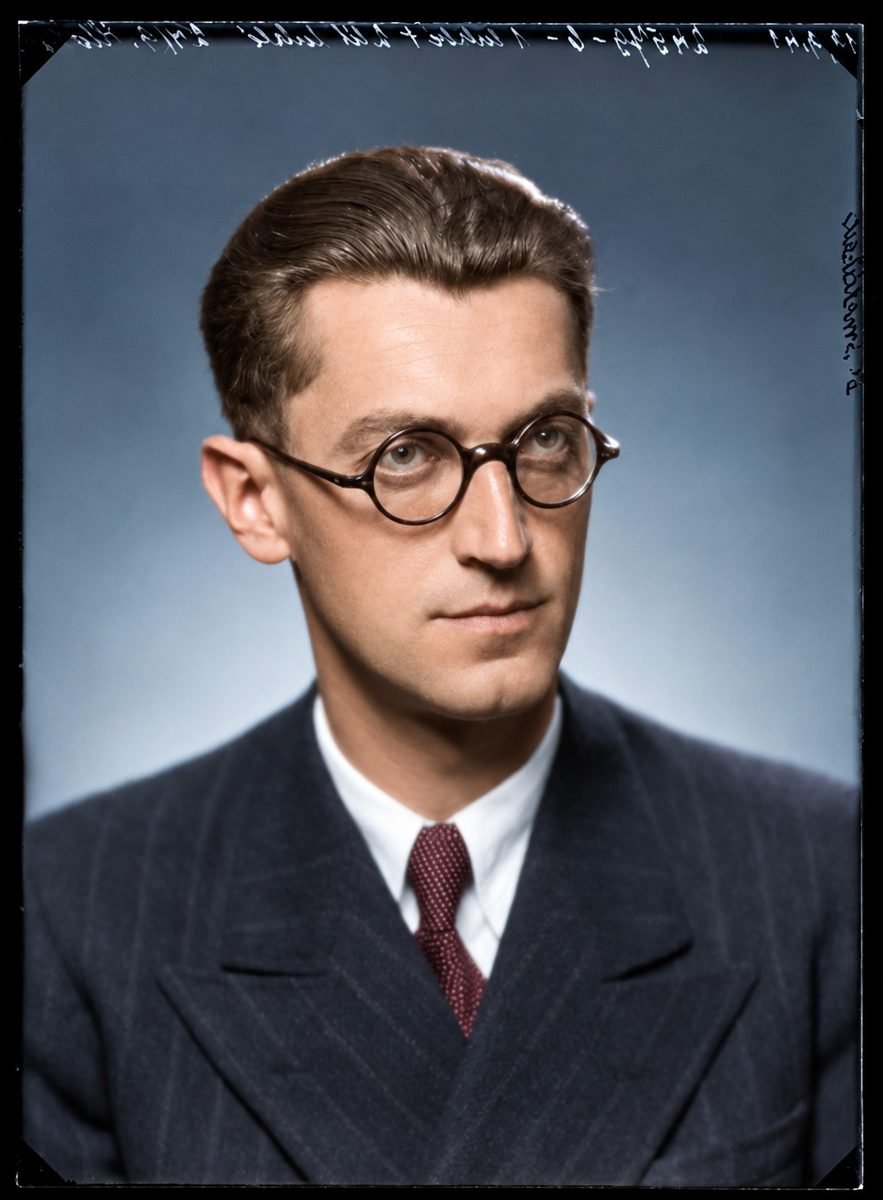
The career of Václav Smetáček (1906–1986) is one of the most remarkable examples in twentieth-century Czech music of a musician who gradually transformed himself from an instrumentalist and scholar into an orchestral leader of major importance. He was not merely a conductor who happened to be Czech, nor simply an interpreter of Smetana, Dvořák and Janáček. He was also an oboist, chamber musician, musicologist, teacher, organizer, champion of contemporary music and, above all, the man who helped transform the Prague Symphony Orchestra FOK into one of the principal orchestras of Czechoslovakia.
Born in Brno on 30 September 1906, Smetáček grew up in a cultivated household in which music was already part of everyday life. His father was a lawyer and an amateur musician, and the young Václav received a broad education that combined academic seriousness with practical musical training. He did not approach music from a single narrow path. Instead, he studied several disciplines at once, and this intellectual breadth would later become one of the defining characteristics of his conducting.
At the Prague Conservatory, he studied oboe with Ladislav Skuhrovský, composition with Jaroslav Křička, and conducting with Metod Doležil and Pavel Dědeček. At the same time, he studied musicology at Charles University, where his teachers included important Czech scholars and aestheticians, and he also pursued philosophy. His doctoral dissertation examined the orchestration of Bedřich Smetana’s early works, an indication that even before becoming widely known as a conductor he was already thinking analytically about orchestral colour and structure.
This double identity — practical musician and scholar — remained with him throughout his life. Unlike conductors who approached scores primarily through instinct or theatrical temperament, Smetáček had a strong analytical mind and an unusually detailed knowledge of instrumentation.
THE OBOIST BEFORE THE MAESTRO
Before establishing himself as a conductor, Smetáček was a professional oboist of considerable distinction. From 1930 to 1933 he served as deputy principal oboist of the Czech Philharmonic, placing him inside one of the most important orchestras in Central Europe.
This experience was fundamental to his later conducting. An orchestral player experiences a conductor from the opposite side of the podium: he learns which gestures are useful, which rehearsals waste time, how balance really works from inside the ensemble, and how quickly musicians recognize whether a conductor genuinely understands the score.
Smetáček therefore carried into conducting the perspective of someone who knew what orchestral musicians needed from a maestro.
In 1928, while still very young, he founded the Prague Wind Quintet, an ensemble he would lead until 1956. The original group included flute, oboe, clarinet, horn and bassoon, and its existence reflects his lifelong commitment to chamber music. The discipline of chamber performance — listening, balance, precision and shared phrasing — also became deeply embedded in his orchestral style.
RADIO, CHORAL MUSIC AND THE FIRST CONDUCTING YEARS
During the 1930s, Smetáček’s career expanded rapidly. Between 1934 and 1943, he worked at Czechoslovak Radio in Prague, first in administrative and programming roles and later as a conductor. He also became closely associated with the important Prague choral society Hlahol, initially as assistant to Josef Herle and later, from 1940 to 1946, as its choirmaster.
This choral experience was important because it gave him a profound understanding of breathing, vocal phrasing and large-scale choral architecture. Later performances of works such as Bach’s Mass in B minor, Verdi’s Requiem and major Czech choral compositions benefited from this background.
By the late 1930s, Smetáček was increasingly emerging as a conductor whose interests extended far beyond the ordinary concert repertory.
THE PRAGUE SYMPHONY ORCHESTRA FOK
The defining relationship of Smetáček’s life began during the Second World War.
In 1942, after the orchestra’s founder and chief conductor Rudolf Pekárek was interned in a concentration camp, Smetáček took over leadership of the Prague Symphony Orchestra FOK.
This appointment would shape the next three decades of his career.
When Smetáček assumed responsibility, the orchestra was not yet the large, fully established symphonic institution it would later become. He expanded it numerically, recruited stronger players, broadened its repertory and steadily raised its artistic standards.
By the post-war years, and especially after 1952, when the orchestra became an official cultural institution of the city of Prague, the FOK had become one of the three principal Czech orchestras alongside the Czech Philharmonic and the Czechoslovak Radio Symphony Orchestra.
This transformation was one of Smetáček’s greatest achievements.
He served first as artistic director and chief conductor, later continuing as chief conductor until March 1972, and even after leaving the formal leadership he returned frequently as a guest conductor almost until the end of his life.
Few conductor-orchestra relationships of the period were as long or as institutionally important.
MUSIC UNDER OCCUPATION
Smetáček’s role during the Nazi occupation deserves special attention because repertory itself could carry political meaning.
During the occupation years, Czech musical works often became symbols of cultural resistance. Smetáček repeatedly programmed music by Bedřich Smetana, Antonín Dvořák, Josef Suk and other Czech composers at a time when cultural identity had profound emotional significance.
On 1 January 1940, he conducted the complete Má vlast in Mělník. Later, when performing the complete cycle became politically more difficult, he continued to program individual symphonic poems from the work, including Vyšehrad, Vltava and From Bohemia’s Woods and Fields.
This was not simply normal repertory planning. In the context of occupation, such music could be heard by Czech audiences as an affirmation of national continuity.
The situation became increasingly difficult. Orchestra members were subjected to compulsory labour and, toward the end of the war, musicians were forced into manual work. Yet the orchestra survived, and Smetáček emerged after liberation as the central figure capable of rebuilding it.
A PROGRAMME FAR BROADER THAN NATIONAL REPERTORY
Although strongly associated with Czech music, Smetáček was never a narrow nationalist conductor.
After the war he expanded the FOK repertoire to include the Viennese classics, major Romantic composers and a remarkable range of twentieth-century music. His programmes included Stravinsky, Mahler, Kodály, Prokofiev, Shostakovich, Roussel and Honegger, alongside contemporary Czech composers.
One composer he supported with particular consistency was Miloslav Kabeláč, whose works Smetáček not only performed in Czechoslovakia but also promoted abroad.
As early as 25 March 1936, he had conducted a remarkable concert containing premieres by several contemporary Czech composers, among them Pavel Bořkovec, Jaroslav Ježek, Hans Krása, Iša Krejčí and Bohuslav Martinů.
This reveals a conductor whose artistic curiosity was already highly developed before the war.
THE TEACHER
Smetáček’s influence extended strongly into education.
From 1945, he taught at the Prague Conservatory, where in addition to his oboe class he taught chamber ensemble for wind players. Beginning in 1946, he also taught chamber wind interpretation at the Academy of Performing Arts in Prague, and from 1952 he served as an external teacher of orchestral conducting and directed the academy’s chamber orchestra.
This pedagogical work created a direct connection between Smetáček and later generations of Czech musicians.
Among conductors who studied with him was Zdeněk Košler, who would become one of the leading Czech conductors of the following generation.
In this sense, Smetáček functioned not only as an orchestral leader but as a transmitter of a tradition.
BERLIN AND THE INTERNATIONAL CAREER
Although Prague remained the centre of his life, Smetáček developed an extensive international career.
During the 1959–1960 season he served as conductor and director of the Berlin Municipal Symphony Orchestra, while guest engagements took him to many European countries and beyond.
He conducted orchestras in Germany, Poland, the Soviet Union, Romania, Hungary and other countries, and developed a reputation as a conductor who could arrive in front of an unfamiliar orchestra and establish order quickly.
That quality was especially valuable in an era when guest conductors often worked with limited rehearsal time.
A CONDUCTOR WHO KNEW THE ORCHESTRA FROM INSIDE
One of the most interesting aspects of Smetáček’s personality was the combination of scholarly seriousness and practical directness.
He had been an orchestral player himself, and therefore he did not romanticize the conductor’s position. He understood that musicians respond to clarity, preparation and efficiency far more readily than to theatrical gestures unsupported by musical substance.
His conducting technique was economical rather than flamboyant. He valued clear indications and tended to rely on rehearsal precision rather than exaggerated movement.
This perhaps explains why his performances often sound remarkably disciplined without becoming mechanical.
AN ANECDOTE: THE CONDUCTOR WHO WAS STILL AN OBOIST
An amusing aspect of Smetáček’s professional identity was that many musicians continued to think of him not only as a conductor but as an oboist who happened to stand on the podium.
That background gave him a particularly sharp ear for wind balance. In rehearsal he could immediately identify problems of breathing, attack or intonation in the wind section because he had spent years experiencing exactly those difficulties himself.
Players sometimes discover very quickly whether a conductor truly understands the physical reality of their instruments; with Smetáček, there was little possibility of hiding behind generalities.
He knew from personal experience what was technically possible, what was uncomfortable and what was simply bad orchestral writing.
DVOŘÁK, SMETANA AND THE CZECH TRADITION
Naturally, the core Czech repertoire remained central throughout Smetáček’s life.
His interpretations of Dvořák combined warmth with structural discipline, while his Smetana avoided excessive nationalistic rhetoric.
In Má vlast, Smetáček’s connection with the work was not merely musical. He had conducted it under occupation, when the cycle carried extraordinary symbolic importance.
That history gave later performances an added dimension.
For him, Smetana was neither museum music nor patriotic decoration. It was part of lived history.
MAHLER AND THE LARGE SYMPHONIC FORM
Smetáček also had a strong affinity with Gustav Mahler, whose works required exactly the kind of large-scale structural control that suited him.
Unlike conductors who emphasized Mahler primarily through emotional excess, Smetáček approached the scores with architectural seriousness. His training as a musicologist and composer helped him maintain control over enormous forms, while his experience as a wind player gave him an instinctive sensitivity to Mahler’s often extraordinary orchestration.
His Mahler interpretations also reflected the broader Central European continuity that connected Prague, Vienna and Moravia far more closely than national labels might suggest.
CHORAL MASTERY
Smetáček’s background with Hlahol made large choral-orchestral scores an important part of his repertory.
During the war he conducted works such as Bach’s Mass in B minor, Dvořák’s Saint Ludmila and Verdi’s Requiem, works requiring not merely orchestral power but precise control over vocal forces.
Here again, his multiple identities reinforced one another: the oboist understood breathing, the choirmaster understood voices, the scholar understood structure and the conductor coordinated everything into a whole.
THE RECORDING LEGACY
Smetáček left a substantial recorded legacy, much of it associated with Czech orchestras and labels such as Supraphon.
His recordings include Czech symphonic works, twentieth-century repertoire and major choral compositions, and although his discography never acquired the same global celebrity as that of Karajan or Bernstein, it remains historically valuable because it preserves the style of an important branch of the Czech orchestral tradition.
For collectors, his recordings are particularly interesting because they capture a conductor whose sound-world emerged directly from pre-war Czech musical culture but whose repertory extended well into modernism.
A FAMILY OF MUSICIANS
Music continued through the Smetáček family.
His son Pavel Smetáček (1940–2022) became a clarinettist, saxophonist, composer, arranger and important figure in Czech traditional jazz. Another son, Ivan Smetáček, was also active as an instrumentalist, and subsequent generations continued the family’s musical involvement.
There is something fitting in the contrast: the father became one of the great custodians of Czech orchestral tradition, while the son became closely associated with jazz.
It reflects the same openness that had characterized Václav himself.
THE LAST YEARS
After leaving the formal chief conductorship of the Prague Symphony Orchestra in 1972, Smetáček did not withdraw from musical life.
He continued returning to the FOK as a guest conductor and maintained an active international career. By then, his association with the orchestra had lasted three decades and had become inseparable from the institution’s identity.
He continued conducting into old age, still appearing before orchestras long after many colleagues of his generation had retired.
Václav Smetáček died in Prague on 18 February 1986, aged seventy-nine.
THE FINAL LEGACY
The importance of Václav Smetáček (30 September 1906 – 18 February 1986) cannot be reduced to his discography.
He was an oboist who became a conductor.
A chamber musician who became an orchestral builder.
A musicologist who became a practical man of the podium.
A choirmaster who mastered large symphonic forms.
A Czech nationalist in repertory who remained intellectually open to Stravinsky, Mahler, Prokofiev, Shostakovich and contemporary music.
Most importantly, he took the Prague Symphony Orchestra FOK at a moment of extraordinary historical difficulty and helped transform it into one of the central institutions of Czech musical life.
His career therefore represents something larger than personal success. It is the story of how a musician can shape an orchestra over decades, how national tradition can coexist with modernity, and how technical knowledge, intellectual curiosity and practical musicianship can be brought together in a single artistic personality.
Behind Václav Smetáček stood not the image of the glamorous maestro, but something perhaps more durable: a complete musician who understood an orchestra from the inside and devoted much of his life to making it better.