11 March 2026
The Night That Changed Opera Forever
On Classicapedia: Ludwig Schnorr von Carolsfeld, Richard Wagner
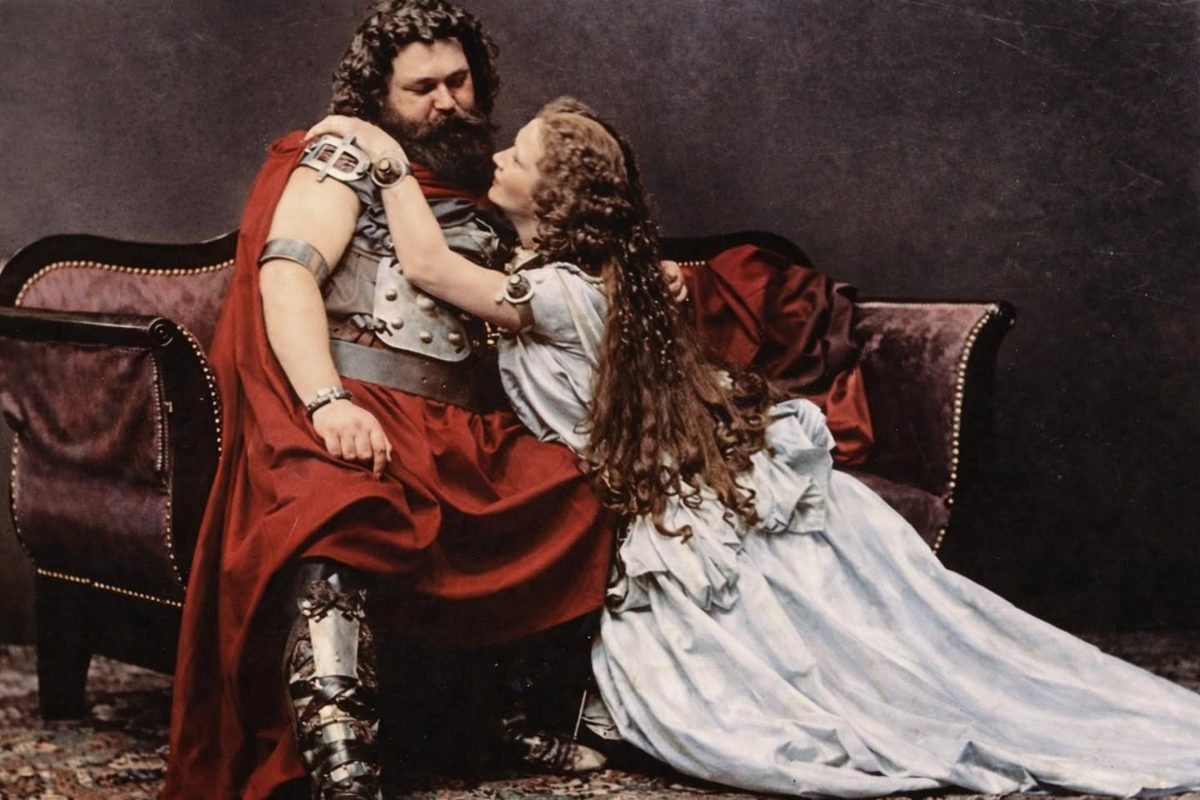
Tristan und Isolde, 1865 — the stage triumph, the vocal abyss, and the fate of its first lovers
Ludwig Schnorr von Carolsfeld and his wife Malwina were not merely the original Tristan and Isolde: they were the human vessels through which Wagner’s most dangerous dream first entered the theater. When Tristan und Isolde finally reached the stage at the Königliches Hof- und Nationaltheater in Munich on June 10, 1865, under Hans von Bülow, it was already surrounded by an aura of near-impossibility. The score had been finished years earlier, but repeated attempts to stage it had failed, most notoriously in Vienna, where long rehearsal efforts collapsed under the sheer difficulty of the work. By 1865, the opera had already acquired the reputation of being almost unperformable.
What made the premiere historic was not simply that it happened, but that it revealed a new kind of operatic language. Wagner did not think of Tristan as conventional opera at all; he called it a Handlung, a drama of continuous unfolding rather than a sequence of separate numbers. Its harmonic daring, its endless melodic tension, and its vast emotional architecture created something that shocked and transformed musical thought. Later generations would treat the work almost as a dividing line in music history, and the premiere of 1865 became one of those rare evenings after which the art form itself no longer sounded quite the same.
Yet the road to that first night had been extraordinarily difficult. Earlier plans in Karlsruhe, Dresden, Weimar, Prague, and especially Vienna came to nothing. In Vienna, the project collapsed after around seventy rehearsals, an astonishing sign of how intimidating the piece seemed to singers, conductors, and institutions alike. Only the intervention of King Ludwig II of Bavaria, who became Wagner’s decisive patron, made the Munich production possible. Even then, the intended date had to be postponed from May 15 to June 10 because Malvina Schnorr von Carolsfeld was hoarse. The very birth of the work seemed to confirm the legend that Tristan resisted incarnation.
Ludwig Schnorr von Carolsfeld was central to the success of the premiere. Wagner had heard him earlier and recognized in him the rare combination of vocal authority, intelligence, stamina, and tragic presence needed for Tristan. Contemporary and later accounts alike stress that he was not just a heroic noise-maker but a deeply musical artist, exactly the kind of singer Wagner needed if this revolutionary score was to sound convincing rather than chaotic. His wife, Malvina, older and already an experienced soprano, possessed the dramatic force necessary for Isolde, even if Wagner had once harbored reservations about her suitability in earlier planning stages. In Munich, however, the couple together became the indispensable center of the performance.
The circumstances around the premiere made the event almost unbearably charged. Hans von Bülow conducted, even though Wagner was involved with Cosima von Bülow, the conductor’s wife. That alone gives the occasion an almost surreal emotional backdrop: an opera about transgressive, consuming love brought to life amid one of the most notorious emotional entanglements in nineteenth-century musical life. The performance thus stood at the intersection of artistic revolution and personal scandal, which only intensified the feeling that something extraordinary and dangerous was taking place.
As for the performance itself, what mattered most was that Wagner finally felt he had found singers capable of sustaining his immense line and his psychological intensity. Ludwig and Malvina sang the title roles in the first production that satisfied Wagner in a way earlier attempts had not. Ludwig in particular seems to have made an overwhelming impression. His Tristan was not merely loud or strenuous; it embodied the feverish inwardness of the role. This is crucial, because the part of Tristan is one of the great turning points in tenor history: after this, the expectations placed on dramatic tenors changed permanently. In that sense, Ludwig did not just create a role; he helped create a new category of operatic heroism.
And then came the tragedy that has haunted the premiere ever since. Ludwig Schnorr von Carolsfeld died suddenly on July 21, 1865, only weeks after the premiere and after singing Tristan only a handful of times. He was just twenty-nine. Almost immediately, rumors spread that the role itself had killed him, as though Wagner’s music had exacted a fatal physical price. Strictly speaking, that was speculation rather than established fact: sources note his sudden death, mention that he had become ill, and record the sensational association people made between the role and his collapse, but they do not prove that singing Tristan directly caused it. Still, the legend was born at once, and it became one of the central myths of Wagnerian performance history.
The effect on Malvina was devastating. After her husband’s death, she fell into profound depression and never sang on stage again. That fact alone gives the 1865 premiere an almost unbearable poignancy. The first Isolde, who had just taken part in one of the most decisive first nights in music history, was silenced for the rest of her theatrical life by grief. She lived on for decades, later teaching singing, but her active career as a performer was effectively over. Thus the original Tristan and Isolde were not followed by a long triumphal reign in the roles: instead, the premiere became retrospectively sealed by loss, as though the opera had consumed its first interpreters.
This is why the 1865 premiere occupies such a singular place in operatic memory. Many premieres launch careers; this one almost destroyed the lives at its center. The singers who first gave voice to Wagner’s vision did not go on to dominate the repertory for years together. Ludwig died almost immediately after inscribing his name into history, and Malvina withdrew forever from the stage. The event therefore appears to later generations not simply as a success, but as a kind of artistic martyrdom: a revelation purchased at terrible cost. That interpretation has fed the later mythology of the so-called Tristan curse, the recurrent sense that this opera asks too much of those who dare to serve it.
From a historical point of view, however, one should be precise. The premiere was not important because of superstition, but because it proved that Wagner’s most radical music drama could live in performance. It established Tristan und Isolde as a stage work rather than a beautiful impossibility. It also bound the work forever to the names of Ludwig and Malvina Schnorr von Carolsfeld, who stand at the beginning of its performing tradition like tragic guardians of a threshold. Every Tristan and Isolde since then has had to confront not only Wagner’s score, but also the memory of the first two artists who opened that abyss.
In the end, the destiny of the premiere singers seems almost too symbolic to be real. He became immortal and died within weeks. She survived, but the stage lost her. Together they turned a long-delayed, feared, nearly impossible new work into one of the central monuments of Western music. That is why the story of the 1865 premiere remains so compelling: it is not only the birth of a masterpiece, but also the story of two artists whose lives were forever marked—one extinguished, one broken—by the very triumph that made them unforgettable.