16 October 2026
The Hammer of Fate: Mahler's Sixth Symphony
On Classicapedia: Gustav Mahler, Richard Strauss, Alfred Roller
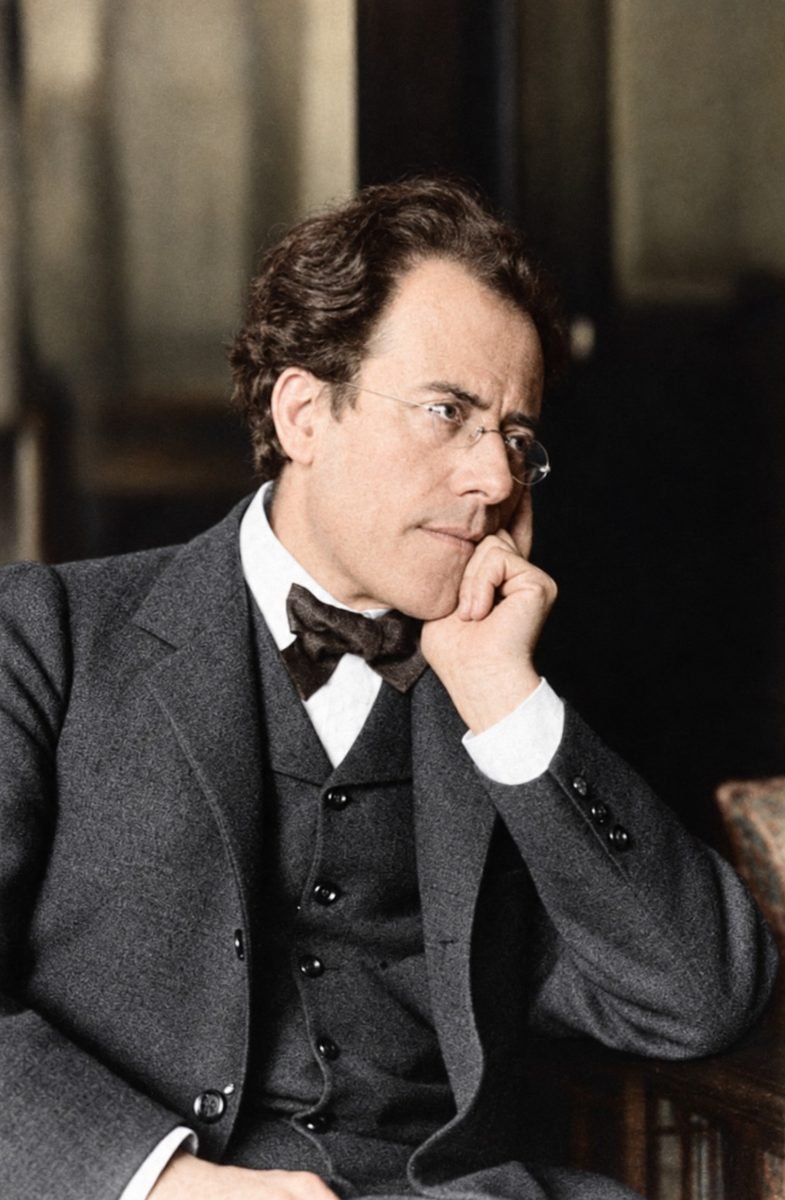
1903–1906
When Gustav Mahler began work on his Sixth Symphony during the summer of 1903, his outward life offered very little reason to imagine a work dominated by defeat. He had reached a position of enormous power at the Vienna Court Opera, had just begun with Alfred Roller one of the most important theatrical reforms of his time, his marriage to Alma Mahler was still in its early years, and the family was beginning to build at Maiernigg an existence that, at least from the outside, could appear extraordinarily fortunate. That is precisely why it is so disconcerting that, in the midst of such apparent fulfilment, there emerged the most radically negative of his symphonies, a work that does not lead toward resurrection, redemption or affirmation, but toward an ending in which almost every possibility of consolation has disappeared.
The Sixth was begun in the summer of 1903 and completed in May 1905. At first glance it appears even more traditional than many of its predecessors: it consists of four movements, uses no voices, preserves a recognizable symphonic structure and even includes a formal repeat of the exposition in the first movement. Yet this classical appearance is deceptive, because within that apparently orderly architecture Mahler constructed one of his most violent, ambiguous and difficult works, a symphony in which the traditional mechanisms of conflict and resolution seem deliberately to lead toward a conclusion in which defeat is not overcome.
A SYMPHONY BORN IN A MOMENT OF APPARENT HAPPINESS
The fundamental paradox of the Sixth lies precisely in the fact that it was not written during a personal catastrophe. Mahler had not yet lost his daughter Maria, had not yet received the heart diagnosis that would profoundly alter his life, and the marital crisis of 1910 had not yet arrived. All of that still belonged to the future. In 1903 and 1904 he was still the all-powerful director of the Vienna Opera, his international reputation was growing, and Maiernigg provided during the summers the isolation he needed in order to compose.
This circumstance makes it necessary to distrust any interpretation that automatically turns the Sixth into an autobiographical prophecy. The romantic idea of a Mahler capable of musically anticipating the disasters of 1907 may be seductive, but it reduces the complexity of the creative process to a kind of personal clairvoyance. Mahler did not need to have lived through a specific tragedy in order to imagine disaster in musical terms, just as Beethoven did not need literally to experience every event represented by his works in order to construct a convincing dramatic world in sound.
The Sixth shows precisely how far Mahler’s tragic imagination could go when his external existence seemed relatively stable. That contradiction between life and work does not diminish the mystery of the symphony; it makes it even greater.
MAIERNIGG: THE LAKE, THE MOUNTAINS AND MUSIC THAT MOVES TOWARD DISASTER
During those summers, Mahler’s life continued to be organized around the composing hut at Maiernigg. As had been the case with the Fifth, the first hours of the day belonged exclusively to work and were protected with an almost ritual discipline. The nature surrounding the Wörthersee was not simply pleasant scenery in which to rest after the exhausting Viennese months, but an essential part of his creative process, and in the Sixth it once again reappears transformed into sound.
Nature, however, no longer plays the same role here as it had in the earlier symphonies. In the Third it had formed an immense hierarchy of life that seemed to lead from matter toward love; in the Sixth, natural evocations appear as fragile interruptions within a world governed by the march. The distant cowbells create an almost unreal sense of remoteness, as though they came from a region outside the conflict, a place in which peace might still be possible.
That is precisely why their presence is so moving. They do not remove the threat, but briefly show that another world might exist, even though the symphony does not allow us to remain there.
THE MARCH RHYTHM BECOMES THE MOTOR OF THE ENTIRE WORK
The march had accompanied Mahler since childhood in Iglau. Military bands, trumpet signals and parade rhythms formed part of his earliest sound memories and appeared again and again in his songs and symphonies, sometimes with irony, sometimes with solemnity and at times in association with death.
In the Sixth, however, the march acquires a more implacable function. The first movement begins with a rhythm that seems to move forward without any possibility of stopping, and that pulse ultimately permeates almost the entire work, with the exception of the Andante. Even the Scherzo, traditionally a territory of contrast or lightness, becomes infected by the same rhythmic energy.
There is an important precedent in the song Revelge, written in 1899, where an obsessive military rhythm drives soldiers toward a grotesque march of death. The Sixth contains no comparable narrative, but that same capacity to turn the march into an inexorable force assumes gigantic symphonic proportions.
THE FIRST MOVEMENT: MOVING FORWARD WITHOUT KNOWING TOWARD WHAT
The first movement immediately establishes the essential character of the work through a powerful march in which the regularity of the pulse creates a sense of extraordinary strength but also of threat. The music advances with almost military certainty, yet that certainty is unsettling precisely because it seems too absolute, as though the movement of the symphony had been set in motion by a mechanism that could no longer be stopped.
Heroic rhetoric is present, but Mahler treats it with enough ambiguity that we can never be completely sure we are meant to believe in it. The great opening theme may sound like the entrance of a hero, but it possesses something excessively emphatic, almost over-monumental, as though Mahler were simultaneously displaying the grandeur of that language and its vulnerability.
This is one of the fundamental differences from the Fifth. There, the Funeral March began from death and eventually opened into a luminous affirmation. The Sixth seems to begin its journey with energy and strength, but the further it proceeds, the more we understand that this initial force may also become the instrument of its own destruction.
THE MAJOR-TO-MINOR MOTIF: FATE REDUCED TO TWO CHORDS
One of the most recognizable signs of the Sixth is a formula of extreme simplicity: a major chord that immediately turns into minor. Mahler accompanies this change with the march rhythm in the timpani and a roll on the side drum, allowing two apparently elementary chords to acquire enormous structural importance.
That movement from major to minor seems to condense within a few seconds the entire logic of the work. What begins as affirmation darkens; what appeared stable loses its security, and a minimal harmonic transformation is enough to turn a luminous declaration into something threatening.
Mahler uses this motif repeatedly, allowing it to reappear at different points and with changing meanings. The greatness of his technique lies precisely in this ability to construct enormous architectures from extraordinarily simple materials, to the point that a basic relationship between two chords ends up becoming a kind of fatal sign running through the whole symphony.
THE SO-CALLED “ALMA THEME”
After the initial violence comes a second theme, broader, ascending and passionate, which tradition has for decades identified with Alma. According to her memoirs, Mahler approached her during the summer of 1904 and told her that he had portrayed her musically in that melody.
The story is attractive and has been repeated so often that the so-called “Alma theme” has become almost inseparable from the legend surrounding the Sixth. Yet a certain caution is necessary, because many autobiographical interpretations later transmitted by Alma simplify the music and cannot always be independently verified.
Moreover, the theme itself is more ambiguous than its romantic label suggests. It is expansive, vehement and proud, but it also possesses something theatrically emphatic, as though its passionate character had deliberately been pushed to the limit.
It may reflect something of the energy Mahler associated with Alma, but reducing it simply to a musical portrait of love would impoverish its function within the symphony.
THE COWBELLS: A DISTANT WORLD TO WHICH THE SYMPHONY CANNOT RETURN
In the midst of the tension of the first movement, the cowbells appear, one of the most unusual sounds in Mahler’s orchestral world. They do not function as a picturesque effect intended merely to evoke an Alpine landscape, but rather as an image of distance.
One can imagine a walker who has climbed above the pastures and hears from far away the last sounds of the inhabited world, growing fainter as he continues upward. That sense of distance creates within the Sixth an entirely different space, a kind of acoustic oasis in which the march is temporarily suspended.
Peace, however, never becomes a solution. The bells allow us to hear for a few moments another possible world, but the symphony inevitably returns to its own.
THE SCHERZO: DANCE BECOMES THREAT
Mahler had transformed the traditional Scherzo many times before, but in the Sixth he carries that process especially far. The movement combines elements of march and ländler, so that an apparently familiar dance can gradually become rigid, aggressive and disturbing before changing again.
The result is a constant sense of instability. At times the music recalls the world of Austrian folk dances, but its irregular proportions, displaced accents and violent interventions prevent the listener from finding any real comfort.
Particularly disturbing are passages in which the horns seem to deform the festive character of the Scherzo into something almost painful. What in other music might represent physical exhilaration becomes here a nervous and grotesque form of gesture.
The dance still exists, but it has lost its innocence.
THE ANECDOTE OF MAHLER’S DAUGHTERS
Alma would later claim that certain irregular passages in the Scherzo represented Mahler’s little daughters playing or staggering over the sand. It is another of those biographical images that have acquired a life of their own around the symphony and that are charming precisely because they provide such an intense contrast with the violence of the work.
The chronology, however, immediately creates a difficulty. At the time to which the memory would correspond, the younger daughter was far too small to walk, making it impossible to accept the description literally as it was later transmitted.
The point is not to deny that family life could have suggested rhythms or gestures to the composer, because Mahler was perfectly capable of transforming everyday impressions into musical material, but rather to avoid reducing so complex a work to a collection of domestic photographs converted into sound.
The Sixth is not a Sinfonia domestica. Even when private life enters it, it is transformed until it becomes almost unrecognizable.
THE ANDANTE: A REFUGE THAT CANNOT CONSOLE
The Andante provides the clearest contrast in the entire symphony because it temporarily abandons the march rhythm that dominates the other movements and opens a space of greater lyricism. Yet it would be a mistake to hear it as a simple interlude of rest between the violence of the Scherzo and the Finale.
Its expressive world is closely related to the Kindertotenlieder, especially to the atmosphere of one of the songs in the cycle, although Mahler makes no literal quotation. The resemblance lies in the way the music breathes, in the delicacy of certain lines and, above all, in that profoundly Mahlerian mixture of tenderness and pain.
The Andante sings, but its song does not possess the intimate love-song quality of the Adagietto from the Fifth. As it proceeds, moments of increasing emotional intensity appear until the movement reaches an outburst that seems to open a wound within the lyricism itself.
Its function is therefore not to offer consolation, but to show how deeply consolation is desired and how impossible it is to preserve.
SCHERZO OR ANDANTE: THE DOUBT MAHLER NEVER HAD WITH ANY OTHER SYMPHONY
No other Mahler symphony caused him comparable uncertainty concerning the order of its middle movements. The question was apparently simple: should the Scherzo come first and the Andante second, or the other way round?
Mahler altered his decision even in the manuscript, and the issue continued to provoke debate for decades. In the earliest performances he appears to have used the order Andante-Scherzo, although the surviving documentation is not always completely consistent.
His hesitation is understandable. If the Scherzo follows immediately after the first movement, the listener again encounters a rhythmic drive very similar to the opening march, and Mahler may have feared that such continuity would sound like an obvious repetition. Placing the Andante second created an immediate contrast before the return to rhythmic violence.
Yet the Scherzo-Andante order also possesses a strong dramatic logic, because it allows the pressure of the first two movements to accumulate before opening the lyrical space that precedes the immense Finale.
The uncertainty reveals the extent to which Mahler continued to regard the symphony as a living organism even after he had finished composing it.
THE FINALE: ONE OF MAHLER’S GREATEST SYMPHONIC BATTLES
The fourth movement belongs to an entirely different scale. It is one of the longest movements Mahler ever wrote and seems to gather, transform and ultimately destroy much of what the symphony had previously established.
Its opening is uncertain, almost as if the music were trying to discover a direction before the immense mechanism begins moving once again. Gradually the marches, previous motifs, contrasts between major and minor and distant evocations of nature all return, but everything has acquired a more threatening dimension.
The impression is not simply that of a struggle between two clearly identifiable forces. The Finale seems to create a series of attempts to move toward some kind of resolution, only for them repeatedly to be interrupted, diverted or destroyed.
In other Mahler symphonies, even after crossing regions of extraordinary darkness, there remained some horizon of transformation. In the Second came resurrection; in the Fifth the chorale could finally assert itself; even in later works we will find different forms of reconciliation or farewell.
The Sixth grants no such escape.
THE COWBELLS RETURN, BUT THEY CAN NO LONGER SAVE ANYTHING
The cowbells reappear in the Finale, but their effect has changed profoundly. In the first movement they could be heard as a peaceful interruption, a kind of window opening onto a world outside the conflict. Now they seem even more distant and vulnerable, almost like memories of something that can no longer be recovered.
It is one of Mahler’s most moving procedures: to use exactly the same kind of sound and allow the experience accumulated by the symphony to transform its meaning completely.
What had once suggested peace now begins to sound like loss.
The better world may still exist somewhere far away, but the symphony can no longer reach it.
THE HAMMER
And then appears the element that would become the most famous symbol of the entire work. Mahler introduces in the Finale a series of hammer blows that were not intended to produce a conventional metallic sound. He wanted a dull, enormous and terrifying impact, something that would not resemble a bell or an ordinary percussion stroke, but rather a brutal force that seemed physically to destroy whatever it struck.
Finding the right sound posed a considerable practical problem because no standard orchestral instrument produced exactly the effect Mahler imagined. It was necessary to construct a device capable of generating enormous resonance without acquiring a metallic quality, and what we now simply call “Mahler’s hammer” was born from that demand.
The gesture is theatrical, but not superficial. After many minutes of conflict, the blow appears as a physical interruption of musical continuity, an event that seems to come from outside the orchestra itself and fall upon it.
FROM FIVE BLOWS TO THREE, AND FROM THREE TO TWO
The history of the hammer blows is more complex than the legend suggests. Mahler seems initially to have considered a larger number of blows, then reduced them to three and finally removed the third.
That suppression is essential because it profoundly complicates any overly simple autobiographical interpretation. If the three blows were intended to represent three concrete and inevitable events of fate, it becomes difficult to explain why Mahler chose to remove precisely the last one.
The issue continues to have practical consequences because some editions and some conductors have restored the third blow, while others respect Mahler’s revision and retain only two.
Beyond the exact number, what matters is the character of the sound: Mahler wanted the blow to seem to strike at the very root of existence, like an axe directed against life itself.
THE LEGEND OF THE “THREE BLOWS OF FATE”
Alma would later build around these blows one of the best-known stories in Mahler’s biography. According to her, her husband explained that the three hammer blows represented three blows of fate falling upon the hero, with the third finally felling him like a tree.
After 1907, Alma retrospectively associated those three blows with three major disasters in Mahler’s life: the death of his daughter Maria, the discovery of his heart condition and the loss of his position at the Vienna Opera, although in other later reconstructions the marital crisis and the appearance of Walter Gropius also became absorbed into the legend.
The story is extraordinarily powerful because it appears to turn the Sixth into a prophecy, but that is precisely why it must be treated with caution. Music does not need to predict biography in order to be tragic. Mahler was capable of imagining destruction artistically without having experienced it yet, and the greatness of the Finale lies precisely in that ability to create an experience of defeat that transcends any specific event in his own life.
To turn the hammer blows into a calendar of future disasters is to reduce one of Mahler’s most complex constructions to a biographical riddle.
IN THE SIXTH THERE IS NO RESURRECTION
The difference between this symphony and almost all its predecessors becomes especially clear at the end. The Second had answered death through resurrection; the Third culminated in love; the Fourth reached its strange childlike paradise; and the Fifth transformed its Funeral March into an affirmative Rondo-Finale.
The Sixth rejects all of those solutions. No voice appears from another world, no chorale is able finally to establish victory, and no door opens toward transcendence. The final movement advances toward destruction and ends by confirming the minor aspect of the major-minor formula that had appeared much earlier in the symphony.
After the entire enormous journey, the music does not rise.
It collapses.
THE LAST WORD BELONGS TO DEFEAT
The closing moments are among the most desolate in all Mahler’s music. The formula that has run through the symphony returns in its minor form, while the march rhythm reappears in the timpani like the final reflex of the force that had driven the whole journey.
But there is no longer any real forward movement. The energy seems reduced to the final convulsions of an organism that continues to react after the battle has already been lost, until a final pizzicato in the strings closes the work without allowing any reconciliation.
The Sixth therefore ends in a manner exceptional within Mahler’s output: it does not transform defeat, but confirms it.
MAHLER CALLED IT A “RIDDLE”
Mahler himself offered very few explanations of the Sixth. He had long since abandoned the detailed programmes of his early symphonies and no longer seemed interested in giving the listener a story that could function as an interpretive key.
In 1904 he expressed the conviction that the work would pose riddles that could only be solved by those who had deeply absorbed his first five symphonies.
The remark is important because it suggests that Mahler understood the Sixth not as an absolute break with his past, but as a consequence of everything he had been building since the First. The marches, nature, distorted dances, contrasts between the vulgar and the sublime, questions about fate and death, and the continual transformation of earlier materials were all still present.
What was new was the answer.
This time there would be no salvation.
ESSEN, 20 MAY 1906: MAHLER TRAVELS TOWARD THE PREMIÈRE
Mahler left for Essen on 20 May 1906 to prepare the première, and he did so with an anxiety unusual even for someone who suffered intensely before hearing his new works for the first time.
He knew that the score imposed enormous demands. The orchestra required was so large that the local players had to be reinforced by musicians from Utrecht, and the organizers proudly announced that around 110 players would participate.
Paradoxically, Mahler was not pleased with this publicity. He disliked the way it reinforced the image of him as a composer obsessed with monstrous dimensions and gigantic orchestras, because for him the number of performers was not a spectacle but simply a consequence of what the score required.
Even so, the first rehearsals pleasantly surprised him, and he expressed satisfaction with the quality of the orchestra.
RICHARD STRAUSS SAYS WHAT MAHLER LEAST WANTED TO HEAR
The days in Essen were charged with tension, and one of the most revealing episodes occurred after the final rehearsal. Mahler was profoundly disturbed by the result and was found in his dressing room pacing nervously, weeping and wringing his hands while several friends stood around him without knowing how to comfort him.
Among those associated with the rehearsals was Richard Strauss, whose artistic personality was in certain respects almost the opposite of Mahler’s. Strauss possessed extraordinary practical confidence and seemed able to make his enormous scores sound clear after relatively little rehearsal, while Mahler could hear an excellent performance and immediately concentrate on everything that still failed to work.
Strauss considered the Sixth, and especially its Finale, excessively orchestrated, and the comment struck Mahler at one of his most sensitive points. He had already suffered greatly over the orchestration of the Fifth and had spent years revising it precisely because he felt that his new contrapuntal language required a transparency he did not always achieve. Now, with the Sixth, he again faced the same fear: that he had imagined a world of sound whose very orchestral density might prevent it from being heard clearly.
Strauss’s apparent ease in solving such problems tormented him.
THE PREMIÈRE — 27 MAY 1906
Finally, on 27 May 1906, Mahler conducted the first public performance of the Sixth Symphony in Essen as part of the annual festival of the Allgemeiner Deutscher Musikverein.
The work reached the public after almost three years of gestation, but for Mahler it was not emotionally closed. The rehearsals had once again revealed the distance between a score imagined in silence and the physical impact of hearing it performed by more than a hundred musicians in a hall.
Rarely does a first performance of one of his own works seem to have affected Mahler so deeply. The Sixth was not simply another new score that he had to defend before a difficult audience, because Mahler appeared to feel confronted by something that even he found disturbing.
THE SIXTH WAS ALSO A PROBLEM FOR ITS OWN COMPOSER
The uncertainty over the order of the movements, the changes to the orchestration and the removal of the third hammer blow all show that Mahler continued to question the work after he had finished composing it.
This is particularly significant because it contradicts the image of a composer who had conceived from the beginning a perfectly defined autobiographical programme. If the Sixth had simply represented a hero struck three times by fate, then the suppression of the third blow or the hesitation over the central structure would be difficult to understand.
What we find instead is Mahler behaving as a composer: testing, listening, doubting, correcting and searching for a form that would produce exactly the effect he needed.
The legend came later.
The music was born out of that process of uncertainty.
THE “TRAGIC”
The term “Tragic” eventually became associated with the Sixth, and Mahler did at times allow its use, although the exact relationship with the title is not as simple as it is sometimes presented. The word undoubtedly fits the Finale and the absence of reconciliation in the work, but it can also become too convenient a label if it encourages the idea that the entire symphony directly represents an individual tragedy.
The Sixth is tragic in a deeper sense because it develops a structure in which energy, will and the capacity to struggle do not guarantee victory.
The musical protagonist, if we choose to use such a term, is not destroyed because he is weak.
He is destroyed despite fighting.
There lies one of the essential differences from many heroic narratives of the nineteenth century.
FROM BEETHOVEN TO MAHLER: WHEN THE JOURNEY FROM DARKNESS TO LIGHT NO LONGER WORKS
Since Beethoven, one of the great narratives of the symphony had been the transformation of conflict into victory. Beethoven’s Fifth Symphony offered the most powerful model: beginning in C minor and ending in triumphant C major.
Mahler knew this tradition perfectly and had used, transformed and questioned it throughout his work.
The Fifth could still be understood within that large trajectory because its opening Funeral March eventually gave way to a luminous Finale.
The Sixth makes the opposite journey.
The initial affirmation cannot sustain itself, major turns into minor, energy does not lead to victory and the ending does not retrospectively redeem the suffering that came before, but instead seems to declare that all the struggle has been insufficient.
THE SIXTH DID NOT PREDICT 1907
It is almost inevitable to view the Sixth with knowledge of what happened later. In 1907 Maria would die, Mahler would receive the diagnosis of his heart disease and his relationship with the Vienna Opera would come to an end.
Seen retrospectively, the hammer blows seem to acquire an almost supernatural precision.
But that reading confuses the work with later events.
The greatness of the Sixth does not lie in Mahler’s ability to predict his future, but in something far more disturbing: that an artist living through one of the apparently happiest and most successful periods of his life could imagine with such intensity an experience of absolute destruction.
Fate had not yet needed to strike.
Mahler already knew how it could sound.
THE HAMMER IS NOT THE CENTRE OF THE SIXTH
The spectacular nature of the blows has caused the whole symphony often to be remembered through them, but focusing exclusively on the hammer can obscure the true radicalism of the work.
The decisive element is not an extraordinary instrument used for a few seconds, but the complete architecture. From the first bar, the march establishes a movement that seems inevitable; the major-minor motif introduces an elemental threat; the Scherzo turns dance into unease; the Andante opens a region of beauty that cannot become a permanent refuge; and the Finale takes all these materials, subjects them to a gigantic struggle and ends by denying the possibility of victory.
The hammer blows do not create the tragedy.
They simply make it physically visible.
AFTER THE SIXTH, MAHLER’S SYMPHONY COULD NEVER BE THE SAME
With the Sixth, Mahler took to an extreme one of the possibilities opened by the Fifth. He had renounced voices and literary programmes and now trusted entirely in the ability of instrumental form to construct a drama on an immense scale.
But whereas the Fifth ultimately demonstrated that music could transform pain into affirmation, the Sixth demonstrated something far more disturbing: that the same symphonic machinery could lead toward destruction without offering any compensation afterwards.
The work needed no words to speak about fate, no poem to name death, and no chorus to deny or confirm the existence of another world.
The structure itself had become fate.
THE HAMMER OF FATE
Between 1903 and 1906, Mahler wrote and first brought before the public a work that occupies a unique place in his output. The Sixth was born during years of professional success, marriage, children and extraordinarily fertile creativity, yet it ended by constructing one of the darkest worlds produced by the European symphony at the beginning of the twentieth century.
In it, a march advances from the first movement as though an invisible machine had begun to operate; an expansive theme traditionally linked with Alma tries to oppose it with another kind of energy; the cowbells open fleeting windows onto a world of peace; the Scherzo transforms dance into unease; the Andante sings from a place of profound melancholy; and the Finale gathers all those forces and subjects them to a battle of enormous proportions.
Then come the blows, but the true blow of the Sixth is not the hammer itself. It is the discovery that after all that energy, all that beauty and all that resistance, the music can still end without having found a way out.
In the earlier symphonies, Mahler had repeatedly asked what might exist beyond suffering and death.
In the Sixth he asks a far more terrible question: what happens if there is no answer?