19 July 2026
The Fifteen-Year-Old in Vienna
On Classicapedia: Gustav Mahler, Robert Fuchs
MAHLER
JOSE LUIS PEREZ DE ARTEAGA
POST 6
The Fifteen-Year-Old in Vienna
Into the Musical Capital
When Gustav Mahler arrived in Vienna in 1875, he was only fifteen years old, but he had already passed through enough suffering to lose any illusion of an easy youth. He came from Iglau, carrying with him the memory of family conflict, repeated deaths among his brothers and sisters, and, above all, the recent loss of Ernst, the beloved brother whose illness and death had deeply marked him.
Yet he also arrived with something stronger than sorrow: a fierce musical vocation.
The provincial child who had once been discovered at an old piano in an attic had now entered the most demanding musical city in the German-speaking world. Vienna was not simply a place where music was performed. It was a place where music was judged, debated, revered, and fought over. To enter it was to accept an ordeal.
Vienna offered glory, but it demanded proof.
Julius Epstein and the Door to the Conservatory
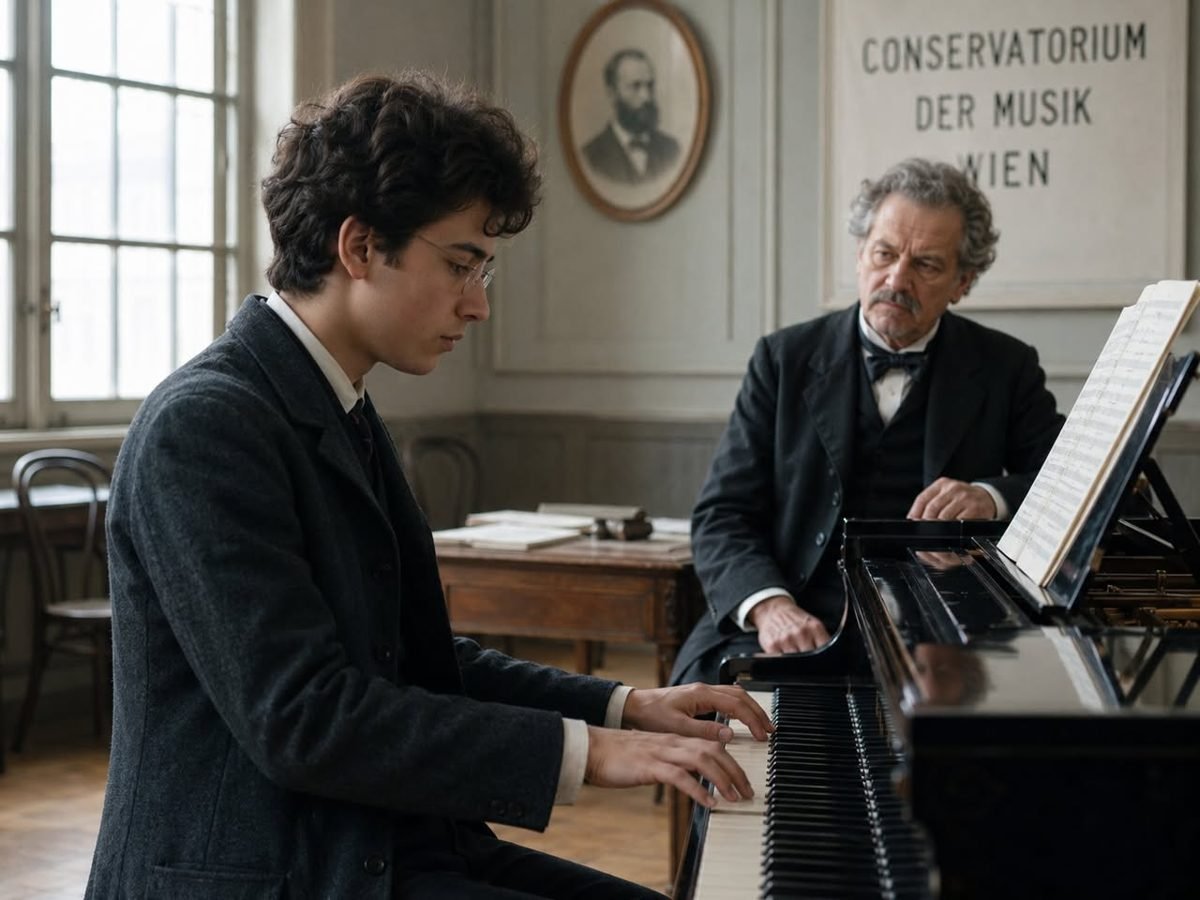
The decisive figure at the threshold of this new life was Julius Epstein, one of the most respected piano teachers at the Conservatory of the Gesellschaft der Musikfreunde. Mahler’s future initially depended on Epstein’s judgement.
When the young candidate played for him, it became clear that he was not a dazzling virtuoso in the mould of the great international pianists. His technique was serious, his musicianship obvious, but what truly impressed Epstein was not sheer brilliance. It was something less easy to define and ultimately more important: musical intelligence, inner fire, and creative instinct.
Epstein understood that the boy before him was not merely a student with promise. He was, in essence, already a musician.
That is why his famous verdict carried such weight:
“This boy is a born musician.”
With that judgment, the gates of the Conservatory opened. On 10 September 1875, Mahler officially began his studies.
He worked in piano with Julius Epstein, in harmony with Robert Fuchs, and in composition and counterpoint with Franz Krenn.
Poverty Beneath the Imperial Splendour
If Vienna represented artistic abundance, Mahler’s own existence within it was precarious from the beginning.
He did not arrive as a wealthy prodigy protected by comfort. He arrived as the son of a provincial family with limited means, burdened by the constant need to justify every expense. His father, Bernhard Mahler, valued education and supported his son’s ambitions, but he had many mouths to feed and could not indefinitely finance Gustav’s studies in the capital.
The reality of Mahler’s student life was therefore shaped by financial anxiety.
He had to find pupils, economize relentlessly, and endure the humiliations of dependence. Behind the image of the young artist in the great imperial city stood a harsher truth: he was living close to hardship, and at times close to desperation.
In 1876, still only sixteen, Mahler wrote a letter to the Conservatory authorities explaining that his situation had become nearly impossible. He had too few private pupils, his father could not adequately support him, and unless assistance were granted he might be forced to abandon his studies.
The letter is revealing because it combines humility with pride. He did not beg like someone resigned to defeat. He appealed like someone convinced that his continuation at the Conservatory mattered.
He even promised that, should his financial situation later improve, he would repay what had been granted.
The adolescent already possessed that mixture of vulnerability and inflexible self-belief that would mark him all his life.
The request succeeded. He received help, and Julius Epstein also assisted him in finding additional pupils. Without this support, Mahler’s Viennese formation might have been interrupted before it had properly begun.
The First Prizes
Despite these hardships, Mahler quickly distinguished himself.
At the end of his first year, he completed his piano studies under Epstein and entered the Conservatory competition. He performed the first movement of a Schubert Sonata in A minor, and the jury awarded him first prize by unanimous decision.
This early triumph was significant. It proved that the poor provincial student could not be dismissed as merely gifted or promising. He had already become a serious contender.
Soon afterward, he entered the Conservatory’s composition competition. There he submitted the opening movement of what was described as a piano quintet but was למעשה connected to the work now known as the Piano Quartet in A minor, the only important surviving fragment from his earliest creative period.
Again, Mahler received first prize.
In the following year, he won yet another distinction in piano, this time for his performance of Schumann’s Humoreske.
These successes mattered not only because they decorated a student career, but because they confirmed something essential: Mahler could compete and prevail in Vienna. He was not crushed by the city’s standards. On the contrary, he was beginning to force the city to recognize him.
The Limits of the Piano
And yet, these same years also brought one of Mahler’s first acts of artistic self-knowledge.
His father had imagined a future for him as a brilliant concert pianist. Such an ambition was not absurd. Mahler had talent, he won prizes, and he had already given public performances. But Vienna showed him what true international pianism meant.
A decisive moment came when he heard Anton Rubinstein perform a cycle of the Beethoven piano sonatas for the students.
The impact was profound.
Mahler understood that he could become a fine pianist, even a distinguished one, but not a supreme virtuoso of Rubinstein’s order. The revelation must have been painful, but it was also liberating.
He did not discover that he was not a musician. He discovered that he was not meant to be only a pianist.
Gradually, his centre of gravity shifted. The piano remained fundamental, but it ceased to be the final goal. Composition and, increasingly, the larger world of orchestral sound began to claim him more powerfully.
Failure, Technique, and Will
Mahler’s years at the Conservatory were not a simple sequence of triumphs. They also revealed weaknesses that wounded his pride and deepened his sense of struggle.
One of the most significant was his failure in counterpoint. Though he had passed the subject earlier, he later failed the examination and was therefore barred from entering a subsequent composition competition.
For admirers of the mature Mahler, this fact long seemed almost embarrassing. How could the future composer of such immense symphonic worlds have failed a technical subject?
But the answer lies precisely in the kind of artist he was becoming. Mahler was not a creator of effortless fluency. He was a creator of intense inner necessity, and he had to conquer technique through labour, not through ease. Throughout his life, his works would be revised, rethought, corrected, and reorchestrated with obsessive care.
The failure in counterpoint did not diminish him. It forced him to recognize that talent alone would not suffice.
What he lacked in spontaneous technical ease, he would make up for through intelligence, endurance, and iron will.
Vienna as School of Ambition
Outside the classroom, Mahler was absorbing far more than formal instruction.
Vienna itself was a second Conservatory. Its streets, concert halls, theatres, newspapers, cafés, and intellectual circles exposed him to an entire civilization of music. He was living in the city of Haydn, Mozart, Beethoven, and Schubert, while also encountering the living presence of Brahms, Bruckner, and the contested legacy of Wagner.
Music there was inseparable from argument. It was also inseparable from social ambition, public recognition, and cultural identity.
Mahler did not merely want to survive in Vienna. He wanted to prove himself within its most demanding standards. Poverty sharpened that ambition rather than weakening it. Every prize, every lesson, every pupil, every bureaucratic appeal became part of a larger struggle.
He was learning how to persist.
The Boy Who Would Not Be Turned Away
By the end of these early Viennese years, Mahler had not yet become the figure history would remember. He was still a student, still poor, still uncertain of his precise path. But something decisive had already happened.
He had entered the Conservatory.
He had earned the confidence of Julius Epstein.
He had endured hardship without surrender.
He had secured assistance when circumstances threatened to expel him.
He had won first prizes in piano and composition.
He had recognized that virtuoso pianism was not his destiny.
And he had begun to move, slowly but unmistakably, toward the two vocations that would define him: composing and conducting.
Vienna had tested the fifteen-year-old outsider with poverty, competition, and severity. But it had also revealed his strength.
He had come to the capital as a provincial boy seeking a future. He was already beginning to become the man who would one day challenge the entire musical world.