14 April 2026
The Compositional History of Carl Orff's Carmina Burana
On Classicapedia: Carl Orff, Eugen Jochum, Gundula Janowitz, Gerhard Stolze, Dietrich Fischer-Dieskau
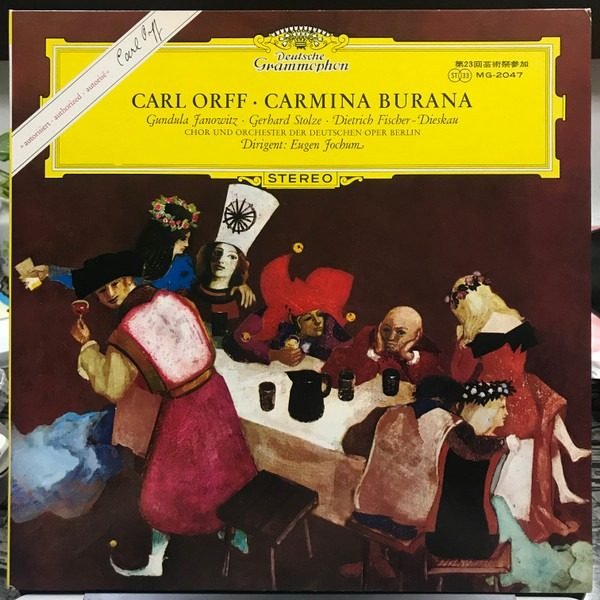
Carl Orff. Carmina Burana - Eugen Jochum. Berlin Deutsche Oper Orchestra - Gundula Janowitz: Soprano - Gerhard Stolze: Tenor
Dietrich Fischer-Dieskau: Baritone - Schonberg Boys Choir
Berlin Deutsche Oper Chorus
CARL ORFF’S CARMINA BURANA: THE HISTORY OF ITS COMPOSITION
Carmina Burana was composed by Carl Orff in 1935–1936 and premiered in Frankfurt am Main on 8 June 1937. From the moment it appeared, it marked a decisive turning point in Orff’s career, becoming not only his most famous work but the composition with which his mature artistic identity truly began.
The title “Carmina Burana” refers to a 13th-century medieval manuscript discovered in 1803 at the Benedictine monastery of Benediktbeuern in Bavaria. The collection contains poems and songs written mainly in Latin, with some texts in Middle High German, and its contents range widely: drinking songs, love songs, moral reflections, satirical verses, and religious pieces. The manuscript was later published under the title Carmina Burana by the scholar Johann Andreas Schmeller, and it was from this source that Orff drew the texts for his work.
What attracted Orff was not simply the medieval origin of the poems, but their raw directness, vivid rhythm, earthy sensuality, and elemental force. These were not refined salon verses or abstract literary meditations. They spoke of fortune, spring, drinking, desire, bodily pleasure, and the instability of human life. Orff immediately sensed that they could be transformed into something theatrical, physical, and almost ritualistic. Because the surviving medieval notation was fragmentary and largely not practically usable for modern performance, he was free to invent an entirely new musical language for them.
Orff did not set the whole manuscript. Instead, he selected 24 poems and organized them into a highly deliberate architecture: a framing chorus, “O Fortuna,” followed by three main sections—“Primo Vere” and “Uf dem anger” for the arrival of spring and dancing youth, “In Taberna” for the tavern world of intoxication and excess, and “Cour d’Amours” for the realm of erotic desire and love. At the end, “O Fortuna” returns, giving the whole composition a circular design governed by the medieval image of the Wheel of Fortune.
This structure was central to the conception of the work. Orff was not writing a conventional cantata in the old academic sense. He imagined a scenic cantata—something halfway between concert work, ritual theater, and stylized stage action. Even when performed in the concert hall, Carmina Burana carries within it a latent dramatic impulse. Its choruses do not simply “comment”; they proclaim, celebrate, shout, mock, seduce, and threaten. The music was conceived from the beginning as something physical, communal, and theatrical.
Musically, Orff rejected the dense chromaticism and philosophical complexity associated with much late-Romantic and post-Wagnerian German music. Instead, he pursued a style built on short melodic cells, obsessive rhythmic repetition, stark harmonic simplicity, massive choral declamation, and powerful percussion. This was one of the most original aspects of the score. Rather than developing long symphonic arguments, Orff preferred block-like construction, immediate impact, and primal momentum. The result was music that sounded at once ancient and modern—archaic in spirit, yet unmistakably of the 20th century.
One of the reasons the work made such a strong impression was precisely this sonic world. The orchestration is often described as simple, but that simplicity is deceptive. Orff used the orchestra and chorus with extraordinary instinct for color and impact, especially through rhythmic percussion and sharply profiled choral writing. The famous opening of “O Fortuna” became one of the most instantly recognizable passages in all modern music because it compresses so much force into such direct means.
The composition of Carmina Burana also marked a personal watershed for Orff. Later accounts note that after the success of the premiere he regarded his earlier output as belonging to a different phase and treated this work as the true beginning of his mature catalogue. In other words, Carmina Burana was not merely one success among others: it was the work by which Orff effectively redefined himself.
Historically, the premiere took place in Nazi Germany, which has inevitably made the context of the work more complicated. The premiere itself was a major event in 1937, and the composition quickly achieved prominence. But the enduring power of Carmina Burana lies less in that political moment than in the extraordinary directness of its artistic conception: a medieval text collection reborn through a modern language of rhythm, ritual, chorus, and theatrical concentration.
Orff later placed the work at the head of a larger triptych called Trionfi, followed by Catulli Carmina and Trionfo di Afrodite. Yet Carmina Burana has always stood apart as the most popular and universally performed of the three. Its appeal has proved enormous because it unites several things listeners feel immediately: the terror of fate, the joy of spring, the intoxication of pleasure, and the dark instability of human fortune.
In the end, the story of its composition is the story of a composer finding exactly the right material for his deepest instincts. Orff discovered in a medieval manuscript a world of texts that allowed him to escape both academic convention and late-Romantic excess. Out of that encounter he created a work of elemental rhythm, collective energy, and unforgettable theatrical force. That is why Carmina Burana still sounds less like a historical reconstruction than like a ritual rediscovered.