16 April 2026
The Childhood of Ludwig van Beethoven (III): The Apprentice of Genius (1779–1783)
On Classicapedia: Ludwig van Beethoven, Christian Gottlob Neefe, Johann Sebastian Bach, Wolfgang Amadeus Mozart, Ernst Christoph Dressler
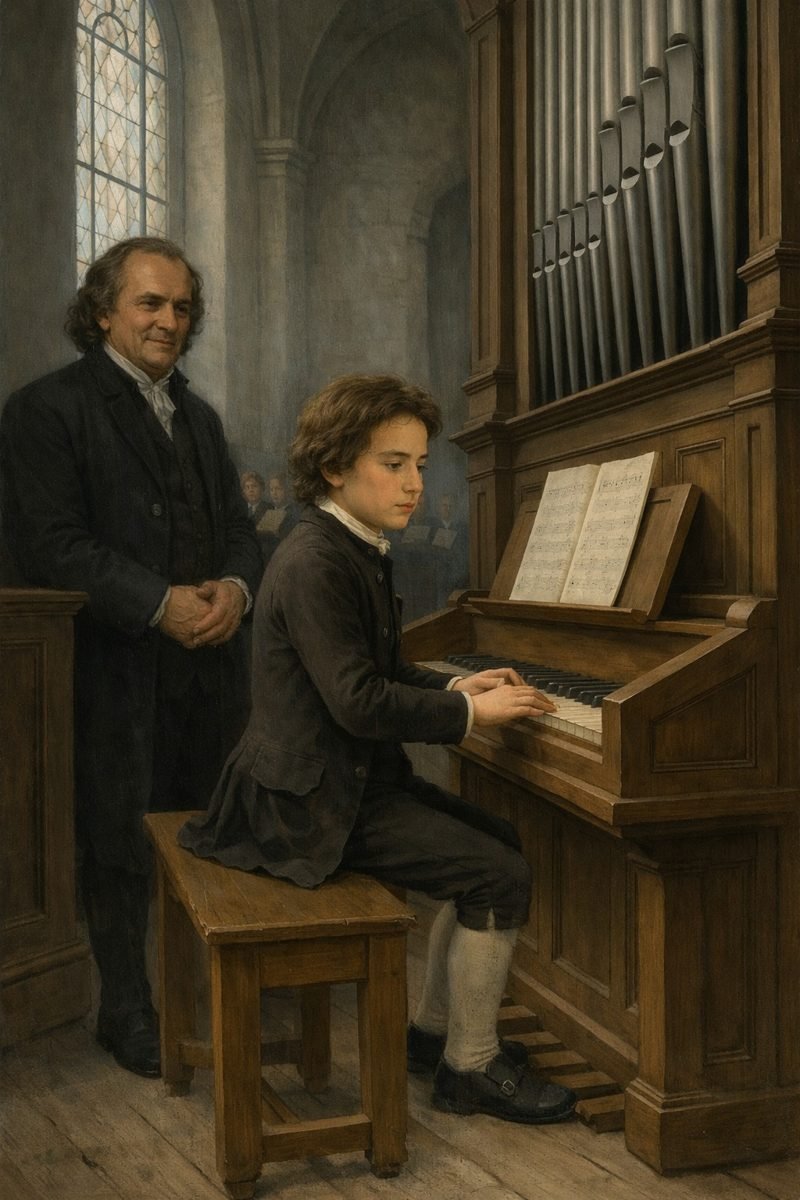
“The Apprentice to Genius” (1779–1783)
Chapter 15: The Arrival of Neefe
In the spring of 1779, a new figure entered Beethoven’s life — Christian Gottlob Neefe, a composer, organist, and philosopher from Saxony, who had just been appointed court organist in Bonn. Neefe was a man of the Enlightenment: cultivated, rational, and steeped in the humanistic spirit of the age. He read Kant, Goethe, and Schiller, and believed that music should serve not merely to entertain, but to elevate the human soul.
From the first meeting, Neefe recognized the boy’s potential. Beethoven, then only eight or nine, possessed not only remarkable technique but a seriousness far beyond his age. Neefe later wrote:
“If he continues as he has begun, he will surely become a second Mozart.”
Under Neefe’s guidance, Beethoven’s musical education acquired structure. For the first time, he studied harmony, counterpoint, and composition systematically. Neefe made him copy out and analyze the works of Johann Sebastian Bach, particularly The Well-Tempered Clavier, whose polyphonic intricacies fascinated the boy. Beethoven once told a friend, “I learned from Bach how God moves through sound.”
Neefe’s lessons transformed the turbulent energy of his early improvisations into disciplined thought. The young Beethoven began to understand that freedom and structure are not opposites but partners — a revelation that would remain at the heart of his art forever.
Chapter 16: The Influence of Enlightenment Thought
Neefe’s influence extended beyond music. He introduced Beethoven to the ideals of the Age of Reason — the belief that art and intellect could ennoble humanity. He encouraged him to read philosophical works, to think for himself, and to cultivate inner strength.
At Neefe’s home, Beethoven encountered conversations about literature, politics, and morality. He heard the names Voltaire, Rousseau, and Lessing, and absorbed the notion that the artist must also be a moral being. These discussions left deep impressions. They shaped the adolescent’s conviction that the purpose of art was not luxury, but truth — a conviction he would later express in his music and letters.
Though still a boy, Beethoven began to think like a young philosopher. His natural gravity of expression deepened. The Breuning family noticed the change; he spoke less, listened more, and his eyes seemed “lit by some inward fire.” Even at that tender age, he was becoming the thinker at the keyboard.
Chapter 17: First Works and the Birth of Style
Under Neefe’s encouragement, Beethoven began to compose more seriously. His earliest surviving pieces date from 1782, when he was just eleven or twelve years old. Among them are a set of Nine Variations on a March by Ernst Christoph Dressler (WoO 63) — published that same year in Mannheim — his first printed work.
Though a small composition, the piece already reveals Beethoven’s identity: bold harmonies, unexpected modulations, and rhythmic vitality. Neefe was proud enough to submit it to Cramer’s Magazin der Musik in 1783, accompanied by a notice that would become legendary:
“This young genius deserves support to travel to Vienna and study with Mozart. He plays the harpsichord and organ with great skill, and if he continues as he has begun, he will be one of the greatest composers of Europe.”
In addition to the Dressler Variations, Beethoven wrote short dances, keyboard sonatas, and exercises in counterpoint, often under Neefe’s supervision. These were no childish imitations but experiments in voice-leading and texture. He explored the contrasts between tension and release, light and shadow — a premonition of his later dramatic style.
Chapter 18: Assistant Organist at the Electoral Chapel
By 1782–1783, Beethoven’s progress astonished his teachers. When Neefe was absent from Bonn, the Elector Maximilian Friedrich allowed the young Beethoven — barely twelve — to serve as assistant organist at the Electoral chapel.
It was an extraordinary responsibility. Every Sunday, the boy sat at the great organ of the court church, directing the choir and accompanying Masses. The solemn grandeur of the service, the echoing acoustics, and the spiritual dignity of the instrument left a lasting impression on him. The organ became for Beethoven what the orchestra would later be — a cathedral of sound, a medium through which human emotion touched the divine.
He was punctual, humble, and completely absorbed in the work. Older musicians treated him with respect tinged with astonishment. Many remembered seeing the small, serious boy climbing the organ loft with his scores tucked under his arm, his expression grave but luminous. It was there that Beethoven first experienced the sacred solitude that would define his creative life.
Chapter 19: The Young Artist’s Reputation
By 1783, Beethoven had become known throughout Bonn’s small but vibrant musical community as a prodigious young musician. He played continuo for the court orchestra, accompanied singers at rehearsals, and even substituted for senior performers. Word spread quickly: “There is a boy in Bonn who improvises like a master.”
Members of the Breuning family and local patrons occasionally invited him to play at private gatherings. In these evenings, he astonished listeners with his improvisations on given themes — a skill that would remain his hallmark throughout his life. One guest recalled:
“He seemed possessed; his eyes lifted, and the notes flowed as if from another world.”
Yet fame brought him no luxury. The family still lived modestly, and his father’s alcoholism continued to cast a shadow. Money was scarce, and the burden of expectation weighed heavily on the boy. But hardship only hardened his resolve. He once told Neefe, “I must become a great man — for poverty will not make me small.”
That mixture of humility and burning will was already the essence of Beethoven.
Chapter 20: Glimpses of Inner Life
In the quiet hours of the night, Beethoven would sit by the window of the family’s small home on Bonngasse, watching the flicker of the Rhine’s reflection under moonlight. He loved to walk alone by the riverbanks, listening to the wind in the poplars and the distant bells of Bonn Cathedral. Music, for him, was not a profession — it was the language of nature and of the soul.
Friends noticed that he was happiest when playing the organ or improvising at the clavichord. His playing became both prayer and rebellion — a dialogue with forces greater than himself. Already, he was turning solitude into creation, transmuting suffering into sound.
By the close of 1783, the twelve-year-old Beethoven stood on the threshold of his adolescence: a boy hardened by discipline, illuminated by genius, and beginning to sense the vast destiny ahead. Neefe’s prophecy — that he would become one of Europe’s greatest composers — no longer seemed far-fetched.
The child of Bonn had become the apprentice to eternity.
PHOTO AI: Ludwig van Beethoven in 1783, aged twelve, seated before the great organ of the Electoral Chapel in Bonn. The interior glows with soft daylight filtering through stained glass, illuminating the polished wood of the organ pipes. Beethoven’s small figure, dressed in a dark waistcoat and breeches, sits upright, his hands poised on the keys, his face calm yet illuminated with silent concentration. Behind him, Christian Gottlob Neefe stands in shadow, watching with quiet pride. In the distance, the choir is faintly visible, their scores raised in devotion.