16 April 2026
The Childhood of Ludwig van Beethoven (II): The Young Musician of Bonn (1774–1778)
On Classicapedia: Ludwig van Beethoven, Tobias Friedrich Pfeiffer, Gilles Van den Eeden
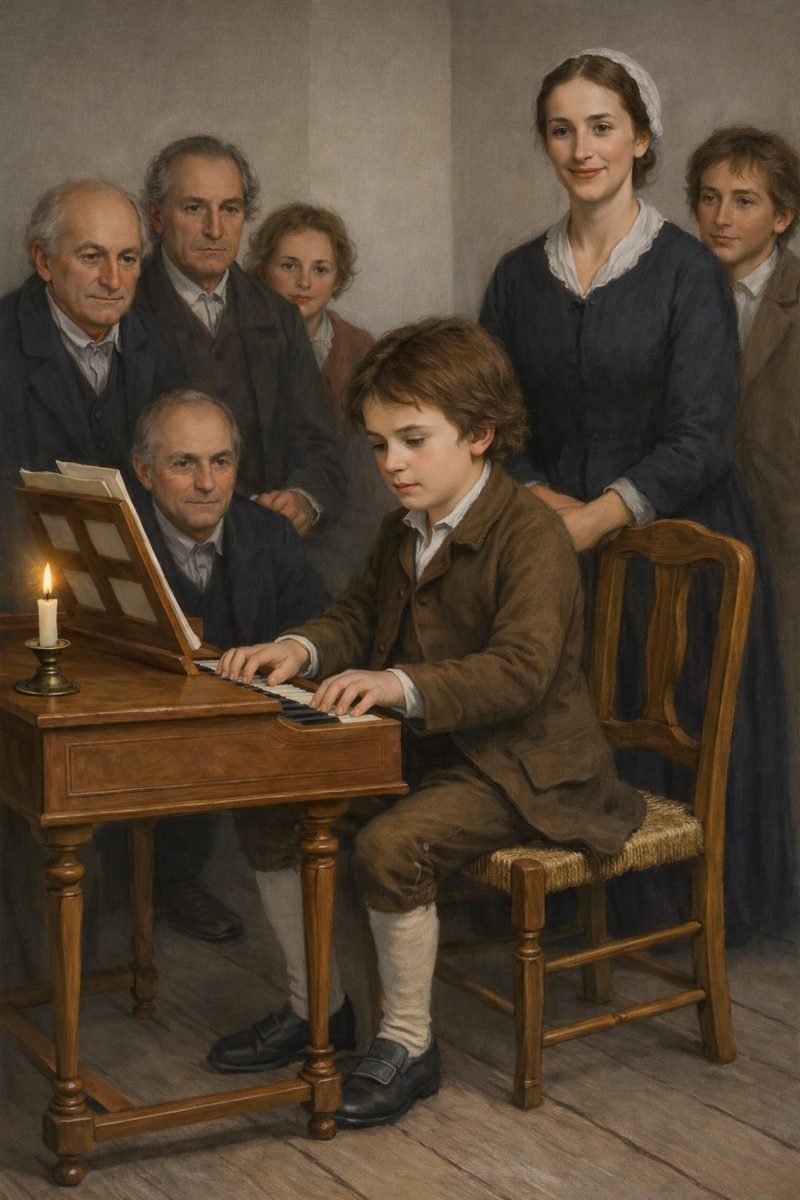
“The Young Musician of Bonn” (1774–1778)
Chapter 8: The Awakening of Musical Mind
By 1774, Ludwig was four years old and already known among neighbors for his precocious ability to reproduce melodies by ear. His small hands barely reached the octaves, but his sense of rhythm and pitch astonished anyone who heard him. His father Johann, though unreliable, took pride in parading the boy before visitors. “He will be the new Mozart!” he declared, dragging Ludwig from sleep to play sonatas or sing scales late into the night.
But the child’s talent was no longer mere mimicry. He began to explore the keyboard as a world of colors, inventing short melodies of his own, surprising his father by modulating from one key to another with intuition rather than knowledge. His mother, Maria Magdalena, watched silently, torn between admiration and concern. “He plays as if dreaming,” she once said to a friend, “and sometimes he forgets to eat.”
Outside their modest house on Bonngasse, the city stirred with the sounds of parades and church bells. Bonn’s musical culture, centered around the Elector’s court, offered Ludwig the first glimpses of a wider world — one where music was both profession and art.
Chapter 9: The Elector’s Chapel and the Court Musicians
The Elector of Cologne, Maximilian Friedrich, maintained a court ensemble that employed some of the region’s best musicians. Though small, this orchestra mirrored the artistic excellence of the German principalities. Among its members were several who would later influence the young Beethoven profoundly: Christian Gottlob Neefe, Franz Rovantini, and Gilles van den Eeden.
Through his father’s position as tenor, Ludwig was granted occasional access to rehearsals in the court chapel. He would stand quietly in a corner, watching the violinists tune and the organist draw stops. The solemnity of the Mass and the grandeur of the Electoral concerts left a deep impression. Unlike the drunken noise of taverns where his father often sang, this was music of dignity — a revelation.
By the time he was six, he was already able to play simple keyboard works by Carl Philipp Emanuel Bach and Johann Christian Bach — the sons of the great Sebastian. Their expressive, stormy style, filled with sighing motifs and sudden contrasts, spoke directly to the young Beethoven’s temperament. Even before formal schooling, he seemed destined for “Empfindsamkeit” — the art of feeling.
Chapter 10: The First Teachers
In 1776, the family hired Tobias Friedrich Pfeiffer, a traveling musician who temporarily lived in their home. Pfeiffer was gentle and eccentric — a contrast to Johann’s harshness. He often played duets with Ludwig late into the night, encouraging improvisation. The two would exchange themes and variations by candlelight, and the boy’s imagination began to expand. It was perhaps with Pfeiffer that he experienced for the first time the joy of musical freedom, the act of creation rather than repetition.
Later, another teacher, Gilles van den Eeden, organist at the court, introduced him to more formal techniques: counterpoint, figured bass, and church harmony. Ludwig’s response was instinctive; he absorbed complex rules as if rediscovering what he already knew.
At the same time, his violin studies advanced under Franz Rovantini, a court musician who taught him bow control and tone. Rovantini saw in him a fierce concentration: “He played with such seriousness,” he later said, “that one forgot his age.”
Through these mentors, Beethoven’s education began to take shape — not as a prodigy drilled by ambition, but as a natural musician finding structure for his inner fire.
Chapter 11: The First Concerts
In 1778, Johann decided to present his son to the public as a child prodigy. He arranged a concert at Cologne, announcing “a boy of six years” — though Ludwig was in fact nearly eight, his father lowering the age to increase the impression of genius.
The program likely included short keyboard works, improvisations, and perhaps simple sonatas. Though no detailed report survives, local witnesses remembered the event as remarkable. The boy played with gravity beyond his years, his eyes fixed on the keyboard, his face pale with concentration. After the performance, some compared him to the young Mozart who had toured Europe two decades earlier.
But unlike Mozart, Ludwig’s path was not gilded. There were no royal patrons, no lavish journeys, no parental diplomacy. Bonn was provincial; its opportunities were few. Yet the concert marked a crucial moment: the first public emergence of a genius who would transform the musical world.
Johann’s expectations were grand, but the household’s poverty persisted. The dream of international fame faded quickly; Ludwig returned to his daily lessons, unaware that destiny was quietly gathering around him.
Chapter 12: The Breuning Family — A World of Warmth
Around 1778, Beethoven’s life took a gentler turn. Through mutual acquaintances, he came into contact with the Breuning family, one of the most cultivated households in Bonn. The matriarch, Helene von Breuning, was an intelligent and benevolent woman who soon took pity on the serious, shy boy.
She invited him into her home to give piano lessons to her children — Eleonore, Christoph, and Lorenz. There he found what he had never known before: an atmosphere of affection, culture, and refinement. Books lined the walls, conversation was witty and kind, and laughter replaced his father’s shouting. Helene treated him almost as a son; he addressed her as “my second mother.”
Through the Breunings, Beethoven was introduced to German literature — especially Klopstock, Schiller, and Goethe — which would later shape his moral and poetic world. The girl Eleonore, graceful and intelligent, became his first innocent affection, a friendship tinged with admiration and tenderness.
For the first time, Beethoven began to understand that music could express not only discipline and skill, but human feeling. The Breuning household opened his heart as much as the court had opened his ear.
Chapter 13: Early Compositions and Experiments
During these same years, Ludwig began to write his first small compositions — keyboard variations, short dances, and fragments of songs. One early work, Nine Variations on a March by Dressler (WoO 63), was likely written around 1782, but sketches from earlier years suggest that he was already experimenting with melody by 1778–79.
Even in these miniature forms, one senses the embryo of the Beethovenian voice: firm rhythmic identity, unexpected harmonic turns, and a powerful inner pulse. The boy’s music was not decorative but urgent, as if compelled to speak.
He also began to improvise extensively, turning the themes of other composers into spontaneous fantasias. Visitors recalled that he would sit at the clavichord, eyes closed, inventing whole structures on the spot, moving from major to minor, from calm to storm — a foretaste of his later creative storms.
Chapter 14: Between Two Worlds
By the end of 1778, Beethoven stood between two worlds — that of a child shaped by poverty and discipline, and that of a budding artist awakening to freedom and thought. His relationship with his parents remained strained: Johann saw him as a vehicle for ambition; Maria Magdalena, though loving, was worn down by hardship.
Yet Bonn itself, small and provincial as it was, became his first true stage. Its churches, salons, and private gatherings were filled with music, and Ludwig, still not ten, was beginning to be recognized among the city’s musicians as something more than a curiosity. He was a mind in formation, a boy whose silence concealed a vast interior landscape.
The contrast between the tenderness of the Breuning home and the coldness of his own formed a duality that would remain with him for life — a longing for human warmth against the harshness of fate, a theme that would later echo in every slow movement he wrote.