30 May 2026
The Beginning: An Orchestra Becomes Independent. The Birth of the Berlin Philharmonic in 1882
On Classicapedia: Ernst Rudorff, Franz Wüllner
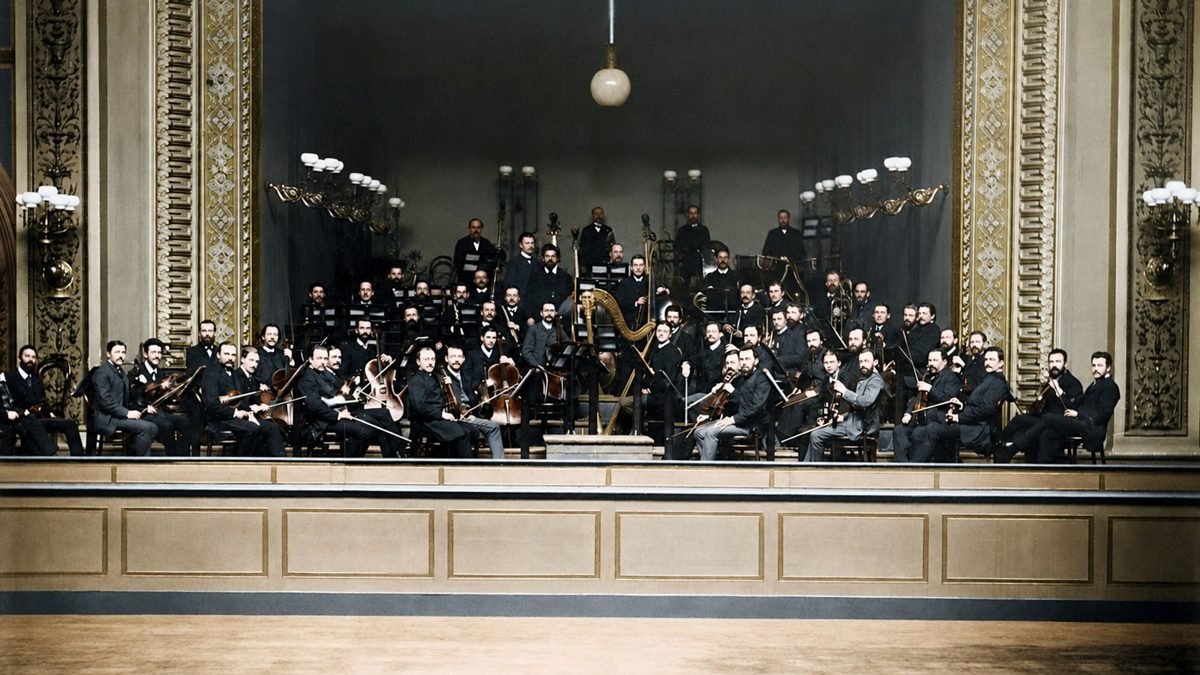
The Birth of the Berliner Philharmoniker in 1882
A great orchestra born not from royal patronage, but from rebellion
The history of the Berliner Philharmoniker does not begin with an imperial decree, a magnificent concert hall, or the appointment of an illustrious conductor. It begins instead with a collective refusal. In March 1882, a group of musicians working in the orchestra of the popular Berlin conductor Benjamin Bilse refused to sign new contracts that they considered humiliating. Their pay was scarcely superior to that of ordinary day labourers, and the conditions imposed upon them reflected the precarious position of professional orchestral musicians in late nineteenth-century Berlin.
The official history of the Berliner Philharmoniker states that fifty musicians rejected Bilse’s contracts in March 1882; its biographical account of Bilse refers to fifty-four founding members of the new orchestra. The essential fact remains clear: a substantial body of Bilse’s players chose to abandon the relative security of employment under their former director and to establish an ensemble of their own, working at their own financial risk and under their own responsibility.
This was a remarkably bold decision. An orchestra in the nineteenth century was rarely an independent artistic democracy. Musicians generally depended upon courts, theatres, municipal institutions, or private impresarios. The foundation of the Berliner Philharmoniker was therefore more than a change of employer: it was an act of professional self-assertion, the declaration that musicians could shape their own artistic future rather than submit indefinitely to unfavourable conditions.
Benjamin Bilse: the man who created the conditions for his own orchestra’s rebellion
Benjamin Bilse should not be dismissed merely as the oppressive employer against whom the musicians rebelled. In fact, without Bilse there would probably have been no Berliner Philharmoniker in the form in which it emerged. Born in 1816 in Liegnitz, in Silesia, he had received practical training as a town musician from the age of fourteen, learning the workings of orchestral instruments from the inside. He later travelled to Vienna, where he played violin in the orchestra of Johann Strauss the Elder.
Returning to Liegnitz in 1842, Bilse gradually raised the standard of the local town band. He was not only a capable conductor but also a shrewd musical organizer. He taught talented young musicians who lacked financial means, expanded his ensemble’s repertory and took it on increasingly ambitious tours. By the time he left Liegnitz in 1865, the group had long been known as the Bilsesche Kapelle — Bilse’s Orchestra.
In 1867 Bilse and his musicians settled in Berlin. There they became a conspicuous part of the city’s musical and social life, performing daily during the winter season in the Konzerthaus on Leipziger Strasse. These concerts appealed to a wide public: listeners could encounter respected classical works, lighter entertainment pieces and compositions by younger or unfamiliar composers. Bilse’s orchestra was not an élite institution in the later sense of the Berlin Philharmonic; it was a highly visible, flexible and commercially successful ensemble that helped create an audience for orchestral music in the German capital.
Yet Bilse’s strengths as an entrepreneur also contained the seeds of the conflict. He controlled his orchestra as a private enterprise, and the musicians remained dependent on conditions they had little power to negotiate. One widely transmitted account of the immediate dispute recalls that Bilse intended to take the already poorly paid orchestra on a tour to Warsaw travelling in fourth-class railway accommodation. Whether one emphasizes that specific episode or the unfavourable contracts themselves, the musicians clearly felt that their artistic labour was no longer being treated with dignity.
The “Former Bilse’s Ensemble”: the first identity of the new orchestra
When the dissident musicians broke away, they initially called themselves the “Former Bilse’s Ensemble” — Die frühere Bilsesche Kapelle. The name was revealing. It acknowledged their origin and, at the same time, announced their separation from the man who had previously defined their professional existence.
At first, their programmes did not radically differ from Bilse’s model. The new ensemble continued to perform Popular Concerts, in which accessible and entertaining music played an important role, while its more ambitious Symphony Concerts included challenging repertoire and “novelties” by contemporary composers. This was necessary for survival: the musicians needed a broad audience and could not immediately rely upon the prestige associated with the later Philharmonic tradition.
The circumstances were modest. Berlin in 1882 was politically powerful, but it was not yet the leading musical capital it would later become. In orchestral culture, Leipzig and Vienna still possessed greater prestige, more developed concert traditions and more impressive halls. The earliest appearances of the emerging Philharmonic Orchestra took place not in a grand temple of music, but in an open-air restaurant. From the summer of 1882, it performed in the hall of a converted roller-skating rink in Bernburger Strasse, a building seating approximately two thousand people. After renovation and improvement, this unlikely venue became the old Philharmonie, the orchestra’s historic first home.
There is something symbolically appropriate in this origin. The Berliner Philharmoniker, later associated with the most exalted standards of orchestral art, first established itself in a repurposed popular-entertainment space. Its greatness was not inherited: it had to be built.
Hermann Wolff: the entrepreneur who turned rebellion into an institution
The breakaway musicians possessed courage and talent, but independence alone could not guarantee survival. They required organization, prestige, subscribers, influential contacts and a viable financial structure. At this crucial moment, the most decisive external figure entered their history: Hermann Wolff.
Born in Cologne in 1845 and raised in Berlin from childhood, Wolff combined musical instinct with extraordinary entrepreneurial ability. In 1880 he founded his own Concert Bureau in Berlin and rapidly became one of the most influential concert agents of his era. He understood not only artists, but also audiences, publicity, subscription systems and the mechanisms through which an orchestra could become an enduring cultural institution.
From the beginning, Wolff supported the new orchestra administratively. He organized a subscription concert series, provided professional counsel and helped guide the ensemble away from financial collapse. Under his influence, the former Bilse musicians increasingly assumed the name Berliner Philharmonisches Orchester. Wolff was not merely an agent who booked concerts; he was effectively one of the architects of the orchestra’s future identity.
His contribution became even more decisive because he could attract distinguished musicians and conductors. He placed the young orchestra in contact with the musical élite of Europe, procuring important soloists and eventually bringing to its subscription concerts two conductors who would transform its reputation: Hans von Bülow and, later, Arthur Nikisch. In this respect, Bilse had provided the musicians and the initial public platform; Wolff gave the new institution the means to endure and to aspire to greatness.
The first conductors: Ludwig von Brenner, Ernst Rudorff and Franz Wüllner
Before the arrival of Hans von Bülow, the orchestra’s first years were guided by conductors who helped demonstrate that this was more than a rebellious group of displaced musicians. Ludwig von Brenner became its first artistic leader and is generally regarded as the orchestra’s initial principal conductor, serving from 1882 to 1887. He had the difficult task of preserving musical discipline while the ensemble was still fighting for economic survival and public recognition.
The orchestra also gained important early successes under Ernst Rudorff and especially Franz Wüllner, both respected representatives of German musical life. Their involvement helped raise the ensemble beyond the level of popular concert entertainment. Under such conductors, the orchestra increasingly acquired the ambition to become a serious symphonic body capable of presenting demanding works with authority.
Yet these artistic advances did not eliminate the financial danger. An independent orchestra had to pay its musicians, secure audiences and compete for prestige in a city whose musical institutions were still developing. The very freedom won in 1882 could easily have resulted in bankruptcy.
Joseph Joachim: prestige, support and rivalry
In its struggle for stability, the orchestra entered into cooperation with the Royal Music Conservatory, directed by the celebrated violinist Joseph Joachim. Joachim was one of the most distinguished musicians of his age, closely associated with Brahms and revered as a guardian of serious German musical tradition. The Philharmonic musicians agreed to make themselves available for a certain number of Conservatory concerts, a relationship that offered both practical security and artistic prestige.
However, this alliance also introduced a tension into the orchestra’s development. Joachim and Hermann Wolff represented different conceptions of musical authority and institutional direction. Joachim embodied the conservatory world, artistic tradition and academic seriousness; Wolff represented modern concert management, public strategy and entrepreneurial expansion. Rivalry gradually arose between them.
Ultimately, it was Wolff who succeeded in extending his influence over the orchestra. His triumph was not simply administrative: it determined the future course of the Berliner Philharmoniker as a major public concert orchestra rather than as an adjunct to an educational institution. The decisive result of his influence was his ability to secure the services of Hans von Bülow, one of the most formidable conductors of the nineteenth century.
Hans von Bülow: the man who turned promise into greatness
By the time Hans von Bülow became associated with the orchestra’s subscription concerts in 1887, the Berliner Philharmoniker had survived its most uncertain beginnings. But survival was not enough. It still needed an artistic personality capable of imposing uncompromising standards and giving the ensemble a reputation beyond Berlin.
Bülow was ideally suited to this task. A brilliant pianist, an intellectual musician and an exacting conductor, he was already one of the commanding figures of European musical life. Under his influence, the young orchestra was subjected to a discipline and seriousness that would become central to its identity. He demanded precision, stylistic understanding and absolute commitment from the players.
Thus the founding story of the Berliner Philharmoniker unfolds in two stages. In 1882, the musicians gave the orchestra its independence. In the years that followed, Wolff and Bülow gave that independence its institutional and artistic meaning. What began as a protest against poor contracts gradually became one of Europe’s most formidable musical organizations.
The historical meaning of 1882
The creation of the Berliner Philharmoniker is especially remarkable because it reveals that artistic excellence does not always originate in privilege or established prestige. The orchestra was born from insecurity, conflict and risk. Its first members were not merely performers: they were men who wagered their livelihoods on the conviction that their profession deserved better conditions and greater respect.
Benjamin Bilse occupies an ambiguous but essential place in this story. He was the organizer who had assembled and trained the musical forces from which the Philharmonic emerged; yet his treatment of those musicians provoked their departure. He was both the predecessor and the involuntary catalyst of the new orchestra.
Hermann Wolff transformed their rebellion into an organized future. Ludwig von Brenner, Ernst Rudorff and Franz Wüllner helped establish their early artistic credibility. Joseph Joachim offered prestige and temporary institutional support, even as his rivalry with Wolff shaped the orchestra’s direction. Hans von Bülow finally gave the ensemble the severe artistic discipline that enabled it to rise from a fragile independent venture to an orchestra of international consequence.
The Berliner Philharmoniker would later be associated with Nikisch, Furtwängler, Karajan, Abbado, Rattle and Petrenko. Yet behind all that later splendour lies the courageous decision of a group of musicians in 1882: they refused to accept conditions they considered unworthy, left their employer, and created an orchestra of their own.
The history of the Berlin Philharmonic therefore begins not with fame, but with dignity; not with power, but with independence; not with a maestro standing above an orchestra, but with musicians deciding that their collective voice mattered.
Main historical figures
Benjamin Bilse (1816–1902) — conductor and founder of the Bilsesche Kapelle, the immediate predecessor of the Berliner Philharmoniker; a gifted organizer whose unfavourable employment conditions provoked the musicians’ breakaway.
The founding musicians — the players who rebelled against Bilse in 1882, initially performing as the “Former Bilse’s Ensemble” and assuming the risks of independence.
Hermann Wolff (1845–1902) — concert agent and entrepreneurial strategist who organized subscriptions, secured important artists and guided the orchestra through its earliest existential crises.
Ludwig von Brenner (1833–1902) — the orchestra’s first principal conductor, who led it during its difficult first period of independence.
Ernst Rudorff and Franz Wüllner — respected conductors whose appearances helped confirm the artistic ambition of the young ensemble.
Joseph Joachim (1831–1907) — celebrated violinist and director of the Royal Music Conservatory, whose cooperation with the orchestra provided temporary stability and prestige.
Hans von Bülow (1830–1894) — the commanding conductor whose arrival in 1887 elevated the orchestra’s discipline and established the foundations of its international artistic reputation.
Sources
The principal source for this account is the official historical archive of the Berliner Philharmoniker, particularly its sections on the orchestra’s foundation, Benjamin Bilse and Hermann Wolff. Additional confirmation of the founding circumstances and the dispute over working and travelling conditions is provided by visitBerlin, the official tourism portal of Berlin.