8 July 2026
Tadaaki Otaka: A Life of Dignity, Clarity and Orchestral Nobility
On Classicapedia: Tadaaki Otaka, Hisatada Otaka, Hideo Saito, Seiji Ozawa
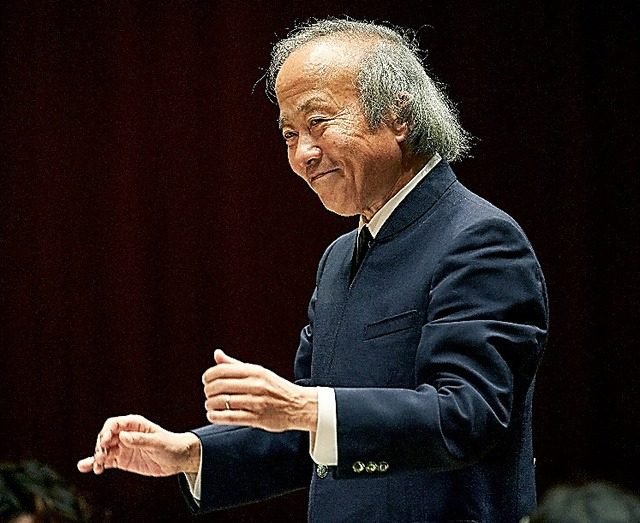
Tadaaki Otaka is one of the most distinguished Japanese conductors of the post-war generation: a musician whose career has united Japanese discipline, European training, British orchestral culture, and a deep commitment to the great symphonic tradition.
Born in Kamakura, Japan, in 1947, he came from a strongly musical background: his father, Hisatada Otaka, was a composer and conductor, and his mother was a pianist.
His formation was rigorous. Otaka studied at the Toho Gakuen School of Music, one of Japan's most important musical institutions, under Hideo Saito, the legendary teacher whose pupils also included Seiji Ozawa and Hiroshi Wakasugi. He later continued his studies in Vienna with Hans Swarowsky and Professor Spannagel, thus absorbing both the Japanese school of precision and the Central European tradition of structural understanding.
Otaka made his professional broadcasting debut in 1971 with the NHK Symphony Orchestra, a significant beginning for a young conductor in Japan. He soon became closely associated with the Tokyo Philharmonic Orchestra, serving for 20 years as its Permanent Conductor and touring extensively in Asia and Europe. In 1991, the Tokyo Philharmonic named him Conductor Laureate, a recognition of a long and formative relationship.
One of the central pillars of Otaka's career has been his long association with the Sapporo Symphony Orchestra. He served as its Chief Conductor from 1981 to 1986, and over four decades helped establish the orchestra internationally through European tours and sustained artistic development. Since 2015, he has held the title of Honorary Music Director of the Sapporo Symphony.
His British career is especially important. In 1987 he became Principal Conductor of the BBC National Orchestra of Wales, a post he held until 1995. His relationship with that orchestra continued long after his official tenure, and he later became its Conductor Laureate. This connection has lasted for more than three decades and remains one of the defining artistic partnerships of his life.
Otaka's work in Britain also brought him particular distinction in British repertory, especially Elgar. His recordings with the BBC National Orchestra of Wales helped consolidate his reputation as a conductor of noble line, broad architecture, and emotional restraint. For his services to music in the United Kingdom, he received an honorary CBE, and in Japan he has received the Suntory Music Award, one of the country's major musical honours.
His repertoire has always been broad, but his artistic personality seems particularly suited to music requiring clarity, long-breathed phrasing, colour, and symphonic control. He has been associated with late Romantic and early twentieth-century composers such as Elgar, Rachmaninov, Prokofiev, Richard Strauss, and Franck, while also conducting a wide range of orchestral and operatic music.
Otaka has also been active in the operatic field. He served as Artistic Director of the New National Theatre, Tokyo from 2010 to 2014, showing that his musical authority extends beyond the concert platform into staged drama, vocal architecture, and institutional leadership. Between 2009 and 2012 he was also Principal Guest Conductor of the Melbourne Symphony Orchestra.
In 2018, he became Music Director of the Osaka Philharmonic Orchestra, another major chapter in his Japanese career. This appointment confirmed his continuing importance in Japan's orchestral life after decades of international activity.
What defines Otaka most deeply is not flamboyance, but authority without excess. His conducting suggests seriousness, order, balance, and respect for the score. He is the kind of conductor whose art is built on patience, craft, culture, and long loyalty to orchestras. His career has been shaped less by spectacle than by durable relationships: Tokyo, Sapporo, Wales, Osaka, Melbourne, and the international guest-conducting circuit.
Tadaaki Otaka's life is therefore the story of a conductor who became a bridge between musical worlds: Japan and Europe, the concert hall and the opera house, institutional leadership and pure musical service. His legacy is that of a musician of nobility, refinement, discipline, and profound orchestral integrity.