16 May 2026
Otto Klemperer and Johanna Geisler: A Marriage Between Theatre, Exile, Music, and Survival
On Classicapedia: Otto Klemperer, Friedrich Schorr, Erich Wolfgang Korngold, Alexander Zemlinsky
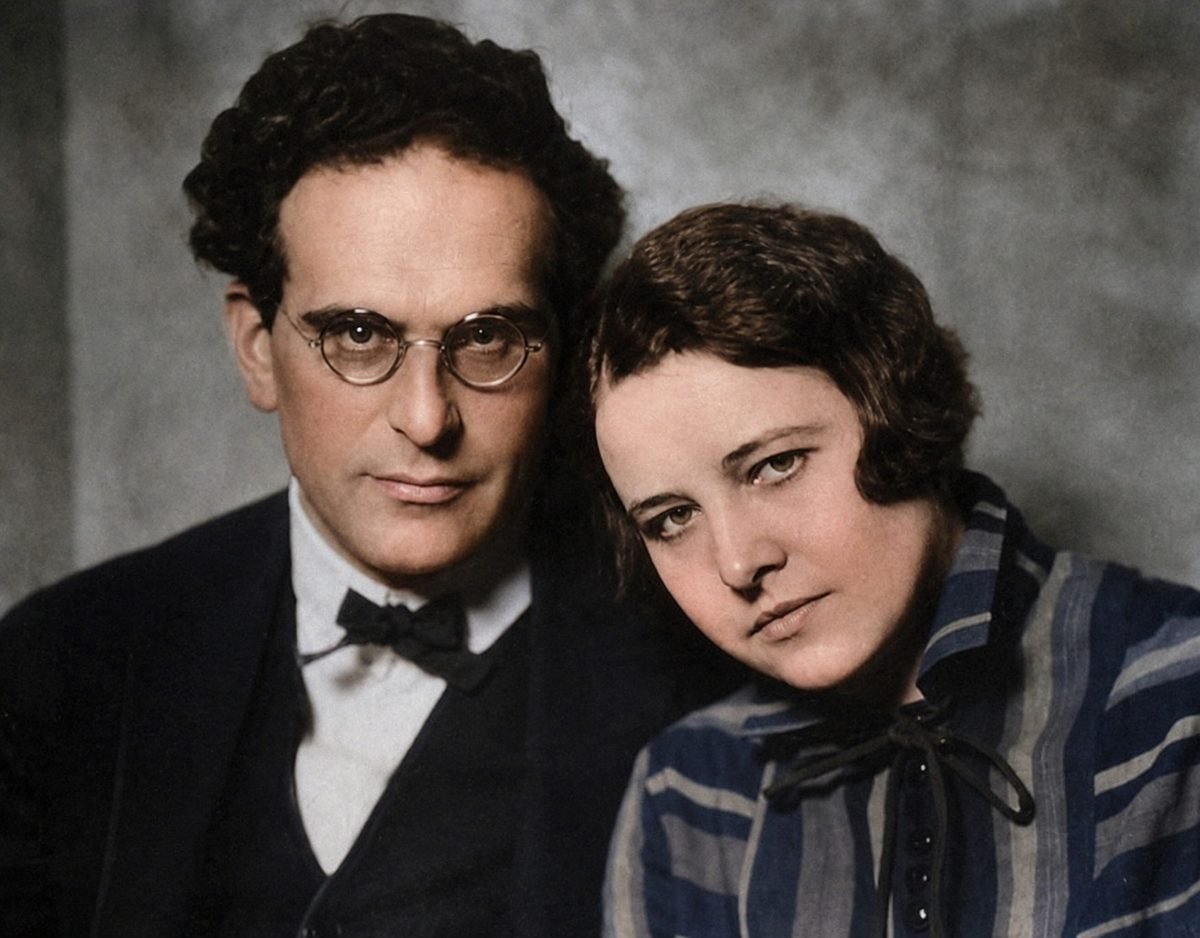
A Relationship Born in the Opera House
The relationship between Otto Klemperer and Johanna Geisler was not a secondary episode in the conductor’s life. It belonged to the very centre of his human and artistic existence. They met in the world of German opera, at a time when Klemperer was becoming one of the most powerful young conductors in the German-speaking theatre system and Geisler was already a working soprano of considerable dramatic instinct.
Johanna Geisler, born Johanne Elisabeth Meyer in Hanover in 1888, began her career very young, first in the chorus of the Hanover Court Opera and later as a soloist in Mainz and Cologne. She was not merely “the wife of Klemperer”; she had her own stage identity as a soprano and actress, appearing under several names, including Johanna Klemperer, Johanna Klee, and Hanne Klee. Her career included Mozart, Bizet, Strauss, Offenbach, Korngold, Hindemith, and other repertory, and she became especially associated with the Cologne Opera, where she met Klemperer.
Their relationship began in an environment where music, theatre, professional ambition, and personal intensity were inseparable. Klemperer was never an easy man, and Geisler was not a passive companion. Contemporary descriptions present her as lively, humorous, strong-nerved, and resilient — exactly the sort of temperament required to live beside a conductor of Klemperer’s force, instability, and severity.
Cologne: The Decisive Musical and Personal Bond
The crucial setting of their relationship was Cologne. Klemperer was chief conductor of the Cologne Opera from 1917 to 1924, a period in which he consolidated his reputation as one of the most formidable conductors of his generation. Geisler joined the Cologne Opera in 1916 and quickly became active in a wide repertory. In the 1915–16 season alone, records show her involved in 23 of 44 productions, an indication of her importance within the company.
Their professional contact became intense. In 1917, Klemperer conducted Beethoven’s Fidelio in Cologne with Geisler as Marzelline. The symbolism is striking: Beethoven’s opera of imprisonment, fidelity, moral courage, and liberation became one of the early artistic links between them. Geisler later appeared in roles such as Despina, Susanna, Cherubino, the Countess, and Donna Elvira in Mozart, and she also sang demanding modern repertory under Klemperer’s direction.
Before marrying Klemperer, Geisler had had a close relationship with the baritone Friedrich Schorr, who apparently expected to marry her. That episode gives the story a more human complexity: her marriage to Klemperer was not simply the inevitable union of conductor and soprano, but the result of a personal decision made amid professional and emotional entanglements.
The Marriage of 1919: Catholic Conversion, Music, and Private Ritual
Klemperer, born into a Jewish family, converted to Catholicism in the period surrounding the marriage. This conversion was not a small biographical detail: it reflects the complex intersection of love, religion, identity, and social life in early twentieth-century Germany. He and Geisler married on 16 June 1919 in a Jesuit chapel in Cologne, in the presence of a small circle of family and friends that included the philosopher Max Scheler.
Immediately after the ceremony, the marriage was linked again to music. The couple took part in a private rehearsal of Klemperer’s Missa sacra at the Gürzenich. This detail is extremely revealing. Their wedding was not followed merely by social celebration; it was framed by sacred composition, rehearsal, performance, and the atmosphere of musical vocation. For Klemperer, life and music were rarely separate, and Johanna entered not simply into a domestic marriage but into the turbulent religious, artistic, and psychological world of a conductor-composer.
In 1923, Geisler sang the soprano part in the first public performance of Klemperer’s Missa sacra, a difficult work whose soprano writing was noted by critics as exceptionally demanding. This was more than spousal support; it was artistic collaboration at a high level.
Artistic Collaboration: Korngold, Zemlinsky, Hindemith, and the Modern Stage
One of the most important artistic moments in Geisler’s career came with Erich Wolfgang Korngold’s Die tote Stadt. She performed Marietta in the world premiere at Cologne on 4 December 1920, with Klemperer conducting. The opera had a simultaneous premiere in Hamburg, but the Cologne production remains one of the major events connecting the couple artistically.
This is important because it places their relationship at the heart of post-war German operatic modernity. They were not confined to the safe repertory of Mozart and Beethoven. They were involved in the living theatre of their time. Klemperer’s reputation as a champion of new music and Geisler’s willingness to perform demanding contemporary roles made them, for a time, a true operatic partnership.
In 1922, she also appeared in the Cologne premiere context of Alexander Zemlinsky’s Der Zwerg, conducted by Klemperer. Later, in 1927, she sang Hélène in the world premiere of Paul Hindemith’s short opera Hin und zurück at the Baden-Baden Festival.
The image that emerges is not of a domestic wife standing behind a famous husband, but of a soprano who belonged to the same artistic battlefield: new opera, difficult scores, theatrical experimentation, and the modern stage.
Berlin and the Kroll Opera: The Radical Period
When Klemperer moved to Berlin’s Kroll Opera in 1927, Geisler followed him into one of the most experimental institutions of Weimar musical life. At the Kroll, she appeared under various names, including Hanne Klee, and sang roles including Susanna, Donna Elvira, Marzelline, Luisa Miller, Marie in Smetana’s The Bartered Bride, Madama Butterfly, Hélène in Hindemith’s Hin und zurück, and Adele in Die Fledermaus.
The Kroll Opera was not merely another opera house; it was a laboratory for modern staging and musical renewal. Geisler’s presence there shows that she shared, or at least lived within, Klemperer’s most radical artistic phase. The couple’s life was therefore tied to one of the great cultural experiments of the Weimar Republic.
Yet this period also exposed the cost of such a life. Geisler’s voice, described as natural and not fully shaped by systematic professional training, began to suffer under the pressure of wide-ranging and sometimes heavy roles. After a vocal crisis, she performed less frequently.
This decline must have altered the balance of the relationship. In the early years, Geisler was an active stage partner; later, she increasingly became the companion of Klemperer’s career rather than a singer at its centre.
Family Life: Werner, Lotte, and the Domestic World Around a Difficult Genius
Otto and Johanna had two children: Werner Klemperer, born in 1920, who later became an actor, and Lotte Klemperer, born in 1923, who later became closely involved in her father’s life and legacy.
The family photographs of Klemperer with Johanna and the children are especially revealing because they show a private side often hidden behind the severe public image. Klemperer is remembered as monumental, sarcastic, unstable, and authoritarian, yet the family images show tenderness, domestic proximity, and dependence. Johanna’s role was probably not simple. She lived beside a man of enormous artistic stature but also of emotional volatility, serious illness, and later exile.
Lotte’s later role is especially significant. After Johanna’s death in 1956, Lotte became the guardian of Klemperer’s personal life and increasingly acted as his assistant and caregiver. This suggests that Johanna had previously occupied a crucial stabilizing place in his domestic world.
Nazism and Exile: The Marriage Under Historical Pressure
The rise of Nazism transformed their private life into a matter of survival. Klemperer, Jewish by birth and associated with modernist culture, was directly threatened after 1933. His conversion to Catholicism offered no protection against Nazi racial ideology. He left Germany with Johanna and their children, first moving to Zurich and then, after accepting an American appointment, to the United States.
This exile was a defining test of their relationship. Johanna followed Klemperer from Germany to Switzerland, then to Los Angeles, later back to Europe, including Budapest, and finally again to Zurich. The journey was not glamorous. It meant displacement, adaptation, loss of status, and the psychological burden of being uprooted from the German-speaking musical world that had formed them both.
Geisler’s own career did not flourish in exile in the same way Klemperer’s career partially did. This is one of the quiet tragedies of the relationship. She had been a soprano and actress with an active stage life; exile and vocal problems reduced her independent public identity. Increasingly, she became part of Klemperer’s survival structure — wife, companion, mother, and stabilizing presence.
The Last Years: Zurich, Illness, and a Final Musical Moment
Johanna died in Munich on 3 November 1956. One of the most moving details of her final days is that the last time she heard Klemperer conduct was by radio from her hospital bed on 19 October 1956, when he led the Bavarian Radio Symphony Orchestra in Haydn’s Symphony No. 101 “The Clock” and Mahler’s Symphony No. 4. The Mahler programme, with its vision of heavenly life, gives the episode an almost symbolic resonance. At her funeral, Bach’s Bist du bei mir and Wenn ich einmal soll scheiden were performed.
This final scene condenses the whole relationship: music, illness, distance, devotion, Bach, Mahler, and the long shadow of a life lived through opera houses, exile, family burden, and artistic survival.
After Johanna’s death, Lotte increasingly became indispensable to Klemperer’s personal life. This transition also shows how much Johanna had represented: not only wife and former colleague, but part of the practical and emotional framework that allowed Klemperer to continue.
What Their Relationship Reveals
The relationship between Klemperer and Geisler reveals several important truths.
First, it shows that Klemperer’s life was deeply rooted in opera. His marriage was not detached from his artistic world; it emerged directly from it.
Second, it reveals Johanna Geisler as a singer of real professional identity, not merely as “Mrs. Klemperer.” She sang major roles, participated in modern premieres, acted on stage, and belonged to the theatrical culture of her time.
Third, it shows the human cost of life beside a genius. Klemperer’s personality was formidable, unstable, and often difficult. Johanna needed humour, strength, and resilience to live within that orbit.
Fourth, their marriage illustrates the catastrophe of twentieth-century history. The Nazi seizure of power turned an artistic family into an exiled family. Their relationship had to survive not only private difficulties but the collapse of the world that had made them.
Finally, it shows how music remained the language of their bond until the end. From the private rehearsal after their wedding to the radio broadcast Johanna heard from hospital shortly before her death, music framed their life together.
Conclusion: A Love Story Without Sentimentality
The story of Otto Klemperer and Johanna Geisler is not a simple romantic anecdote. It is a story of opera, marriage, artistic collaboration, vocal sacrifice, religious conversion, children, exile, illness, and endurance. It contains tenderness, but not softness; loyalty, but not ease; admiration, but also burden.
Johanna was present before the monumental late Klemperer became a legend. She knew the younger conductor: ambitious, radical, severe, difficult, brilliant, and still forming himself. She shared Cologne, Berlin, exile, America, Budapest, and Zurich. She saw the private man behind the public monument.
Their relationship was one of the hidden foundations of Klemperer’s life. It did not produce the myth of the solitary conductor; it complicates it. Behind the stone figure at the podium stood a family history, a wife who had once sung under his baton, and a marriage tested by the full violence of the twentieth century.