6 January 2026
Mozart - The Four Horn Concertos (K. 412/386b, K. 417, K. 447, K. 495) - Barry Tuckwell - ASMF - Neville Marriner
On Classicapedia: Wolfgang Amadeus Mozart, Joseph Leutgeb, Franz Xaver Süssmayr, Barry Tuckwell, Sir Neville Marriner
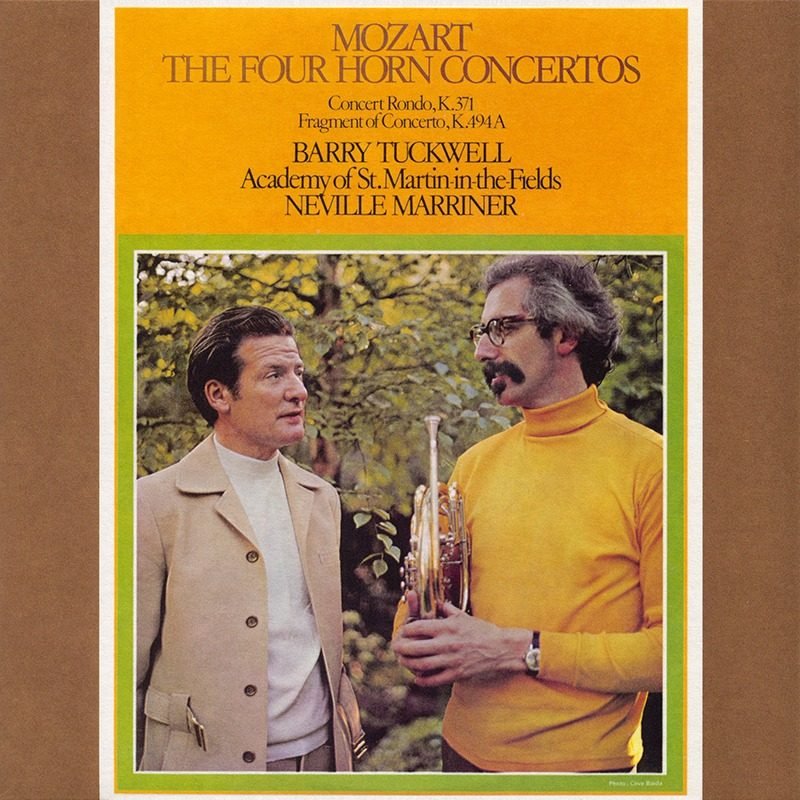
Mozart’s four horn concertos occupy a unique and deeply personal place in his output. Unlike his violin or piano concertos, these works were written not for public display or formal patronage, but for friendship, affection, and intimate collaboration. They are inseparable from the figure of Joseph Leutgeb, Mozart’s close friend and one of the finest horn players of his generation. As a result, these concertos combine technical understanding, instrumental warmth, humor, and lyrical nobility in a way unmatched elsewhere in the Classical repertoire for the horn.
Taken together, the four concertos form a portrait of the Classical natural horn at its expressive peak—heroic yet gentle, rustic yet aristocratic, humorous yet capable of profound song.
Mozart wrote these concertos for the natural horn, an instrument without valves, capable of producing only the notes of the harmonic series, with chromatic inflection achieved through hand-stopping. This limitation did not restrict Mozart’s imagination; instead, it shaped a style that emphasizes:
Broad, noble melodic arcs
Resonant open tones
Graceful hunting calls and pastoral gestures
Warm integration with the orchestra rather than domination
Mozart understood the horn not as a showy virtuoso instrument, but as a voice of character and personality, ideally suited to music of genial confidence and humane expression.
Nobility and late-style restraint
Often listed first but actually the last concerto Mozart worked on, K. 412 belongs to his final year. The opening Allegro is expansive and dignified, built on ceremonial gestures that recall the horn’s association with the hunt and the open air. The solo line is broad and noble, avoiding acrobatics in favor of clarity and resonance.
The Rondo finale (K. 386b), completed by Mozart’s pupil Franz Xaver Süssmayr, maintains a mood of gentle humor and relaxed charm. Even in this collaborative state, the concerto breathes Mozart’s late style: economical, lucid, and quietly radiant.
Confidence, warmth, and natural eloquence
K. 417 is often considered the most classically balanced of the four. From the opening Allegro maestoso, the horn projects confidence without aggression, its phrases unfolding with relaxed authority. The orchestral writing supports rather than challenges the soloist, creating a sense of musical partnership.
The Andante is lyrical and serene, allowing the horn to sing in long, gently arching lines that exploit its natural warmth. The final Rondo is playful and good-humored, full of rhythmic bounce and conversational ease. It reflects Mozart’s delight in Leutgeb’s personality as much as his technique.
Pastoral poetry and inner lyricism
K. 447 is the most pastoral and introspective of the four. The opening Allegro is relaxed and spacious, favoring lyricism over brilliance. The horn’s voice here feels almost vocal, shaping phrases with a sense of breathing and inward reflection.
The Romanze (Andante) is one of Mozart’s most beautiful slow movements for any wind instrument. Tender, intimate, and gently melancholic, it reveals the horn’s capacity for emotional nuance and quiet poetry. The concluding Rondo restores lightness and grace without losing the work’s overall warmth.
This concerto shows Mozart at his most empathetic, writing not to impress an audience but to give pleasure to a friend and fellow musician.
Humor, brilliance, and affectionate irony
The most famous of the four, K. 495 combines technical assurance with unmistakable Mozartian wit. Mozart famously inscribed humorous remarks into the manuscript, teasing Leutgeb while simultaneously writing music perfectly tailored to his strengths.
The opening Allegro maestoso is buoyant and confident, filled with fanfare-like gestures and radiant E-flat major sonorities. The Romanze offers calm lyricism, while the final Rondo sparkles with playful rhythms and effortless charm.
Despite its humor, K. 495 is a masterwork of proportion and instrumental understanding, balancing brilliance with warmth and elegance.