10 June 2026
Miguel de Cervantes, Don Quixote and Classical Music
On Classicapedia: Miguel de Cervantes, Georg Philipp Telemann, Jules Massenet, Richard Strauss, Manuel de Falla
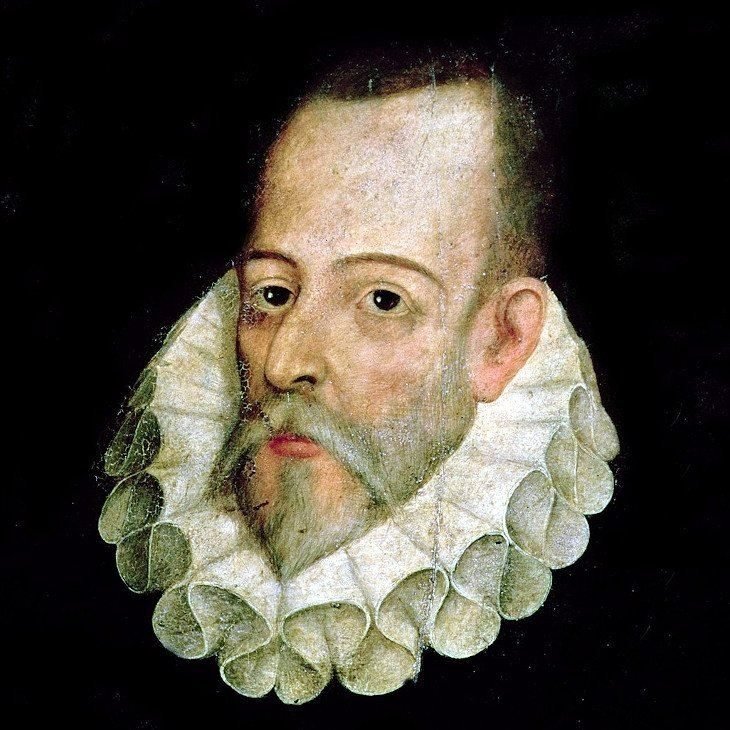
Miguel de Cervantes — 1547–1616
Miguel de Cervantes, the author of Don Quixote, occupies a unique place in the history of literature and music. His masterpiece did not merely create one of the greatest comic and tragic figures in world literature; it also gave composers an inexhaustible symbolic world: illusion, idealism, madness, heroism, parody, nobility, loneliness, and the conflict between dream and reality.
Unlike Shakespeare or Goethe, Cervantes was not especially associated with musical theatre during his lifetime in the later European sense. Yet Don Quixote became one of the most musically fertile novels ever written. It inspired operas, ballets, tone poems, orchestral suites, songs, chamber works, zarzuelas, incidental music, and even modern stage and film scores. The reason is clear: Don Quixote is not only a literary character; he is a musical idea. He is comic and sublime at once. He can be represented by parody, grotesque rhythm, noble melody, melancholy lyricism, and tragic grandeur.
CERVANTES AND THE MUSICAL POTENTIAL OF DON QUIXOTE
The greatness of Don Quixote lies in its double vision. On the surface, it is the story of a poor country gentleman who loses himself in books of chivalry and tries to live as a knight in a world that no longer believes in knights. But beneath the comedy lies something much deeper: the human need for ideals, the dignity of imagination, and the sadness of a world that calls noble dreams madness.
This duality fascinated composers. Don Quixote can be treated as a comic fool, but also as a tragic visionary. Sancho Panza can be rustic, humorous, practical, and earthy, yet he also becomes loyal, affectionate, and emotionally profound. Dulcinea can be a real peasant woman, an imaginary lady, a symbol of ideal beauty, or a musical hallucination. The windmills can become orchestral comedy; the knight’s death can become elegy.
Cervantes therefore gave music a rare subject in which comedy and pathos cannot be separated. That is exactly why so many composers returned to him.
TELEMANN: DON QUIXOTE IN THE BAROQUE IMAGINATION
One of the earliest important musical responses to Cervantes came from Georg Philipp Telemann. His orchestral suite Don Quichotte, also known as Burlesque de Quixotte, belongs to the Baroque tradition of character pieces and descriptive instrumental music.
Telemann was naturally attracted to the comic and picturesque episodes of the novel. The attack on the windmills, Sancho’s tossing in the blanket, Don Quixote’s amorous sighs for Dulcinea, and other episodes are translated into lively instrumental scenes. The music does not attempt to explore the full philosophical depth of Cervantes, but it captures the novel’s comic theatricality with elegance and wit.
This is important because it shows that Don Quixote entered music first as character, episode, gesture, and parody. Before he became a tragic symbol for Romantic and modern composers, he was already a perfect subject for musical humour.
MASSENET’S DON QUICHOTTE: THE KNIGHT AS LYRIC DREAMER
One of the most beautiful operatic treatments of Cervantes is Jules Massenet’s Don Quichotte, premiered in 1910. Massenet’s opera is not a direct full adaptation of Cervantes’s novel. It is based more immediately on Jacques Lorrain’s play Le Chevalier de la Longue Figure, itself inspired by Cervantes. But its emotional centre is profoundly Cervantine.
Massenet presents Don Quichotte less as a ridiculous madman and more as a noble, tender, aging idealist. His love for Dulcinée is impossible, but not absurd in a merely comic sense. It becomes a form of spiritual devotion. The opera is full of melancholy refinement, graceful Spanish colour, and lyrical sadness.
The final scene is especially moving. Don Quichotte dies with dignity, still faithful to his dream. Massenet understands one of the deepest truths of Cervantes: Don Quixote may be deluded, but his delusion contains a moral beauty that ordinary reality cannot equal.
For bass singers, the role of Don Quichotte became one of the great parts of the French repertory: noble, fragile, humorous, and deeply human.
RICHARD STRAUSS: DON QUIXOTE AS SYMPHONIC POEM
The greatest orchestral work inspired by Cervantes is Richard Strauss’s Don Quixote, Op. 35, composed in 1897. Strauss called it “fantastic variations on a theme of knightly character.” It is one of the most brilliant examples of late-Romantic program music.
Strauss assigns Don Quixote to the solo cello, while Sancho Panza is represented mainly by viola, tenor tuba, and bass clarinet. This instrumental characterization is extraordinary. The cello gives Don Quixote nobility, warmth, melancholy, and a human singing voice. Sancho’s instruments give him humour, earthiness, common sense, and comic flexibility.
The work presents a theme and variations, each connected with episodes from the novel: the attack on the windmills, the battle with the sheep, the dialogue between knight and squire, the dream of Dulcinea, the ride through the air, the defeat, and the final death of Don Quixote. Strauss uses the orchestra with dazzling imagination: bleating sheep, absurd combat, hallucinated grandeur, and heartbreaking resignation.
But the genius of the work lies in its emotional ambiguity. Strauss can mock Don Quixote, but he also loves him. The final pages are among the most touching in Strauss’s orchestral music. The cello’s fading line suggests not merely the death of a comic madman, but the disappearance of an entire idealistic world.
Strauss understood that Don Quixote is both parody and elegy. That is why his tone poem remains one of the supreme musical interpretations of Cervantes.
DE FALLA AND THE SPANISH DON QUIXOTE
Spanish composers also naturally responded to Cervantes. Manuel de Falla composed El retablo de maese Pedro, a chamber opera based on an episode from the second part of Don Quixote. This work is one of the most original Cervantes-inspired compositions of the 20th century.
The chosen episode is ideal for music and theatre: Maese Pedro presents a puppet show, Don Quixote watches it, becomes emotionally involved, mistakes fiction for reality, and attacks the puppets. This is pure Cervantes: theatre inside theatre, illusion inside illusion, and the collision between imagination and reality.
Falla’s score is concise, sharp, archaic, and highly stylized. He draws on early Spanish musical colours, but filters them through a modern neoclassical sensibility. The result is not folkloric decoration, but a concentrated musical theatre in which Cervantes’s irony becomes sound.
El retablo de maese Pedro is perhaps the most authentically Spanish musical response to Don Quixote: elegant, dry, theatrical, ironic, and deeply aware of Cervantes’s play with illusion.
DON QUIXOTE AND BALLET
Cervantes also entered the world of ballet. The most famous example is Don Quixote, the ballet associated with Ludwig Minkus and Marius Petipa. First staged in the 19th century, it does not attempt to retell the entire novel. Instead, it uses selected characters and episodes, especially the story of Kitri and Basilio, to create a brilliant ballet of Spanish colour, virtuoso dance, comedy, and theatrical charm.
This ballet is far from the philosophical depth of Cervantes, but it shows another side of the novel’s musical life. Don Quixote became not only a subject for tragic reflection but also a source of spectacle, rhythm, dance, and stage energy. The ballet’s Spanish dances, fan movements, comic episodes, and virtuoso variations created one of the most popular works in the classical ballet repertory.
In ballet, Cervantes becomes movement. The knight’s dream world turns into choreographic fantasy; Spanish theatricality becomes dance; comedy becomes physical rhythm.
RAVEL, IBERT, AND THE SONGS OF DON QUIXOTE
In the 20th century, Don Quixote also inspired important song cycles. Maurice Ravel composed Don Quichotte à Dulcinée, his final completed composition. These three songs — Chanson romanesque, Chanson épique, and Chanson à boire — present Don Quixote through stylized Spanish rhythms, tenderness, nobility, prayer, and drinking-song humour.
Ravel’s cycle is brief but exquisite. It does not narrate the novel; it distills the knight into three musical attitudes: courtly love, spiritual devotion, and earthy intoxication. The music is refined, rhythmically subtle, and touched with late elegance.
Jacques Ibert also composed songs connected with Don Quixote for the same cinematic project that had originally involved Ravel. Ibert’s Chansons de Don Quichotte are more direct, colourful, and theatrical. Together, Ravel and Ibert show how Cervantes could inspire not only large works but also concentrated vocal portraits.
DON QUIXOTE AS MUSICAL SYMBOL
The central reason Don Quixote became so important for classical music is that he is more than a character. He is a symbol of the artist, the dreamer, the idealist, and perhaps even the composer.
Many composers recognized something of themselves in him. The composer also hears worlds that others do not hear. The composer also creates realities out of imagination. The composer also risks ridicule by believing in invisible structures of beauty, meaning, and order. Don Quixote’s madness is comic, but it is also close to artistic vision.
Sancho Panza, by contrast, represents the body, appetite, earth, humour, and practical life. The relationship between Don Quixote and Sancho is therefore musically fertile because it is a dialogue between high idealism and grounded reality. Strauss understood this perfectly by assigning them contrasting instrumental identities.
Dulcinea, meanwhile, represents the unreachable ideal: beloved, muse, illusion, beauty, projection, and spiritual goal. She is less a real woman than a musical idea of longing.
THE COMIC AND THE TRAGIC
Cervantes’s greatest gift to music is the fusion of comedy and tragedy. Don Quixote is funny because he mistakes the world; he is moving because his mistake reveals something the world has lost. His imagination is false in fact but true in spirit.
This is why musical interpretations of Don Quixote often shift between grotesque scherzo and noble elegy. The windmills invite orchestral parody. The sheep episode invites comic sound-painting. Sancho invites bassoon-like humour, rustic rhythm, and earthy speech. But Don Quixote’s death invites lyricism, stillness, and deep tenderness.
Few literary figures allow music to pass so naturally from laughter to tears. Don Quixote is musical because he is built on contrast: body and soul, fantasy and reality, ridicule and dignity.
CERVANTES BEYOND DON QUIXOTE
Although Don Quixote dominates Cervantes’s musical afterlife, other Cervantine materials also entered music, especially through Spanish theatre, zarzuela, and literary adaptations. Cervantes’s world is full of songs, popular culture, pastoral conventions, romances, dances, and theatrical situations. His writings emerged from a Spain in which poetry, theatre, popular song, and courtly entertainment were closely connected.
But no other Cervantes work approached the musical influence of Don Quixote. The novel became universal because it was both specifically Spanish and profoundly human. Its musical afterlife belongs not only to Spain, but to Germany, France, Russia, Italy, and the wider European imagination.
WHY CERVANTES MATTERS TO CLASSICAL MUSIC
Cervantes matters to classical music because he created a character who can be translated into almost any musical language. Baroque suite, Romantic tone poem, French opera, Spanish chamber opera, Russian ballet, French song cycle, and modern theatre can all find something different in Don Quixote.
For Telemann, Don Quixote was comic episode. For Strauss, he was symphonic psychology. For Massenet, he was noble melancholy. For Falla, he was theatrical illusion. For Minkus, he was dance and stage colour. For Ravel, he was stylized song, tenderness, and final elegance.
This variety proves the richness of Cervantes’s creation. Don Quixote is not exhausted by one interpretation. He can be mocked, loved, mourned, danced, sung, and transformed into orchestral metaphor.
THE KNIGHT WHO BECAME MUSIC
The relationship between Miguel de Cervantes, Don Quixote, and classical music is one of the great literary-musical stories of European culture. Cervantes gave composers a figure who lives between parody and sanctity, madness and wisdom, failure and nobility. Don Quixote’s imagination is absurd, but it also protects the world from spiritual mediocrity.
That is why classical music has returned to him again and again. He is a comic knight, but also an image of the artist; a defeated dreamer, but also a witness to the dignity of impossible ideals. His adventures invite laughter; his death invites silence.
Don Quixote became music because he is one of the great symbols of human idealism: ridiculous in the eyes of the world, but inwardly noble, unforgettable, and strangely victorious.