1 July 2026
Joseph Martin Kraus: The Swedish Mozart and the Dark Fire of Classicism
On Classicapedia: Joseph Martin Kraus, King of Sweden Gustavus III, Joseph Haydn, Wolfgang Amadeus Mozart
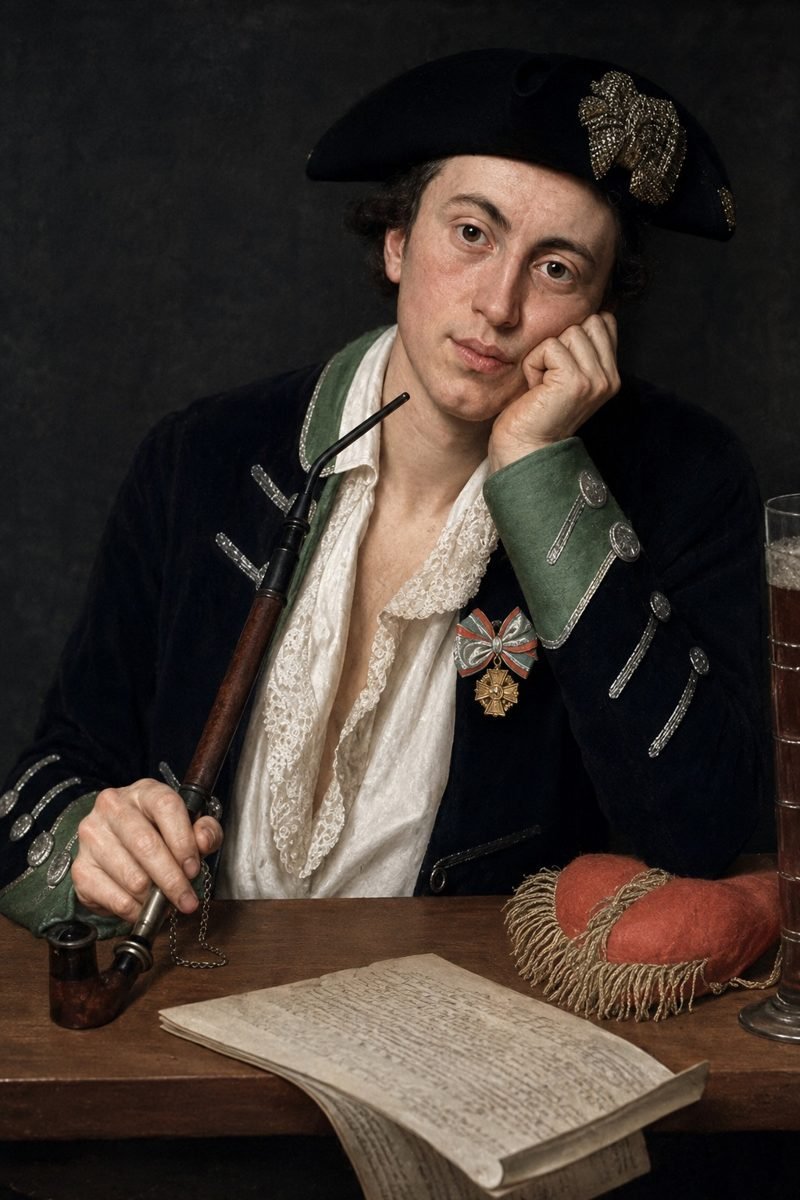
Joseph Martin Kraus
Born: 20 June 1756, Miltenberg am Main, Germany
Died: 15 December 1792, Stockholm, Sweden
Joseph Martin Kraus is one of the most fascinating and unjustly neglected figures of the Classical period. Born in the same year as Mozart, and dying only one year after him, Kraus has often been called the Swedish Mozart. The nickname is attractive, but also incomplete. Kraus was not simply a northern imitation of Mozart. He was a composer of striking individuality, dramatic force and often dark emotional intensity.
His music belongs to the world of Classicism, but not always to its smiling side. He had a taste for minor keys, tragic gestures, daring harmonies and theatrical tension. He stands close to the Sturm und Drang current of the late eighteenth century: restless, intense, expressive and full of dramatic contrasts.
At the court of Gustav III of Sweden, Kraus became one of the leading musical figures of Stockholm. He wrote symphonies, operas, sacred works, chamber music and ceremonial compositions. His career was brief, but his artistic personality was powerful.
A GERMAN BIRTH, A EUROPEAN DESTINY
Kraus was born on 20 June 1756 in Miltenberg am Main, in Franconia. His family background was not that of a court dynasty or a great musical household like the Bachs. He came from a cultivated middle-class environment and received a broad education.
Like many gifted eighteenth-century musicians, Kraus was not only a composer. He was also intellectually ambitious. He studied at several institutions and showed serious interests in literature, drama, philosophy and law. This literary and intellectual background would remain important throughout his life.
He was part of the same cultural atmosphere that produced the German Sturm und Drang movement — a world of emotional intensity, rebellion against convention, fascination with genius, nature, tragedy and the expressive power of the individual soul.
This is essential for understanding him. Kraus was not merely a well-trained court composer. He was a man of letters, theatre and ideas. His music often sounds as if it wants to speak dramatically, not merely decorate.
THE CALL OF SWEDEN
In the late 1770s, Kraus moved to Sweden, a decision that would define his entire career. Stockholm under King Gustav III was an ambitious cultural centre. Gustav III wanted to make Sweden a major European artistic power. He promoted theatre, opera, literature and court spectacle.
This was exactly the kind of environment in which Kraus could flourish. He arrived as a German composer seeking opportunity and eventually became deeply connected with Swedish musical life.
At first, success was not immediate. Like many foreign musicians, he had to prove himself. But his talent was gradually recognized, and he entered the orbit of the royal court. Gustav III became his most important patron.
The relationship between Kraus and Gustav III is central to his biography. The king was not merely a political ruler; he was a theatrical monarch, a patron who saw opera and drama as instruments of national prestige. Kraus became one of the musicians who helped realize this royal artistic vision.
GUSTAV III: THE THEATRICAL KING
Gustav III of Sweden was one of the most culturally ambitious rulers of the late eighteenth century. He loved theatre, ceremony, opera and French-inspired court culture. He founded and supported institutions that would shape Swedish artistic life, including the development of a national opera.
For Kraus, Gustav III was both patron and symbolic figure. The king wanted a Swedish opera culture that could stand beside those of France, Italy and Germany. Kraus, with his German training, dramatic instinct and European awareness, was an ideal composer for such a project.
The court of Gustav III gave Kraus an arena for large-scale theatrical and ceremonial music. It also placed him within the political and cultural tensions of the age. Sweden was not isolated from Enlightenment ideas, aristocratic conflict or the growing instability of European monarchy.
This matters because Kraus’s music often contains a sense of drama larger than private feeling. His works can sound ceremonial, tragic, public, almost political.
A GRAND EUROPEAN JOURNEY
One of the most important episodes in Kraus’s life was the grand European journey that Gustav III sponsored. The purpose was not tourism, but artistic education. Kraus was sent to study the musical life of the continent, to observe theatres, orchestras and composers, and to bring that knowledge back to Sweden.
He travelled through major European centres, including parts of Germany, Austria, Italy, France and England. This journey placed him in direct contact with the international musical world.
During this period he met important musicians and absorbed different national styles. The trip helped broaden his language: German seriousness, Italian vocal style, French theatricality and Viennese instrumental refinement all left traces in his work.
This cosmopolitan education strengthened him as a composer. It also made him one of the most European musicians in Swedish service. He was not a provincial figure transplanted to Stockholm; he was a composer shaped by the full breadth of late eighteenth-century musical culture.
KRAUS AND HAYDN
One of the most famous and meaningful encounters in Kraus’s life was with Joseph Haydn. Kraus visited Haydn at Esterháza during his European travels, and Haydn later spoke highly of him.
This connection is important because Kraus was, like Haydn, a powerful symphonist. But their temperaments were different. Haydn was a supreme architect of wit, proportion, surprise and formal mastery. Kraus was often darker, more tragic and more overtly dramatic.
Haydn reportedly admired Kraus’s music, especially his symphonic writing. That admiration should not be taken lightly. Haydn was not easily impressed by empty brilliance. If he valued Kraus, it was because he recognized genuine craft and originality.
Kraus’s symphonies deserve to be heard alongside the more intense works of Haydn’s Sturm und Drang period. They share a world of urgency, minor-key power and emotional concentration.
THE DARK TEMPERAMENT OF KRAUS
What makes Kraus distinctive is his emotional colour. Many Classical composers cultivated elegance, clarity, balance and charm. Kraus could do this, but his strongest music often moves in another direction.
He had a gift for dramatic darkness. His minor-key works can sound tense, urgent and severe. His orchestral writing often has sharp contrasts, sudden energy and tragic momentum.
This is why the label Swedish Mozart must be used carefully. Mozart’s genius is universal, blending comedy, tragedy, grace, sensuality and metaphysical depth. Kraus’s genius is narrower but very intense. He is especially compelling when he enters the world of solemnity, theatrical fire and psychological pressure.
In this sense, Kraus is one of the most powerful representatives of the darker Classical temperament.
THE SYMPHONIST
Kraus’s symphonies are among his greatest achievements. They show him as a composer of real orchestral imagination.
His symphonic language often combines Classical clarity with Sturm und Drang intensity. The themes can be forceful, the rhythms urgent, the harmonies restless, the orchestral gestures dramatic.
He understood the symphony not merely as elegant entertainment but as a vehicle for powerful expression. His best symphonies possess a seriousness that places him among the most compelling symphonists of his generation.
Unlike some minor Classical composers whose symphonies remain pleasant but conventional, Kraus often sounds personally engaged. There is tension in his music. There is risk. There is an atmosphere of emotional necessity.
This is why modern listeners who discover him often react with surprise: he sounds far more powerful than his fame would suggest.
OPERA AND THEATRE
Kraus was also a major opera composer, and theatre was central to his artistic personality.
His most important opera, Aeneas i Carthago, was connected with the grand ambitions of Gustavian opera. It reflects the desire to create serious Swedish opera on a large European scale. The subject, drawn from the story of Aeneas and Dido, offered opportunities for love, duty, tragedy, royal symbolism and theatrical splendour.
Kraus’s operatic instinct was shaped by several traditions: German seriousness, Italian vocal line and French dramatic spectacle. He was not a mere imitator of any one school. His theatre music often aims at grandeur, emotional force and noble expression.
He also wrote incidental and ceremonial music, including works connected with royal occasions. These pieces show his ability to compose for public drama, not only private emotion.
THE FUNERAL MUSIC FOR GUSTAV III
One of the most moving chapters in Kraus’s career came after the assassination of King Gustav III in 1792.
The king was shot at a masked ball in Stockholm and died shortly afterward. This event shocked Sweden and became one of the great political dramas of the age. Kraus, who had been so closely connected with Gustav’s artistic world, composed funeral music for the dead monarch.
The resulting music is among his most solemn and powerful creations. It reveals Kraus at his darkest and most ceremonial. Here his dramatic temperament, his sense of public tragedy and his command of orchestral colour come together.
In this funeral music, Kraus seems less like a court employee and more like a tragic witness. The music becomes a farewell not only to a king, but to an entire cultural world — the Gustavian dream of enlightened monarchy, theatre and artistic grandeur.
The fact that Kraus himself died later that same year gives this episode an almost symbolic force.
A LIFE PARALLEL TO MOZART
The comparison with Mozart is inevitable. Both Kraus and Mozart were born in 1756. Both died young. Both were connected with opera, symphony and sacred music. Both lived in a Europe where court culture, public concerts and Enlightenment ideals were rapidly changing.
But the comparison should illuminate differences, not erase them.
Mozart became the universal genius of Classical music, transforming every genre he touched with incomparable psychological depth. Kraus did not reach that level of breadth or perfection. Yet he had an unmistakable personality. His music is often more severe, more northern, more shadowed.
If Mozart can move from laughter to metaphysical terror within a single scene, Kraus often begins closer to the tragic atmosphere itself. His strongest voice is one of dark classical nobility.
The nickname Swedish Mozart is useful only if it leads listeners to him. Once they hear the music, they discover that Kraus was not a copy, but a powerful original.
ANECDOTES AND CURIOSITIES
One of the most striking curiosities about Kraus is that he was born in the same year as Mozart and died only one year after him. This coincidence helped create the nickname Swedish Mozart, but it also reminds us how many brilliant lives were cut short in the eighteenth century.
Another fascinating aspect is his transformation from German intellectual student to Swedish court composer. He did not simply work in Sweden; he became one of the central figures of Gustavian musical culture.
His connection with Gustav III gives his life unusual dramatic colour. Few Classical composers were so closely connected with a monarch who was himself theatrical, ambitious and politically controversial.
The assassination of Gustav III at a masked ball seems almost like an operatic scene. That Kraus then composed funeral music for him gives the composer’s final year a tragic grandeur.
Another curiosity is Haydn’s admiration for Kraus. The fact that Haydn recognized his quality gives strong evidence that Kraus was not merely a minor regional figure. He was respected by one of the greatest musical minds of the century.
It is also remarkable that Kraus’s reputation remained relatively obscure for so long. His music has the power to surprise modern listeners because it does not sound like harmless courtly wallpaper. At its best, it has fire, darkness and dramatic purpose.
MUSICAL STYLE: CLASSICAL FORM, TRAGIC ENERGY
Kraus’s style may be described as dramatic Classicism.
He uses the forms of the Classical period, but fills them with a darker emotional pressure. His music often favours minor keys, forceful rhythms, harmonic urgency and sharp orchestral contrasts.
He was influenced by Sturm und Drang, especially in his symphonic writing. This places him near the emotional world of Haydn’s minor-key symphonies of the 1760s and 1770s.
He had a strong theatrical instinct. Even in instrumental music, he often thinks dramatically. His music does not merely proceed; it seems to enact conflict.
He also possessed lyrical gifts, but his lyricism often has a serious or noble character rather than pure charm. Kraus’s beauty is rarely superficial. It tends to be shadowed.
MAJOR WORKS
Aeneas i Carthago
His most ambitious opera, connected with the Gustavian project of creating a serious Swedish operatic tradition. It is a work of grandeur, tragedy and theatrical ambition.
Proserpin
An opera that helped establish his reputation in Sweden and showed his ability to write dramatically for the stage.
Olympie
A dramatic work connected with the serious theatrical culture of the age.
Symphony in C minor
One of his most powerful orchestral works, often admired for its dramatic intensity and Sturm und Drang character.
Symphony in C-sharp minor
A striking example of his darker symphonic voice, unusual in key and atmosphere.
Symphony in E-flat major
A work showing his command of Classical orchestral balance and noble expression.
Funeral Music for Gustav III
One of his most moving and historically charged compositions, written after the assassination of his royal patron.
Requiem
A sacred work of solemn character, showing his capacity for spiritual gravity and dramatic seriousness.
Chamber Music
Works for smaller forces that reveal his refinement, craftsmanship and lyrical sensitivity.
KRAUS IN THE HISTORY OF THE SYMPHONY
Kraus deserves a much higher place in the history of the Classical symphony than he is usually given.
He was not as prolific or historically decisive as Haydn, but his best symphonies are among the most intense of the late eighteenth century. They prove that the Classical symphony could be more than elegance and entertainment. It could become a vehicle for tragedy, tension and dark grandeur.
His orchestral writing has force. His forms are clear, but not bland. His dramatic instincts give the music a sense of direction and urgency.
In this sense, Kraus belongs to the line of composers who expanded the expressive range of the symphony before Beethoven. He shows that the path from Haydn to Beethoven was not only Viennese. It also passed through Mannheim, Stockholm, Paris, London and many other European centres.
LAST YEARS AND DEATH
The final year of Kraus’s life was marked by tragedy. In 1792, Gustav III was assassinated, and Kraus composed music for the king’s funeral ceremonies. This was one of the most solemn tasks of his career.
Only a few months later, Kraus himself died in Stockholm, on 15 December 1792. He was only 36 years old.
His death came at a devastatingly early age. Like Mozart, he left behind the sense of an interrupted destiny. One wonders what he might have written had he lived into the age of Beethoven.
By the time of his death, Europe was entering a new and violent historical period. The French Revolution had begun, monarchy was under pressure, and the old courtly world was changing forever. Kraus’s final works seem to stand at the edge of that transformation.
LEGACY
The legacy of Joseph Martin Kraus is that of a powerful, original and still underappreciated Classical composer.
He was the Swedish Mozart only in the sense that he shared Mozart’s birth year, early death and wide-ranging talent. But his voice was his own: darker, more severe, more tragic, more ceremonial.
He brought German intensity into Swedish musical life. He helped shape the ambitions of Gustavian opera. He wrote symphonies of real dramatic power. He gave Classical form a northern shadow.
Kraus reminds us that the Classical period was not only the age of balance, grace and sunlight. It was also an age of darkness, storm, tragedy and political theatre.
Joseph Martin Kraus was not a mere footnote to Mozart.
He was one of the great dramatic voices of late eighteenth-century music — a composer whose fire still burns beneath the classical surface.