22 December 2025
Joseph Haydn — Survival and Self-Education in Vienna (1749–1755)
On Classicapedia: Joseph Haydn, Johann Joseph Fux, Nicola Porpora
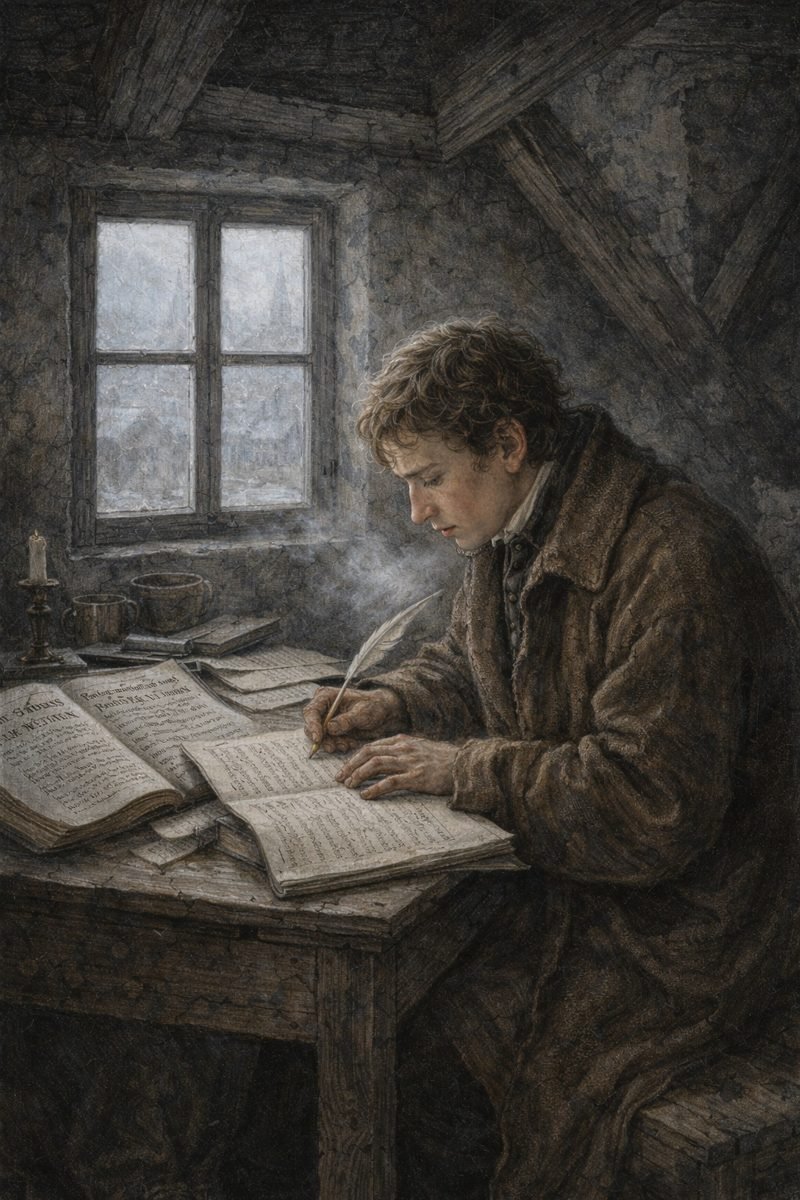
After his abrupt dismissal from the choir of St. Stephen’s Cathedral in late 1749 (when his voice broke), Haydn entered what he later described as the hardest and most formative period of his life. At seventeen, he was suddenly without income, patronage, or family support—left to survive on his own in Vienna.
Teaching, Taverns, and Small Commissions (1749–1753)
From 1749 onward, Haydn scraped together a living by giving private lessons, playing the keyboard and violin in taverns, and accepting tiny compositional commissions—often dances, arrangements, or short occasional pieces that paid little but kept him afloat. These years taught him professional adaptability: he learned to write quickly, tailor music to circumstances, and work under pressure.
Self-Taught Composer: Fux and Counterpoint (c. 1750–1754)
Crucially, Haydn recognized a gap in his education. He had sung complex music for years but had never been formally taught composition. Around 1750, he began a disciplined course of self-study, working through Gradus ad Parnassum by Johann Joseph Fux.
Haydn later credited this book as foundational: it taught him strict counterpoint, voice-leading, and structural thinking—skills that would underpin his symphonies and quartets. He studied at night, copying exercises by hand, correcting himself relentlessly.
Unheated Attics and Physical Hardship (c. 1749–1752)
During these years Haydn often slept in unheated attics, especially in winter. He composed with numb fingers, using whatever light and warmth he could find. Contemporary accounts and Haydn’s own recollections emphasize hunger, cold, and isolation—but also determination. These conditions forged his legendary discipline and resilience.
Servant and Accompanist: Music as Labor (1752–1755)
Before stability arrived, Haydn also worked as a musical servant and accompanist—playing continuo, rehearsing singers, copying parts, and performing whatever tasks were required. Most notably, from 1752, he assisted the Italian composer Nicola Porpora as an accompanist and valet of sorts. Though menial, this position proved invaluable: Porpora corrected Haydn’s compositions, sharpened his Italian style, and introduced him to influential circles.
Toward Stability (by 1755)
By 1755, Haydn’s situation began to improve. His reputation as a reliable teacher and composer grew, commissions became more substantial, and the survival years started to yield professional momentum—setting the stage for his first important appointments and, eventually, his life-changing engagement with the Esterházy family.
Lasting impact:
These Vienna years transformed Haydn from a gifted singer into a self-made composer. Poverty taught him economy; counterpoint taught him rigor; service taught him professionalism. The music that followed—clear, balanced, humane—was built on this crucible of necessity.