22 December 2025
Joseph Haydn and Nicola Porpora: A Transformative Encounter
On Classicapedia: Joseph Haydn, Nicola Porpora
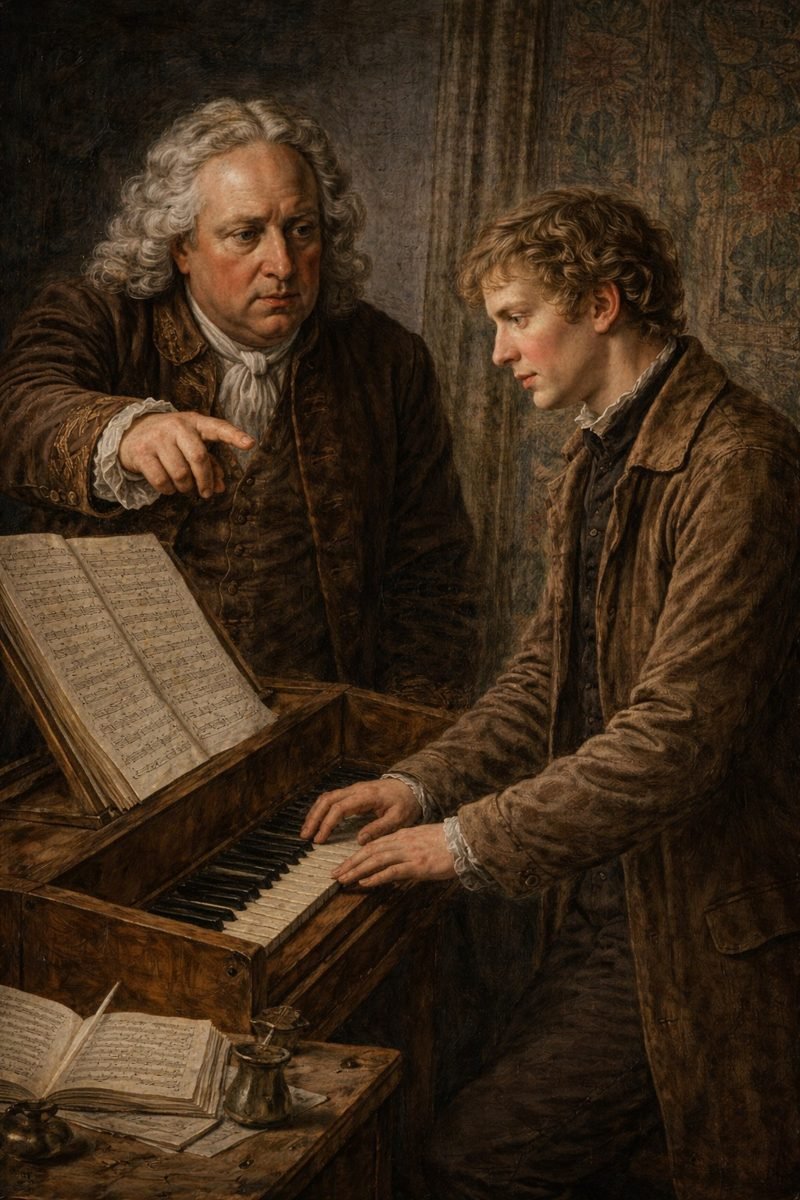
When Joseph Haydn was struggling to survive in Vienna in the early 1750s, poor, largely self-taught, and without influential patrons, a chance encounter would prove decisive: his association with the celebrated Italian composer and singing master Nicola Porpora.
Vienna, c. 1752: Circumstance, Not Prestige
Porpora arrived in Vienna around 1752 already famous across Europe as one of the greatest teachers of Italian bel canto, having trained singers such as Farinelli. Haydn, by contrast, was a young man of about 20 years, living in cold attics, earning small sums from lessons and tavern work, and desperately aware of the gaps in his education—especially in vocal writing and Italian style.
Their meeting was not the result of admiration or recognition, but of necessity. Haydn entered Porpora’s household in a subordinate, almost servile role: accompanist at the keyboard, copyist, rehearsal assistant, page-turner, and general factotum. He later admitted frankly that he learned “more from Porpora than from any book.”
A Harsh Master, a Willing Student
Porpora was notoriously irascible, demanding, and contemptuous of incompetence. He did not spare Haydn. Corrections were blunt, criticism relentless, and praise rare. Yet this severity was exactly what Haydn needed. Porpora drilled him in:
Italian vocal phrasing,
Natural declamation of text,
Breath, line, and cantabile style,
* and the practical realities of composing for singers, not abstractions.
Unlike theoretical treatises, Porpora’s lessons were concrete and unforgiving. Haydn learned how music must function in performance, how voices actually behave, and how elegance is achieved not through excess, but through proportion.
Access and Advancement
Equally important were the social doors Porpora opened. Through him, Haydn gained access to aristocratic salons and musical circles previously closed to him. This exposure led directly to more serious commissions and to Haydn’s growing reputation as a competent, reliable professional rather than a desperate former choirboy.
By 1755, Haydn’s situation had markedly improved. Though he never became Porpora’s equal in temperament or background, he had absorbed something invaluable: the Italian sense of line and clarity that would later distinguish his symphonies, quartets, and vocal works.
Lasting Impact
Haydn never forgot this period. In later years, he spoke of Porpora with a mixture of awe and gratitude, fully aware that the relationship had been unequal but essential. If self-study gave Haydn discipline, Porpora gave him style, vocal instinct, and professional polish.
This encounter marks the moment when Haydn ceased to be merely a survivor and began to emerge as a composer of international stature—forged not by kindness, but by rigor, humility, and relentless learning.