1 September 2026
Josef Hofmann — The Pianist Who Astonished Rachmaninoff: Anecdotes And Curiosities From The Life Of A Legendary Virtuoso
On Classicapedia: Josef Hofmann, Leopold Stokowski
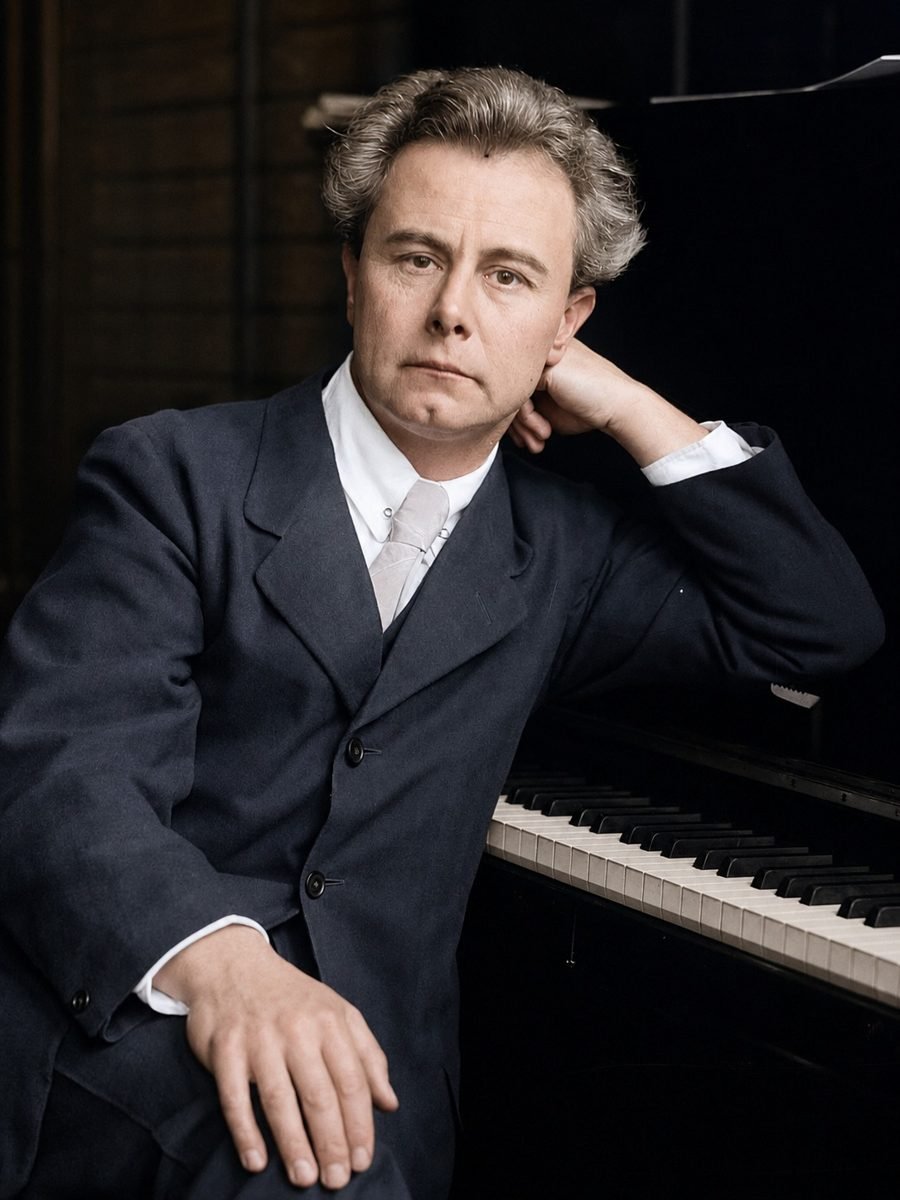
Josef Hofmann — born Józef Kazimierz Hofmann on 20 January 1876 in Podgórze, near Kraków, and died on 16 February 1957 in Los Angeles — was one of the supreme pianists of the late nineteenth and early twentieth centuries. A Polish-born American pianist, composer, teacher and inventor, he belonged to the last great generation directly connected with the Romantic pianistic tradition.
His father, Kazimierz Hofmann, was a pianist, conductor and composer, while his mother, Matylda Pindelska, was a singer. Music therefore surrounded him almost from birth. His extraordinary gifts became apparent when he was still a very small child, and by the age of five or six he was already appearing before audiences. Within a few years he had become one of the most sensational child prodigies in Europe.
His American debut at the Metropolitan Opera House in New York on 29 November 1887 caused an extraordinary sensation. He was only eleven years old, yet critics wrote about him not merely as a remarkable child but as a pianist capable of being compared with mature virtuosi. During that American visit he gave more than fifty concerts within a remarkably short period.
His artistic development reached its decisive point when Anton Rubinstein, one of the legendary pianists of the nineteenth century, accepted him in 1892 as his only private piano pupil outside the regular conservatory system. Hofmann later regarded this relationship as the most important artistic event of his life.
During the following decades Hofmann became internationally famous for his extraordinary precision, rhythmic authority, tonal variety, elegance and apparently effortless technique. Sergei Rachmaninoff admired him profoundly, and some of the greatest musicians of the period regarded him as perhaps the finest pianist alive.
But Josef Hofmann was far more than a virtuoso. He was a serious student of mechanics, mathematics and science, an inventor with numerous patents, an influential teacher, a writer on piano playing, and an important figure in the early history of the Curtis Institute of Music in Philadelphia.
The most astonishing feature of Hofmann as a child was not simply his ability to play difficult music. Europe had already known several brilliant prodigies. What amazed musicians was the apparent maturity of his musical thinking.
By the age of ten he had already appeared with major orchestras and was playing works such as Beethoven concertos. Contemporary listeners repeatedly remarked that he did not sound like a talented child imitating an adult pianist: he sounded like an adult artist inhabiting the body of a boy.
His phenomenal memory meant that large quantities of music could be retained with extraordinary ease.
During his first American tour in 1887–1888, the young Hofmann was subjected to a schedule that would have exhausted many experienced professional musicians.
He performed approximately 52 concerts in about ten weeks, travelling between major American cities while playing substantial programmes of Beethoven, Mendelssohn, Weber, Liszt, Chopin and other composers.
Eventually the New York Society for the Prevention of Cruelty to Children intervened because of concern about the physical consequences of such relentless activity for an eleven-year-old boy.
One of the most remarkable episodes in the history of musical patronage followed.
The wealthy American philanthropist Alfred Corning Clark gave Hofmann's family $50,000, an enormous fortune in the 1880s, allowing the boy to withdraw from the concert circuit and continue his education.
The essential condition was that Hofmann should not be exploited as a touring prodigy and should be allowed to mature before resuming a full concert career.
This extraordinary act effectively gave the young musician back part of his childhood and, even more importantly, gave him time to develop intellectually as well as musically.
The temporary withdrawal from public performance did not turn Hofmann into an exclusively musical student.
He became fascinated by mathematics, physics, mechanics and engineering. That scientific curiosity never disappeared. Years later it would make him one of the most unusual figures in musical history: a world-famous pianist who was also a genuine inventor.
His way of thinking about the piano was consequently both artistic and mechanical. He wanted to understand not only what sound he wished to produce, but precisely how the physical mechanism of the instrument produced it.
In 1892, at approximately sixteen, Hofmann became the private pupil of the legendary Russian pianist Anton Rubinstein.
This was an exceptional privilege. Rubinstein accepted no other comparable private pupil outside his normal institutional teaching.
Their work together consisted of roughly 42 meetings, and Rubinstein imposed an extraordinary rule: Hofmann was not to bring the same composition back for another lesson. The aim was not to polish a handful of pieces endlessly but to develop independence of thought, judgment and imagination.
Perhaps the strangest aspect of those lessons was that Anton Rubinstein generally refused to demonstrate passages at the piano.
Instead, he talked.
Hofmann later explained that his teacher used images, analogies and suggestions and expected the pupil to translate them into sound independently.
When Hofmann repeated a phrase in exactly the same way, Rubinstein might suggest that it should sound one way in fine weather and differently if it were raining.
The purpose was clear: do not imitate the teacher — learn to imagine for yourself.
On 14 March 1894, Rubinstein conducted his own Piano Concerto No. 4 with Hofmann as soloist in Hamburg.
After the performance the master essentially declared his pupil's education finished.
There would be no more lessons.
Remarkably, the two men never met again. Rubinstein died later that same year.
For the rest of his life Hofmann regarded those two years with Rubinstein as the foundation of his mature artistry.
When news reached Hofmann of Rubinstein's death in 1894, he happened to have Chopin's Piano Sonata No. 2 on a forthcoming concert programme.
As he began its famous Funeral March, the audience spontaneously stood.
According to Hofmann's own recollection, the listeners remained standing with bowed heads throughout the movement as a tribute to the dead master.
It was one of the most emotionally charged memories he preserved of his relationship with Rubinstein.
Among Hofmann's greatest admirers was another colossal pianist: Sergei Rachmaninoff.
This is particularly significant because Rachmaninoff himself possessed one of the most formidable piano techniques ever documented.
In an interview in 1932, Rachmaninoff described Hofmann as the greatest pianist of the day, praising not simply his technique but the complete range of pianistic resources at his disposal.
One of the supreme ironies of piano history is associated with Rachmaninoff's Piano Concerto No. 3 in D minor, Op. 30, composed in 1909.
Rachmaninoff dedicated this monumental concerto to Josef Hofmann, the pianist he admired so deeply.
Yet Hofmann never performed it publicly.
He apparently felt that the work was simply not suited to him. Thus one of the most fearsome piano concertos ever written was dedicated to one of the most technically accomplished pianists in history — who chose not to play it.
An often-repeated account relates that after hearing Hofmann play Chopin's Sonata in B minor, Rachmaninoff was so impressed that he ceased performing the work himself.
He reportedly felt that he had not heard playing of such titanic character since Anton Rubinstein.
Whether every detail of the story survived perfectly in transmission or not, it accurately reflects Hofmann's extraordinary standing among his greatest contemporaries.
Unlike Rachmaninoff, famous for his enormous hands, Hofmann had comparatively small hands.
Yet witnesses described his sonority as enormous.
This is one of the most interesting aspects of his technique. He demonstrated that sheer hand size did not determine tonal power. His combination of extraordinary coordination, arm weight, finger strength, timing and understanding of the instrument allowed him to produce an orchestral range of sound.
His hands may not have looked physically imposing, but at the keyboard they were among the most formidable in piano history.
Because of those relatively small hands, Steinway & Sons constructed special keyboards for Hofmann with keys slightly narrower than standard dimensions.
This enabled him to negotiate wide intervals more comfortably.
His concert pianos were also adjusted according to his very precise mechanical requirements, including modifications intended to facilitate rapid repetition.
Even the pedal arrangement could differ from the normal modern Steinway configuration.
Few pianists understood the mechanics of their instruments as deeply as Hofmann.
The precision extended beyond the piano itself.
Hofmann travelled with a specially designed recital chair whose seat sloped slightly downward from back to front.
It was not an eccentric theatrical accessory. Hofmann believed that every element affecting posture, weight distribution and movement at the keyboard mattered.
For him, pianism was a coordinated physical system extending from the musical imagination through the body to the mechanism of the piano.
This was not a superficial hobby.
Josef Hofmann developed and patented numerous mechanical devices. More than 70 patents have often been associated with his inventive activity.
His documented inventions included automobile suspension and shock-absorbing systems as well as improvements involving piano mechanisms.
A pneumatic shock absorber patented in 1920, for example, bears his name, while another patent concerned improvements to the action of the piano itself.
A pianist of lesser mechanical imagination might simply have complained about an instrument's action.
Hofmann tried to redesign it.
His 1941 patent for a piano action sought to reduce friction between moving components, improve key return and provide greater sensitivity of touch.
In other words, the same man who possessed one of the finest piano techniques of his century was thinking like an engineer about how to make the instrument respond more efficiently to the pianist.
As a young man Hofmann became fascinated by the new technology of sound recording associated with Thomas Alva Edison.
He corresponded with Edison, and by the late 1880s Hofmann was experimenting with the phonograph.
He was therefore associated with sound recording almost at its technological birth — decades before electrical recording, LPs or magnetic tape.
It is remarkable to think that a pianist whose artistic inheritance reached directly back through Rubinstein toward the nineteenth-century Romantic tradition was simultaneously fascinated by technologies that would eventually preserve performance for future generations.
When the Curtis Institute of Music was founded in Philadelphia in 1924, Hofmann played an important role in shaping the institution.
The founder, Mary Louise Curtis Bok, had known him for years and relied on his artistic judgment.
Together with figures such as conductor Leopold Stokowski, Hofmann helped establish a faculty capable of attracting exceptional young musicians.
He taught at Curtis from 1924 to 1938 and became director of the institution in 1927.
The influence of Rubinstein remained evident in Hofmann's own teaching.
Rather than producing pianists who simply copied his interpretations, Hofmann emphasised independent musical thought.
The pedagogical tradition passing through him is historically fascinating:
Ludwig van Beethoven → Carl Czerny → Anton Rubinstein → Josef Hofmann.
Through Hofmann and the early faculty of Curtis, elements of the nineteenth-century European piano tradition were thus transmitted directly into twentieth-century American musical education.
One of Hofmann's most modern ideas concerned mental practice.
He described four ways of studying a composition:
playing it at the piano with the score;
studying the score away from the piano;
playing at the piano from memory;
and mentally reconstructing the music away from both piano and score.
He considered the latter methods extremely demanding but exceptionally valuable for memory and musical understanding.
For Hofmann, technique ultimately began in the mind. If the musical image was completely clear, the physical mechanism had a meaningful purpose.
Hofmann strongly opposed mindless repetition.
He advised pianists not to practise for excessively long uninterrupted periods. After one or two hours, he recommended leaving the instrument, walking, thinking about something else and allowing the musical information to settle unconsciously.
This is strikingly close to modern ideas about distributed practice and memory consolidation.
He understood that muscular repetition without mental freshness could actually become counterproductive.
Among Hofmann's many sophisticated observations on interpretation occurs a delightfully practical one.
He recommended practising early in the morning, when the mind was fresh.
But before beginning, he advised the pianist to clean the keyboard.
His reasoning was characteristic: just as food tastes better from a clean table, clean musical work should begin on a clean instrument.
It is a wonderfully mundane glimpse of one of history's greatest virtuosi.
Despite the spectacular character of his technique, Hofmann generally avoided extravagant physical gestures.
Witnesses described a relatively quiet figure at the keyboard.
Unlike pianists who visibly dramatised the effort involved in difficult passages, Hofmann could produce formidable effects while appearing extraordinarily composed.
One maxim associated with his approach summarises that aesthetic perfectly:
"An aristocrat never hurries."
The phrase captures the extraordinary impression created by his playing: virtuosity without apparent strain.
Hofmann was also a composer and published a substantial number of works.
Some appeared under the pseudonym Michel Dvorsky.
The disguise was hardly impenetrable to musicians who knew him, and at his Golden Jubilee celebration in 1937 one of the works performed was by "Michel Dvorsky" — in other words, by Hofmann himself.
It reveals another dimension of his personality: the virtuoso pianist, engineer and teacher also possessed a strong compositional impulse.
In November 1937, approximately fifty years after his sensational American debut, Josef Hofmann was honoured at the Metropolitan Opera House with a Golden Jubilee concert.
The symbolism was extraordinary.
The little boy who had astonished New York in 1887 returned half a century later as one of the legendary figures of the piano.
The programme appropriately included music associated with his teacher Anton Rubinstein, as well as Chopin and Hofmann's own music.
Among the most important surviving documents of Hofmann's artistry is his recital in Casimir Hall at the Curtis Institute in 1938.
Although recording technology of the era could not capture the full range of his sound, these performances offer an extraordinary glimpse of his playing.
His rhythmic freedom, dazzling articulation, sudden changes of colour and ability to make inner voices emerge from complicated textures remain striking even through historical recording limitations.
For later generations of pianists, these recordings became evidence that the almost unbelievable descriptions written by Hofmann's contemporaries were not merely romantic exaggerations.
THE ESSENCE OF JOSEF HOFMANN
The fascination of Josef Hofmann lies in the extraordinary combination of apparent opposites within one personality.
He represented the great nineteenth-century Romantic tradition through his direct connection with Anton Rubinstein, yet he was fascinated by modern engineering and recording technology.
He possessed one of the most formidable techniques in piano history, yet preached economy of movement.
He possessed comparatively small hands, yet produced an enormous sonority.
He was capable of dazzling virtuosity, yet distrusted technique when separated from musical thought.
He taught at one of America's greatest conservatories, yet insisted that artistic independence was more important than imitation.
And he was admired by Sergei Rachmaninoff, himself one of the supreme pianist-composers of history, to a degree achieved by very few of his contemporaries.
Today the surviving recordings of Josef Hofmann can only partially reproduce what audiences apparently experienced in the concert hall. Recording technology was still limited during much of his prime, and many of his greatest performances disappeared with the moment in which they were played.
Yet enough survives to understand why musicians who heard Hofmann, Rachmaninoff, Ferruccio Busoni, Leopold Godowsky and the other giants of that extraordinary age could place Hofmann among the very greatest.
He remains one of the most remarkable figures in the entire history of piano playing: virtuoso, musician, teacher, thinker, engineer and inventor — a pianist whose curiosity extended far beyond the eighty-eight keys of his instrument.