12 May 2026
Jean Sibelius: Anecdotes, Curiosities and Revealing Episodes of His Life
On Classicapedia: Jean Sibelius, Gustav Mahler, Theodor W Adorno, Robert Kajanus, Sir Thomas Beecham
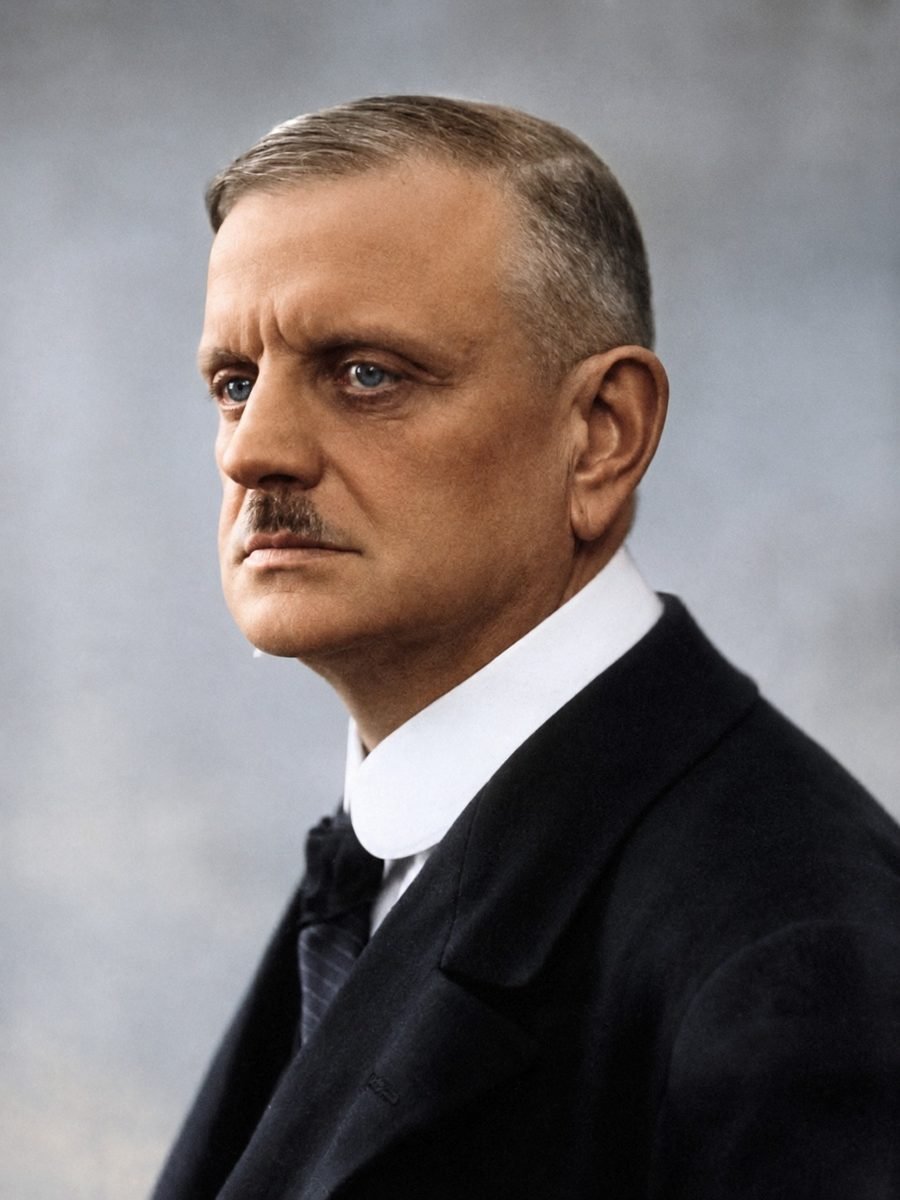
Jean Sibelius — Anecdotes, Curiosities, and Revealing Episodes from His Life
Jean Sibelius was one of those composers whose life seems divided between two almost opposite worlds: on one side, the public figure, the national symbol, the man whose music became inseparable from the Finnish landscape and from the dream of Finnish cultural identity; on the other, the intensely private artist, tormented by self-criticism, financial worries, alcohol, silence, and the almost mystical difficulty of completing what he imagined. His life was not full of theatrical scandal in the manner of Wagner, nor of spectacular virtuoso display in the manner of Liszt, but it was filled with episodes of deep psychological interest. Sibelius lived as a composer who felt that music came not merely from the mind, but from nature, memory, wind, birds, water, forest, and loneliness.
Below are some of the most revealing anecdotes and curiosities from his life, presented not as isolated trivia, but as windows into the personality of a man who became, almost against his own will, the musical voice of Finland.
1. The Child Who Was Not Originally “Jean”
Jean Sibelius was born on 8 December 1865 in Hämeenlinna, in the Grand Duchy of Finland, then part of the Russian Empire. His baptismal name was Johan Julius Christian Sibelius. In the family he was called “Janne,” a familiar Swedish form of Johan. The name “Jean,” by which the world would come to know him, was not his childhood name. It was adopted later, partly inspired by the visiting cards of a deceased uncle who had used the French form “Jean.”
The adoption of “Jean” had something almost theatrical about it. It gave the young composer a more cosmopolitan identity, one that sounded elegant, European, and artistic. Yet this little transformation also reveals an important tension in his life: Sibelius was at once deeply Finnish, Swedish-speaking by background, European by ambition, and almost mythically Finnish by destiny.
2. The Loss of His Father and the Shadow of Family Insecurity
Sibelius’s father, Christian Gustaf Sibelius, was a physician. He died of typhoid fever in 1868, when Jean was only about two and a half years old. The father’s death left the family in a precarious situation, with debts and economic uncertainty. Sibelius was therefore raised mainly by his mother, Maria Charlotta, and by relatives.
This early absence of the father is not a simple anecdote; it helps explain something about Sibelius’s later character. He often projected authority and dignity, but beneath that exterior there was a lifelong anxiety about money, status, and security. He could be proud, generous, and aristocratic in manner, yet he lived for many years with the fear of debt and failure. The combination of grandeur and insecurity became one of the psychological signatures of his life.
3. The Violin Dream That Never Died
Before Sibelius became famous as a composer, he dreamed of becoming a violin virtuoso. He began serious violin studies relatively late, but he pursued the instrument with real passion. The violin was not merely a student instrument for him; it became an emotional ideal. He loved its tone, its singing line, its nobility, and its capacity for melancholy.
The painful truth was that Sibelius never became the great violinist he longed to be. He was talented, but not enough to conquer the international stage as a performer. This disappointment remained with him all his life. It is one of the reasons why the Violin Concerto in D minor, composed in 1903 and revised in 1905, feels so intensely personal. That concerto is not simply a showpiece; it is the ghost of the violinist Sibelius could never fully become.
There is a touching irony here: the man who failed to become a great violinist created one of the most demanding and beloved violin concertos in the repertoire. His disappointment became another artist’s triumph.
4. The Young Sibelius and the Power of Nature
From childhood, Sibelius was unusually sensitive to nature. He did not merely enjoy landscapes; he listened to them. Forests, lakes, wind, birds, and seasonal changes became part of his inner world. Finland’s natural environment was not a decorative background to his music; it was one of its deepest sources.
One of the most revealing curiosities about Sibelius is that he associated certain sounds and impressions with visual or emotional images. He was profoundly alert to the movement of light, the shape of silence, the call of birds, and the atmosphere of weather. Later in life, at Ainola, his home near Lake Tuusula, he would listen intensely to cranes, swans, and other birds. The famous swan theme in the Fifth Symphony was not an abstract musical idea; it grew from a real experience of birds in flight.
For Sibelius, nature was almost a metaphysical teacher. It taught him slowness, vastness, organic growth, and the mysterious connection between movement and stillness.
5. His Early Law Studies — A Very Brief Detour
Like many young men from respectable families, Sibelius initially followed a conventional path. He enrolled to study law at the Imperial Alexander University in Helsinki. But the law never truly possessed him. Music did.
He soon entered the Helsinki Music Institute, where he studied composition and violin. The brief legal episode is almost comic in retrospect. One can imagine the young Sibelius trying to appear responsible, respectable, and practical, while inwardly already belonging to another world. The law lost him; music claimed him completely.
6. The Berlin and Vienna Years: The Shock of Europe
Sibelius studied abroad in Berlin in 1889–1890 and in Vienna in 1890–1891. These experiences were crucial. He encountered the broader musical world of Central Europe, including the legacy of Beethoven, Brahms, Wagner, Bruckner, and the Austro-German symphonic tradition.
But Vienna also produced a crisis. Sibelius still hoped for a career as a violinist, and he auditioned for the Vienna Philharmonic. The attempt failed. This was one of the great humiliations of his early life. He had to confront the fact that his future would not be as a performing virtuoso, but as a composer.
The failure wounded him, but it also clarified him. The loss of the violinist’s dream helped birth the composer. The inner intensity that might have gone into performance was redirected into orchestral imagination.
7. The Discovery of the Kalevala
One of the most important turning points in Sibelius’s artistic development was his encounter with the Kalevala, the Finnish national epic compiled by Elias Lönnrot. The Kalevala was not merely a book for Sibelius; it opened a world of archaic rhythm, mythic atmosphere, and national imagination.
Works such as Kullervo, En saga, Lemminkäinen, The Swan of Tuonela, and many others owe something to this mythic background. Yet Sibelius was never simply illustrating stories. He was absorbing their atmosphere. He transformed myth into sound, and national legend into orchestral destiny.
The Kalevala gave Sibelius a language that was neither German nor Russian, neither academic nor cosmopolitan. It allowed him to become himself.
8. Kullervo: The First Great Sibelian Eruption
In 1892, Sibelius achieved a dramatic breakthrough with Kullervo, a vast symphonic work for soloists, male chorus, and orchestra. The premiere in Helsinki was a sensation. It was not polished salon music; it was raw, monumental, primitive, tragic, and unmistakably Finnish.
The work was based on the tragic figure of Kullervo from the Kalevala, a doomed hero whose life is marked by violence, incest, shame, and destruction. Sibelius, still in his twenties, poured into the work an almost volcanic energy. Kullervo was the moment when Sibelius ceased to be a promising young musician and became a national composer.
Curiously, Sibelius later withdrew the work and did not permit its regular performance during his lifetime. This tells us something important about him. He could be fiercely proud, but also brutally self-critical. He often looked back on earlier music with embarrassment, even when others admired it. His genius was accompanied by a relentless inner judge.
9. Aino Järnefelt: Love, Marriage, and Endurance
Sibelius married Aino Järnefelt on 10 June 1892. The Järnefelt family was cultivated, politically conscious, artistically active, and strongly connected with Finnish national culture. Through Aino, Sibelius entered a circle that reinforced his Finnish identity and artistic seriousness.
The marriage was loving, but not easy. Aino endured Sibelius’s drinking, debts, absences, extravagant habits, and long creative crises. She also protected him, organized family life, and gave him the domestic stability without which his work might have collapsed. Aino was not merely the composer’s wife; she was one of the great supporting pillars of his entire creative life.
Their home, Ainola, was named after her. This is itself a beautiful fact: the house of Sibelius, the sanctuary of the Finnish national composer, bore the name of the woman who made such a life possible.
10. The Death of His Daughter Kirsti
One of the most painful episodes in Sibelius’s family life was the death of his young daughter Kirsti in 1900. She died of typhoid fever at less than two years old. The loss devastated the family.
This tragedy belongs to the emotional background of Sibelius’s life around the time of the First Symphony and Finlandia. The public saw the composer as a national hero, but at home he and Aino were living through grief. The contrast between public triumph and private suffering was one of the recurrent patterns of Sibelius’s life.
His music rarely expresses grief in a sentimental way. More often, grief becomes distance, coldness, landscape, silence, or a slow darkening of orchestral color.
11. Finlandia: The Work That Became Almost a National Prayer
The tone poem Finlandia, composed in 1899 and revised in 1900, became Sibelius’s most famous patriotic work. It emerged during a period of Russian pressure on Finnish autonomy. Officially, it had to be presented under various titles to avoid censorship, but audiences understood its meaning.
The anecdotal power of Finlandia lies in the way music became a form of political speech. People heard in it resistance, dignity, mourning, and hope. The famous hymn-like section came to symbolize Finland’s spiritual endurance. Sibelius did not become a national figure because he wrote propaganda; he became one because his music gave a people a sound for their own inward resistance.
Curiously, Sibelius himself sometimes became irritated by the overwhelming popularity of Finlandia, because it threatened to reduce him to a patriotic composer. He knew that his deeper achievement lay in the symphonies, tone poems, and the evolution of a new musical logic.
12. The Cigars, Champagne, and Expensive Tastes
Sibelius had expensive habits. He loved fine cigars, good food, elegant restaurants, champagne, and a refined style of living that often exceeded his income. This created constant financial tension. He could receive money, grants, or fees and then spend too freely. Debts accumulated.
There is something almost contradictory here. Sibelius lived at Ainola, close to nature, surrounded by forests and silence; yet he also had a taste for urban luxury and convivial excess. He was both the man of the forest and the man of the cigar room.
This tension had consequences. His debts placed great pressure on Aino and the family. Friends, patrons, publishers, and eventually the Finnish state helped him financially. Yet the anxiety never entirely disappeared. Money, for Sibelius, was not only practical; it was bound up with dignity, shame, and self-image.
13. The Drinking Problem
Sibelius’s relationship with alcohol is one of the darker curiosities of his life. In social settings he could be charming, witty, expansive, and charismatic. But drinking could also become destructive. Periods of heavy alcohol use damaged his health, worsened his debts, frightened his family, and interfered with work.
Aino suffered deeply from this. At times she withdrew to protect herself and the children from the chaos of his behavior. Sibelius made promises, broke them, renewed them, and struggled again. His life was not the simple story of a calm national sage; it was also the story of a man fighting his own weaknesses.
The tension between discipline and excess appears in the music too, though transformed. His greatest works are extraordinarily controlled, compressed, and organic, as if the act of composition allowed him to impose order on inner turbulence.
14. The Throat Tumour and the Fear of Death
In 1908, Sibelius underwent a serious operation for a throat tumour. At the time, the possibility of cancer terrified him. For a man who loved cigars and alcohol, the diagnosis was psychologically devastating. After the operation, he was forced to confront mortality more directly than ever before.
This crisis affected his music profoundly. The Fourth Symphony, completed in 1911, is one of the bleakest and most uncompromising symphonies of the early twentieth century. It avoids easy consolation. It seems to look into an empty, cold, metaphysical space. The Fourth Symphony is often heard as the musical shadow of that encounter with death.
During this period Sibelius abstained for a time from cigars and alcohol, partly out of fear. But the struggle was not permanently won. The threat of illness became one of the forces that deepened his art.
15. The Fourth Symphony and the Puzzled Audience
When the Fourth Symphony was first performed, many listeners were bewildered. They expected the patriotic grandeur of Finlandia, the heroic sweep of earlier works, or the broad lyricism of the Second Symphony. Instead, they heard something austere, fragmented, inward, and unsettling.
This reaction reveals how far Sibelius had moved beyond nationalism as a simple style. He was not interested in repeating his successes. He was building a new kind of symphonic language, one based on concentration, organic growth, and the refusal of easy emotion.
The Fourth Symphony is an anecdote in itself: a public occasion that exposed the distance between what audiences wanted Sibelius to be and what Sibelius had actually become.
16. The Swans of the Fifth Symphony
One of the most famous moments in Sibelius’s life occurred on 21 April 1915, when he saw sixteen swans flying overhead. The experience overwhelmed him. He wrote in his diary of one of the great experiences of his life. This vision became connected with the majestic horn theme in the finale of the Fifth Symphony.
The anecdote is famous because it perfectly captures Sibelius’s relationship with nature. He did not merely depict birds. He experienced them as revelations. The swans became music, and the music became an image of vast circular flight.
The finale of the Fifth Symphony, especially in its final revised version of 1919, seems to unfold like a natural phenomenon: not a melody imposed from outside, but a shape growing, circling, rising, and finally arriving at those extraordinary separated final chords. It is one of the greatest examples of Sibelius transforming an observation of nature into symphonic architecture.
17. His Fiftieth Birthday and National Celebrity
In 1915, Sibelius’s fiftieth birthday became a major national celebration in Finland. The country treated him not merely as a composer but as a cultural monument. The Fifth Symphony was premiered in its first version during this anniversary period.
But for Sibelius, celebration did not mean artistic satisfaction. He revised the Fifth Symphony repeatedly, dissatisfied with its structure. The final version came only in 1919. Even when the nation was applauding him, his inner ear was not satisfied.
This is one of the recurring ironies of Sibelius: public triumph often coincided with private torment. The world praised him; he revised, doubted, destroyed, or fell silent.
18. The Way He Revised His Works
Sibelius was not a composer who simply wrote and moved on. He revised obsessively. Several works exist in different versions, and the differences can be profound. The Violin Concerto, En saga, and the Fifth Symphony are among the most famous examples.
His revisions were not cosmetic. He often sought greater concentration, stronger architecture, and more organic necessity. He removed what seemed excessive. He tightened, clarified, purified. Sibelius’s art moved from romantic expansion toward a kind of granite-like condensation.
This makes his manuscripts and revisions especially fascinating. They show a composer struggling to make music seem not written, but grown.
19. Ainola: The House of Silence
In 1904, Sibelius and his family moved to Ainola, near Lake Tuusula. The house became central to his life. It was not simply a residence; it was a retreat, a fortress, a listening post, and eventually a monument.
At Ainola, Sibelius was close enough to Helsinki to remain connected to musical life, yet far enough away to live among trees, birds, and seasonal quiet. The house had symbolic power. Ainola became the physical embodiment of Sibelius’s art: domestic, remote, Finnish, natural, and inward.
Yet the silence of Ainola was not always peaceful. It could be creative silence, but also anxious silence. During his later decades, when he published little or nothing, Ainola became the setting of one of the most mysterious silences in music history.
20. The Piano Forbidden By Sibelius
One curious domestic detail often associated with Ainola is that Sibelius disliked constant piano noise in the house. He needed silence for composition, and the atmosphere of the home was shaped by his requirements. His daughters grew up in a household where the father’s creative concentration had to be protected.
This is revealing because Sibelius’s music is so orchestral in imagination. The piano was a tool, but not his deepest medium. He thought in sonorities, colors, textures, and large processes. Silence, for Sibelius, was not emptiness; it was the space in which music could be heard before it was written.
21. The Sixth Symphony: Pure Cold Water
Sibelius once famously described the atmosphere of his Sixth Symphony, completed in 1923, in terms often paraphrased as pure cold water, in contrast to the colorful cocktails offered by other composers. Whether taken literally or as a remembered formulation, the image is perfect.
The Sixth Symphony does not shout. It flows. It has a modal purity, a transparency, and an almost sacred restraint. It is not a heroic symphony, but a music of light, air, and moral clarity.
The anecdote matters because it shows Sibelius’s self-awareness. He knew that his late style was not modernist in the obvious sense, nor romantic in the old sense. It was something more severe, natural, and distilled.
22. The Seventh Symphony: One Movement, One Breath
The Seventh Symphony, completed in 1924, is one of the most original symphonic achievements of the twentieth century. It is in one continuous movement, yet it contains the emotional and structural weight of a full symphony. It feels less composed than revealed.
The great trombone theme rises like a monumental statement from within the music’s own substance. There is no conventional four-movement layout. Instead, tempo, form, and thematic transformation are fused into one organic process. The Seventh is perhaps the purest example of Sibelius’s dream of organic symphonic form.
As an anecdote of artistic evolution, it is extraordinary: the composer who began with the massive, choral-national world of Kullervo ended by compressing the symphony into a single, inevitable span.
23. Tapiola: The Forest as Cosmic Terror
In 1926, Sibelius completed Tapiola, one of his last major works and one of the most astonishing tone poems ever written. Its subject is Tapio, the forest spirit from Finnish mythology. But Tapiola is not picturesque forest music. It is something far more severe and terrifying.
The forest in Tapiola is vast, ancient, indifferent, and alive with hidden forces. There is no easy human comfort in it. Tapiola is almost the sound of nature before humanity, or nature after humanity.
It is remarkable that after such a work Sibelius largely fell silent. Tapiola sounds like a final gate: beyond it there may have been music, but Sibelius either could not, or would not, bring it into the world.
24. The Mystery of the Eighth Symphony
Perhaps the greatest mystery in Sibelius’s life is the Eighth Symphony. For years he was believed to be working on it. Conductors, publishers, and admirers expected it. There were hints, promises, evasions, and reports. But the symphony never appeared.
The most dramatic story is that Sibelius destroyed manuscripts, possibly including substantial material for the Eighth Symphony, in the fireplace at Ainola. Aino later recalled the burning of papers. Whether a complete Eighth Symphony existed remains uncertain, but it is clear that Sibelius destroyed important late material.
This is one of the most haunting anecdotes in music history. The man who had given the twentieth century one of its most original symphonic voices may have chosen silence over imperfection.
The Eighth Symphony became not a work, but a legend — the absent masterpiece, the music swallowed by the fire.
25. The “Silence of Järvenpää”
After the mid-1920s, Sibelius published very little of major importance. Yet he lived until 20 September 1957. This means that for roughly three decades, the world’s most famous Finnish composer lived in a state of near-creative public silence.
This period is sometimes called the Silence of Järvenpää, after the area where Ainola was located. It is one of the strangest late chapters in the life of any major composer. Unlike Beethoven, who died still composing; unlike Verdi, who returned in old age with Otello and Falstaff; unlike Strauss, who continued writing late works, Sibelius withdrew.
But this silence was not simple emptiness. He remained aware of music, of reputation, of expectations, and of the burden of being Sibelius. His silence may have been the final form of his self-criticism.
26. The World Came to Ainola
Even during his silence, Sibelius remained internationally famous. Conductors, musicians, politicians, writers, admirers, and journalists came to visit him. Ainola became almost a pilgrimage site. The elderly Sibelius was treated as a living monument.
This created an unusual situation: a composer who was no longer giving the world new major works was nevertheless being honoured as one of the great living masters. He was present and absent at the same time.
Visitors often found him dignified, courteous, sometimes humorous, sometimes remote. He had become both man and symbol. The human Sibelius still had doubts; the public Sibelius had become granite.
27. Sibelius and Telephone Birthday Concerts
In his later years, Sibelius’s birthdays became national events in Finland. Concerts were performed in his honour, and sometimes he could hear tributes by radio or telephone. The idea of the old composer at Ainola, listening from a distance while the nation celebrated him, is deeply moving.
It symbolizes his late position perfectly. He was no longer fully in public life, yet public life continued to orbit around him. Sibelius had become a living national relic, but one with an active, painful, self-critical inner life.
28. His View of Modern Music
Sibelius lived through enormous changes in music: late Romanticism, Impressionism, Expressionism, atonality, neoclassicism, and the rise of modernist experimentation. He knew that the musical world had changed drastically since his youth.
His relation to modernism was complex. He did not follow Schoenberg, nor did he become an avant-garde revolutionary in the obvious sense. Yet he was not simply conservative. His late works, especially the Fourth, Sixth, Seventh Symphonies and Tapiola, are structurally radical in their own way. Sibelius was modern not by destroying tonality, but by rethinking musical form from within.
He was sometimes misunderstood because his surface language could appear traditional while his deeper architecture was highly original.
29. The Conductors Who Became His Advocates
Sibelius’s international reputation was helped by conductors who believed deeply in his music. In Britain and America especially, his symphonies found strong support. Conductors such as Robert Kajanus, Thomas Beecham, Serge Koussevitzky, and others played crucial roles in promoting him.
Kajanus, in particular, was central to the early interpretation of Sibelius’s music. His recordings and performances were seen as especially authoritative because of his closeness to the composer and the Finnish musical tradition.
The curiosity here is that Sibelius, though deeply Finnish, became in some ways more consistently admired in the English-speaking world than in certain Central European modernist circles. His music could be heard as an alternative path for the twentieth-century symphony.
30. The Critics Who Attacked Him
Not everyone admired Sibelius. Some modernist critics saw him as reactionary, provincial, or overly celebrated. Theodor W. Adorno famously attacked Sibelius with particular severity. Such criticism damaged his reputation in some intellectual circles for decades.
Yet the later twentieth century saw a powerful reassessment. Many musicians and scholars came to recognize the radical originality of his forms, his compression, his handling of time, and his organic treatment of musical material. The Sibelius of late modern understanding is not a reactionary, but a different kind of modernist.
This is an important curiosity of reception: Sibelius was first made into a national hero, then dismissed by some as old-fashioned, then rediscovered as one of the most original masters of symphonic form after Beethoven.
31. The Finnish State and the Artist’s Pension
Sibelius received financial support from the Finnish state, including a pension. This was a recognition not merely of personal merit but of cultural importance. Finland understood that Sibelius had become part of its national identity.
This support was essential because Sibelius’s finances were frequently unstable. But it also placed him under symbolic pressure. He was not simply Jean Sibelius, private composer; he was a public institution. To be a national composer is an honour, but it is also a burden.
This burden may partly explain the later silence. When everyone expects greatness, the blank page becomes terrifying.
32. His Diary: A Window Into Anxiety
Sibelius’s diary is one of the most valuable windows into his personality. In it, one finds not only artistic reflections, but worry, self-reproach, observations of nature, financial anxiety, fear of illness, and moments of exaltation.
The diary shows a man who was never as calm as his public image suggested. He could experience extraordinary inspiration, but also intense doubt. Sibelius’s inner life was not smooth, nordic, and serene; it was full of struggle, fire, shame, ecstasy, and fear.
This contrast between public monument and private insecurity makes him one of the most psychologically compelling composers of the modern era.
33. Sibelius and the Birds
Birds appear again and again in Sibelius’s life and imagination. Cranes, swans, and other birds were not casual natural details for him. They seemed to carry symbolic meaning: freedom, distance, fate, migration, eternity.
The Swan of Tuonela, part of the Lemminkäinen Suite, gives us one of his most haunting bird images: a mystical swan floating on the dark river of the underworld. The Fifth Symphony gives us birds as revelation and flight. His diary gives us birds as daily omens of nature’s grandeur.
For Sibelius, birds were not merely animals; they were messengers between the visible world and the mysterious order behind it.
34. The Temperament Behind the Stone Face
Photographs of the older Sibelius often show a severe, monumental face: bald head, strong features, piercing eyes, almost sculptural stillness. It is easy to imagine him as stern and immovable.
But those who knew him encountered a more complex man. He could be humorous, sociable, charming, vain, affectionate, anxious, theatrical, and deeply moved by praise or criticism. His external granite covered a volcanic inner temperament.
This is one reason why his music can seem both cold and burning. The surface may be austere, but underneath there is enormous pressure.
35. His Relation to Beethoven
Sibelius inherited the symphonic problem from Beethoven: how to make a large work feel necessary from beginning to end. But he did not imitate Beethoven’s rhetoric. Instead of dramatic opposition and development in the classical sense, Sibelius increasingly preferred germinal growth, transformation, and the emergence of form from small cells.
The anecdotal curiosity here is intellectual rather than biographical: Sibelius found a way to continue the symphonic tradition without writing like Beethoven, Brahms, Bruckner, or Mahler.
Where Mahler expanded the symphony to contain the world, Sibelius compressed the symphony until it seemed to become a force of nature.
36. Sibelius and Mahler: Two Ideas of the Symphony
One of the most famous meetings in Sibelius’s life was with Gustav Mahler in 1907. They discussed the nature of the symphony. Sibelius valued severity, logic, and inner connection. Mahler is reported to have responded that the symphony must be like the world — it must embrace everything.
This contrast is magnificent because it defines two opposite paths in twentieth-century symphonic thought. Mahler sought encyclopaedic expansion; Sibelius sought organic necessity. Mahler’s symphony contains marches, songs, dances, nature, irony, religion, and catastrophe. Sibelius’s mature symphony seems to grow like a tree, a storm front, or a geological formation.
This meeting is one of the great symbolic encounters in modern music.
37. The Sibelius Monument Began Before His Death
Few composers lived long enough to see themselves become almost mythic. Sibelius did. By the time of his old age, he was not only respected; he was monumentalized. Streets, institutions, festivals, and cultural ceremonies were connected with his name.
This could be flattering, but also imprisoning. Imagine living for decades as a symbol of national genius while privately doubting your ability to complete another symphony. Sibelius became a monument while still alive — and monuments do not easily compose new music.
This may be one of the hidden tragedies of his final decades.
38. His Death at Ainola
Jean Sibelius died on 20 September 1957 at Ainola, aged 91. He had lived long enough to see Finland transformed, Europe devastated by two world wars, and music changed almost beyond recognition.
He died in the house that had become inseparable from his name. His funeral was a national event. He was buried in the grounds of Ainola. Aino, who survived him, was later buried beside him.
The ending is deeply fitting. Sibelius returned to the silence, the trees, the seasons, and the Finnish earth that had nourished his imagination.
39. The Paradox of Sibelius
The greatest curiosity about Sibelius may be the paradox of the man himself. He was a nationalist composer who outgrew nationalism; a romantic who became austere; a lover of luxury who sought silence in nature; a public hero who became privately silent; a failed violinist who wrote one of the greatest violin concertos; a composer revered as conservative by some audiences and later recognized as radical in form.
His life is not the story of a man who found peace, but of a man who made great art from the tension between desire and restraint, voice and silence, expansion and condensation.