5 January 2026
Giovanni Punto - Four Horn Concertos - Barry Tuckwell - ASMF - Neville Marriner
On Classicapedia: Giovanni Punto, Ludwig van Beethoven, Barry Tuckwell, Sir Neville Marriner
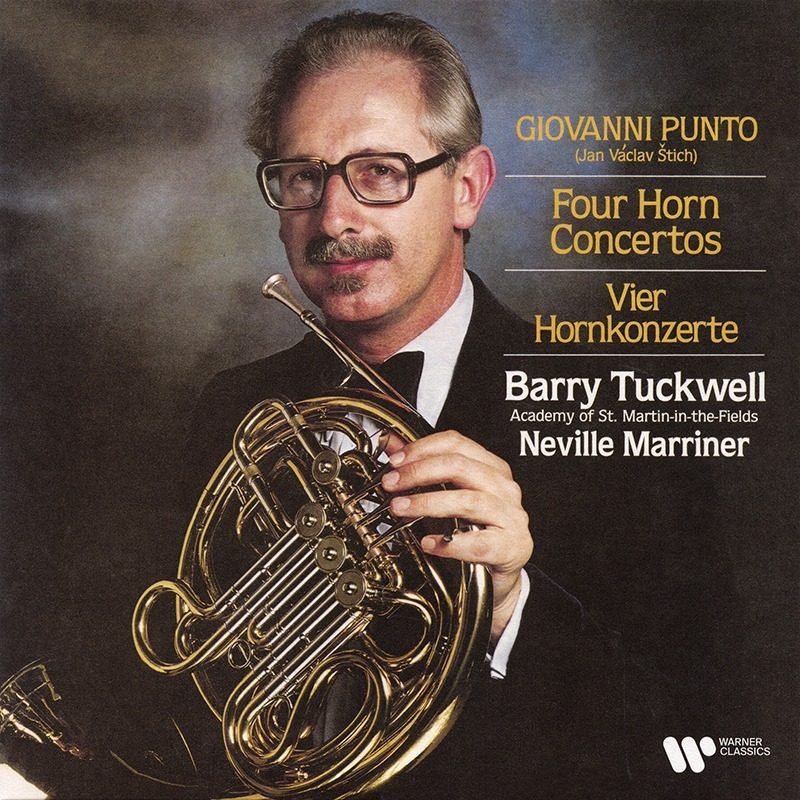
Giovanni Punto — Composer, Virtuoso, Reformer
Giovanni Punto, born Jan Václav Stich on 28 September 1746 in Žehušice, Bohemia, stands as one of the most extraordinary instrumental figures of the late 18th century. Remembered above all as the greatest horn virtuoso of the Classical era, Punto was also a composer of distinction, whose works expanded the expressive and technical boundaries of the natural horn at a decisive moment in European musical history.
Stich was born into a modest Bohemian family at a time when the region was renowned for producing outstanding instrumentalists. His early musical talent was quickly recognized, and as a teenager he entered the service of Count Thun, where he received formal training on the natural horn, then still largely associated with hunting signals and courtly ceremonial music.
From the outset, Stich showed an unusual technical audacity. He experimented instinctively with hand-stopping techniques inside the bell of the horn, achieving chromatic notes and subtle shading that were still rare and controversial. These innovations would later define his international fame.
In 1763, Stich made a dramatic decision: he fled his employer without permission, an act considered highly risky and potentially criminal under feudal law. Reinventing himself under the Italianized name Giovanni Punto, he began a life of independence as a touring virtuoso.
This change of identity was not cosmetic. It symbolized his transformation from a court servant into a modern freelance artist, anticipating the professional independence later associated with figures such as Mozart and Beethoven.
Throughout the 1770s and 1780s, Punto toured relentlessly across Germany, France, England, Italy, and the Habsburg lands, astonishing audiences with feats previously thought impossible on the natural horn.
His innovations included:
Advanced hand-stopping, allowing nearly complete chromaticism
Singing legato lines, rivaling vocal expressiveness
Extreme dynamic control, from heroic brilliance to intimate pianissimo
Agile articulation, transforming the horn into a true solo instrument
Contemporary critics described his playing as “speaking” rather than sounding, and likened his phrasing to that of the finest singers.
Punto was not merely a performer; he was a composer deeply attuned to the physical and expressive realities of the horn. His works were designed to demonstrate the new possibilities he had unlocked.
Principal Works
Horn Concertos (several, now partly lost or fragmented)
Horn Sonatas and Duos
Chamber music with prominent horn writing
Instructional and pedagogical pieces
His compositions combine Classical formal clarity with daring technical demands, serving both as concert repertoire and as practical demonstrations of his technique. Though stylistically aligned with Haydn-era Classicism, they consistently push beyond the conventions of the time.
One of the most significant moments of Punto’s later career occurred in 1800, when he collaborated with Ludwig van Beethoven in Vienna. Beethoven composed his Sonata for Horn and Piano in F major, Op. 17 specifically for Punto.
The work reflects Punto’s revolutionary style:
* Wide leaps and lyrical cantabile writing
* Chromatic passages tailored to hand-stopping
* A heroic yet flexible conception of the horn
Beethoven reportedly admired Punto immensely, and the sonata remains a cornerstone of the horn repertoire to this day.
Despite his fame, Punto’s later years were marked by financial difficulty and declining health. Constant travel and the physical demands of his instrument took their toll. He died in Prague on 16 February 1803, impoverished and largely forgotten by the public that had once celebrated him.
Giovanni Punto occupies a pivotal position in music history:
He transformed the natural horn into a fully expressive solo instrument
He directly influenced Classical and early Romantic horn writing
* His techniques laid foundations later absorbed into valved-horn practice
He stands as a prototype of the virtuoso-composer-performer
Although eclipsed in popular memory by composers of larger output, Punto’s impact was structural rather than superficial: without him, the horn would not have entered the 19th century as a lyrical, heroic, and technically liberated voice.