9 May 2026
Giacomo Meyerbeer: The Man Who Turned Opera into a World
On Classicapedia: Giacomo Meyerbeer, Richard Wagner, Pauline Viardot, Giovanni Battista Velluti, Rosine Stoltz
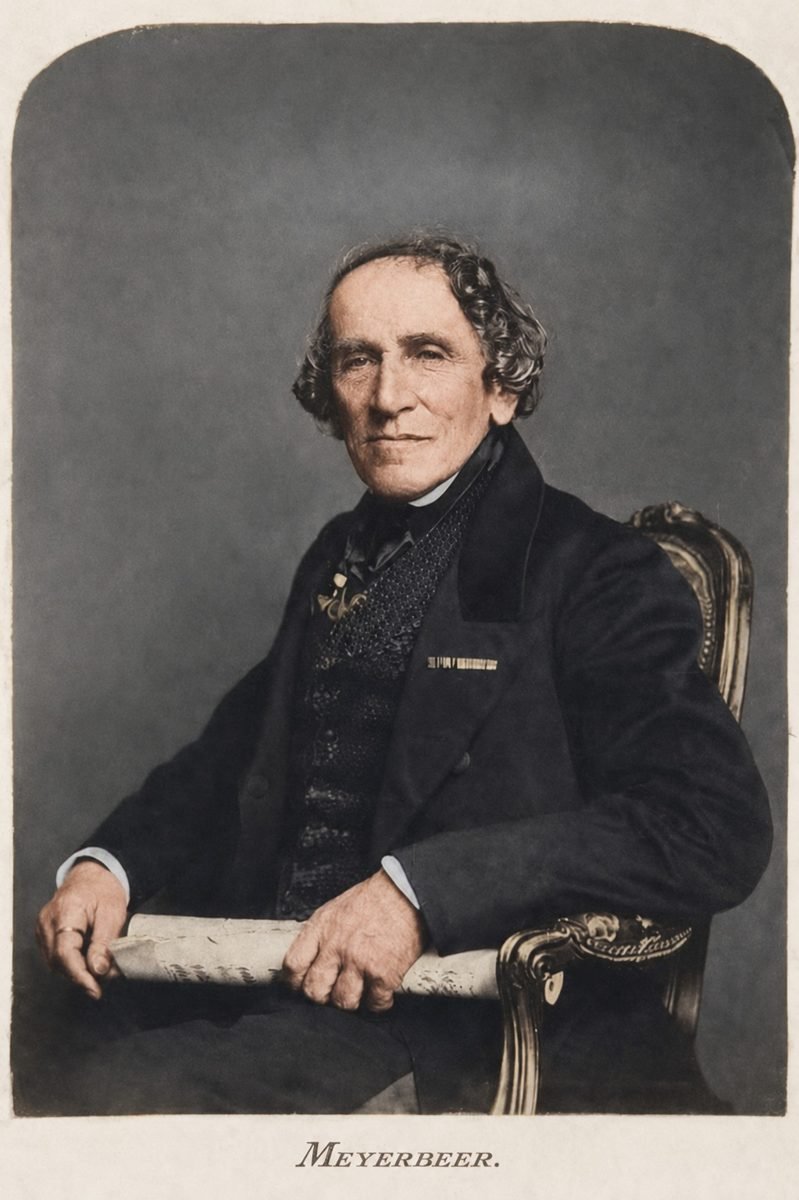
The Man Who Turned Opera into a World
The life of Giacomo Meyerbeer is full of paradoxes. He was one of the most famous opera composers of the nineteenth century, perhaps the most internationally influential operatic figure between Rossini and Wagner, and yet for much of the twentieth century his name was treated almost as a historical curiosity. He was born as Jakob Liebmann Beer on 5 September 1791, near Berlin, and died in Paris on 2 May 1864. His artistic life moved between Germany, Italy, and France, and his identity was shaped by Jewish heritage, Prussian culture, Italian vocal style, French theatrical machinery, and a cosmopolitan instinct for the stage.
Meyerbeer's story is not simply the biography of a successful composer. It is the story of a man who understood that opera in the nineteenth century was not only music, but politics, theatre, religion, money, singers, spectacle, public opinion, and timing. His greatest works were not written merely to be heard; they were designed to overwhelm the eye, the ear, the imagination, and the public conscience.
One of the first curiosities about Meyerbeer is that his career began not in the theatre but at the keyboard. As a child and young man, he was admired as a pianist. This is important because later generations often reduced him to a master of spectacle, as if his art were merely theatrical. In reality, Meyerbeer's musical formation was serious, disciplined, and technically demanding. He was trained within the German musical world before reinventing himself as an Italian and then French operatic composer.
His original name, Jakob Liebmann Beer, already tells a story. "Meyer" entered the family name through inheritance, and "Giacomo" was the Italian form he adopted during his Italian years. The name Giacomo Meyerbeer is therefore almost a miniature map of his career: German-Jewish origin, Italian transformation, European fame.
This change of name was not superficial. Meyerbeer's whole artistic identity was based on adaptation. He did not remain fixed in one national style. He learned from German counterpoint, Italian bel canto, French grand opera, and Parisian stagecraft. This made him extraordinarily successful, but it also later made him vulnerable to nationalist criticism. Wagner and others would attack precisely what had made Meyerbeer great: his cosmopolitanism.
Before he became the architect of French grand opera, Meyerbeer had to pass through Italy. This is one of the most important facts in his artistic development. He absorbed the world of Rossini, vocal brilliance, stage rhythm, and dramatic immediacy. His Italian success culminated in Il crociato in Egitto, premiered at La Fenice in Venice on 7 March 1824.
This opera is a fascinating historical bridge. It still belongs to the world of Italian opera seria, but it also points toward the more spectacular Meyerbeer to come. It was also one of the last major operas to feature a castrato role, because the great castrato Giovanni Battista Velluti appeared in it. That detail alone places Meyerbeer at a crossroads between old and new operatic worlds: the fading tradition of eighteenth-century vocal display and the rising nineteenth-century theatre of mass spectacle.
The Italian years taught Meyerbeer something essential: no operatic effect is persuasive unless it can be sung. Later, in Paris, he would command gigantic choruses, stage machinery, historical tableaux, religious ceremonies, and political crowds; but underneath the spectacle remained the bel canto lesson: the voice must carry the drama.
The true explosion came with Robert le diable, premiered at the Paris Opéra on 21 November 1831. This was not merely a success; it was a cultural event. It helped define what French grand opera could be: five acts, historical or legendary background, ballet, supernatural atmosphere, massive scenic design, vocal display, and an almost cinematic control of public sensation.
One of the most famous curiosities of Robert le diable is the ballet of the dead nuns. In the third act, ghostly nuns rise from their tombs in a ruined cloister. For Parisian audiences of the 1830s, this was sensational: religious transgression, Gothic atmosphere, ballet, erotic unease, and supernatural theatre all combined in one scene. It became one of the most talked-about theatrical moments of its age.
The scene also shows Meyerbeer's genius for contradiction. He understood that opera becomes powerful when opposites collide: sacred and profane, prayer and seduction, death and dance, terror and beauty. Meyerbeer did not merely write arias; he created operatic situations.
If Robert le diable made Meyerbeer famous, Les Huguenots made him monumental. The opera was premiered at the Paris Opéra on 29 February 1836. It deals with the massacre of Protestants during the St. Bartholomew's Day Massacre of 1572, and it became one of the most celebrated operas of the nineteenth century. The work received more than a thousand performances at the Paris Opéra, a fact that shows just how central Meyerbeer once was to European operatic life.
One of the most remarkable curiosities of Les Huguenots is Meyerbeer's use of the Lutheran chorale Ein feste Burg. He does not treat it as a simple quotation. It becomes a dramatic and symbolic marker of Protestant identity. The music does not merely decorate the action; it identifies a community, a faith, and a destiny.
This is one reason why Meyerbeer must be taken seriously as a precursor to Wagner. Modern commentary has noted that Les Huguenots uses recurring melodic shapes, harmonic relationships, rhythmic patterns, and instrumental timbres in ways that helped prepare the later idea of leitmotivic drama. Wagner later attacked Meyerbeer, but he inherited from him the sense that a recurring musical idea could carry historical and symbolic meaning.
The most terrifying scene is the Blessing of the Daggers. Here Meyerbeer transforms religious fanaticism into musical theatre. The scene is not merely dramatic; it is prophetic. It shows how political murder can be sanctified by ritual, how collective violence can be wrapped in sacred language, and how opera can expose the psychology of fanaticism.
One of the most revealing anecdotes about Meyerbeer concerns Le Prophète. By the end of 1841, he had completed a first draft of the opera, but he refused to stage it because the director of the Paris Opéra, Léon Pillet, wanted to cast his mistress, Rosine Stoltz, as Fidès. Meyerbeer insisted instead on Pauline Viardot. He even lodged the score with a Parisian lawyer and refused to allow the production until his conditions were met. The opera finally premiered on 16 April 1849.
This episode tells us almost everything about Meyerbeer's character. He was cautious, patient, strategic, and absolutely determined. He understood that in grand opera, the wrong singer could destroy the architecture of a work. Fidès was not a secondary role; she was the emotional centre of Le Prophète. Meyerbeer waited because he knew that the right voice could make the opera live.
It is also a rare example of a composer powerful enough to resist an opera-house director. Most composers had to accept theatre politics. Meyerbeer, because of his wealth, prestige, and international fame, could say no. This is one of the great curiosities of his career: he was both an artist and a master of operatic power politics.
Le Prophète is one of the strangest and most fascinating operas of the nineteenth century. Its subject is the Anabaptist leader Jean de Leyde, and its themes include religious manipulation, popular uprising, charismatic leadership, maternal sacrifice, and political catastrophe. The work requires enormous forces, including large orchestra, several choruses, onstage brass, and spectacular stage effects. Modern commentary has noted that the Paris premiere used electric lighting at the Opéra and included a famous ballet on roller skates.
The roller-skating ballet is one of the most irresistible Meyerbeer anecdotes. To modern readers it may sound absurd, but in context it was a dazzling technological and theatrical effect: movement, light, spectacle, novelty, and public astonishment. Meyerbeer understood Paris. He knew that the Opéra was not only a theatre; it was a laboratory of sensation.
But beneath the spectacle lies a dark political vision. Le Prophète is not merely grand entertainment. It is about how a man can be turned into a symbol, how crowds can be manipulated, how religious language can serve power, and how private life can be destroyed by public myth. In this sense, Meyerbeer was far more modern than his detractors admitted. He understood mass psychology before it became a central theme of modern politics.
Meyerbeer's operas are full of demanding roles because he wrote for specific singers and theatrical personalities. He understood voices not as abstract categories but as dramatic forces. A Meyerbeer role is often designed around a particular kind of stage presence: heroic tenor, grand soprano, mezzo or contralto of maternal authority, bass of political or religious power.
Pauline Viardot as Fidès is the clearest example. The mother in Le Prophète is not a decorative figure; she is one of the most powerful female presences in nineteenth-century opera. Meyerbeer's insistence on Viardot shows his understanding that casting was not an administrative detail, but an artistic principle.
This also explains why his operas are difficult to revive. They require not only large stages and orchestras, but rare voices: singers capable of bel canto flexibility, dramatic projection, French style, enormous stamina, and theatrical intelligence. Meyerbeer's works disappeared partly because they are difficult to do halfway. They demand the full machinery of opera.
A crucial curiosity about Meyerbeer is that he kept extensive diaries and correspondence. These documents are among the most valuable windows into nineteenth-century musical life. They record rehearsals, dinners, letters, meetings, theatrical negotiations, singers, performances, revisions, travel, illness, money, court duties, and artistic anxieties. Modern scholarship has benefited enormously from the publication of his diaries and correspondence.
The diaries reveal a man very different from Wagner's caricature. Meyerbeer was not simply a theatrical opportunist. He was observant, anxious, meticulous, socially intelligent, and often painfully aware of the fragility of success. His fame did not make him careless. On the contrary, he behaved like a man who knew that every performance could damage or confirm his reputation.
This is one of the most human aspects of Meyerbeer: he was a master of effect, but he was not a careless man of effects. He calculated because the theatre required calculation. He revised because the stage punishes weakness. He waited because timing could decide everything.
Unlike many composers, Meyerbeer came from a wealthy family and later became very rich. This gave him a degree of independence that was almost unique. He could wait. He could negotiate. He could refuse unsuitable casts. He could live between capitals. He could cultivate relationships with courts, theatres, publishers, singers, and critics.
This wealth became part of the mythology against him. Enemies could present him as calculating, commercial, or privileged. But the truth is more complex. Meyerbeer's financial independence allowed him to protect his artistic standards. The Le Prophète casting dispute would have destroyed a poorer composer's bargaining power. Meyerbeer could resist.
There is a deeper irony here. Wagner, who depended on patrons, loans, royal support, and networks of assistance, attacked Meyerbeer partly as a symbol of money and cosmopolitan power. But Meyerbeer's money was not merely luxury. It was a means of artistic control.
One of the most important anecdotes in Meyerbeer's life concerns Richard Wagner. When Wagner was struggling in Paris, Meyerbeer helped him. Wagner completed Rienzi in 1840, and Meyerbeer's strong support helped the opera reach the Dresden Court Theatre, where it became Wagner's first major public success in 1842.
The later betrayal is well known. Wagner attacked Meyerbeer in Das Judenthum in der Musik, first published in 1850 under a pseudonym and republished in 1869 under Wagner's own name in expanded form. The essay attacked Jewish musicians and helped cement a hostile image of Meyerbeer.
The curiosity is not simply that Wagner was ungrateful. It is that Wagner attacked precisely the world from which he had learned so much: grand opera, spectacle, public drama, massed chorus, historical scale, and theatrical effect. Meyerbeer was not Wagner's opposite in any simple sense. He was one of Wagner's hidden origins.
Although Meyerbeer became the supreme master of Parisian grand opera, he never stopped being connected to Berlin and Prussia. In 1842, he was appointed Prussian Generalmusikdirektor and director of music for the royal court.
This dual identity is fascinating. Meyerbeer was simultaneously Berlin court musician and Parisian theatrical conqueror. He wrote court works, occasional music, and pieces for royal ceremonies, but his imagination belonged most powerfully to the international opera stage. He was at home in institutions, but his genius needed theatrical scale.
This also placed him between worlds. To French audiences he was a master of the Opéra. To German critics he could seem too French, too theatrical, too cosmopolitan. To antisemitic critics he was never allowed simply to be German, French, or European. His identity was always turned into an accusation by enemies who could not accept hybridity as artistic strength.
Meyerbeer's final grand opera, long known as L'Africaine, was left unfinished at his death and premiered posthumously in 1865. Modern scholarship has increasingly preferred to examine the work under the title Vasco de Gama, closer to Meyerbeer's own conception. Modern critical editions and revivals have helped restore awareness of the original shape of the opera.
This is a perfect Meyerbeerian curiosity: even after death, his works were entangled in theatre politics, editorial decisions, cuts, titles, revisions, and spectacle. Meyerbeer's operas were not fixed museum objects. They lived in the machinery of production, and that machinery often changed them.
The opera's fate also symbolizes Meyerbeer's historical fate. For a long time he was known through distorted versions, hostile criticism, and partial memory. Modern revival has had to recover not just the music, but the context and scale of a theatrical civilization.
Few composers suffered such a dramatic reversal of reputation. In his lifetime, Meyerbeer was revered across Europe. His works shaped opera houses, singers, staging, orchestration, and public expectations. But by the twentieth century his operas had largely vanished from regular repertoire. They were expensive, difficult to cast, unfashionable in taste, and damaged by Wagnerian criticism and antisemitic reception. During the Nazi period, they were banned in Germany and occupied territories because Meyerbeer was Jewish.
This disappearance is one of the great injustices of music history. It created the false impression that Meyerbeer was historically minor. In reality, he was so important that other composers had to define themselves in relation to him. Wagner's hostility, Verdi's awareness of grand opera, Berlioz's commentary, and the entire development of nineteenth-century spectacle opera cannot be understood without Meyerbeer.
The modern revival of Meyerbeer is therefore not a matter of nostalgia. It is an act of historical correction. To recover Meyerbeer is to recover the world from which much of modern opera emerged.
The common caricature is that Meyerbeer wrote spectacle. That is true but insufficient. He wrote about forces larger than individuals: religious violence, political manipulation, crowd psychology, dynastic power, historical catastrophe, public ritual, and the fragility of private love inside public disaster.
In Les Huguenots, lovers are destroyed by religious war. In Le Prophète, a son becomes a false prophet and loses his mother, his beloved, and himself. In Robert le diable, supernatural temptation invades dynastic and personal identity. Meyerbeer's real subject is often this: how the private soul is caught in public history.
That is why his operas feel newly relevant. They are not merely old spectacles. They are dramas about fanaticism, propaganda, identity, and violence.
One curiosity is Meyerbeer's slowness. He could take years, even decades, to bring a work to the stage. But this was not laziness. It was the result of perfectionism, theatre politics, singer availability, and his obsessive sense that opera required the right conditions. He did not simply finish a score and hand it over. He supervised its destiny.
Another curiosity is his extraordinary social network. Meyerbeer moved among aristocrats, singers, theatre directors, publishers, critics, composers, and court officials. His success was artistic, but also diplomatic. He understood that opera is an institution before it is an evening's entertainment.
Another is his sensitivity to criticism. Despite immense fame, he was not immune to anxiety. His diaries suggest a man constantly monitoring reactions, rehearsals, and performances. He knew that celebrity in Paris could be brutal. A triumph could be followed by attack; applause could coexist with gossip.
Another curiosity is his relationship with technology. Meyerbeer's operas used the most advanced theatre machinery of their time. He embraced stage innovation not as decoration, but as drama. For him, new lighting, scenic movement, mass choreography, and instrumental colour were all part of musical meaning.
Giacomo Meyerbeer was not merely a successful composer of spectacular operas. He was one of the great architects of nineteenth-century theatre. He transformed opera into a total public art long before Wagner gave the idea a new philosophical language. He understood singers, crowds, lighting, history, politics, religion, and spectacle. He could wait years for the right voice. He could resist directors. He could shape public imagination.
His life is full of dramatic contradictions: German-born but Parisian in triumph; Jewish but central to European court and theatre culture; wealthy but anxious; famous but later neglected; mocked by Wagner but indispensable to Wagner's own development; dismissed as superficial yet increasingly recognized as one of opera's great dramatists of collective violence and historical destiny.
The central truth is simple: Meyerbeer did not merely write grand opera. He made opera grand.