5 April 2026
Erich Wolfgang Korngold: The Prodigy Who Took Vienna to Hollywood
On Classicapedia: Erich Wolfgang Korngold, Gustav Mahler, Alexander Zemlinsky, Max Reinhardt
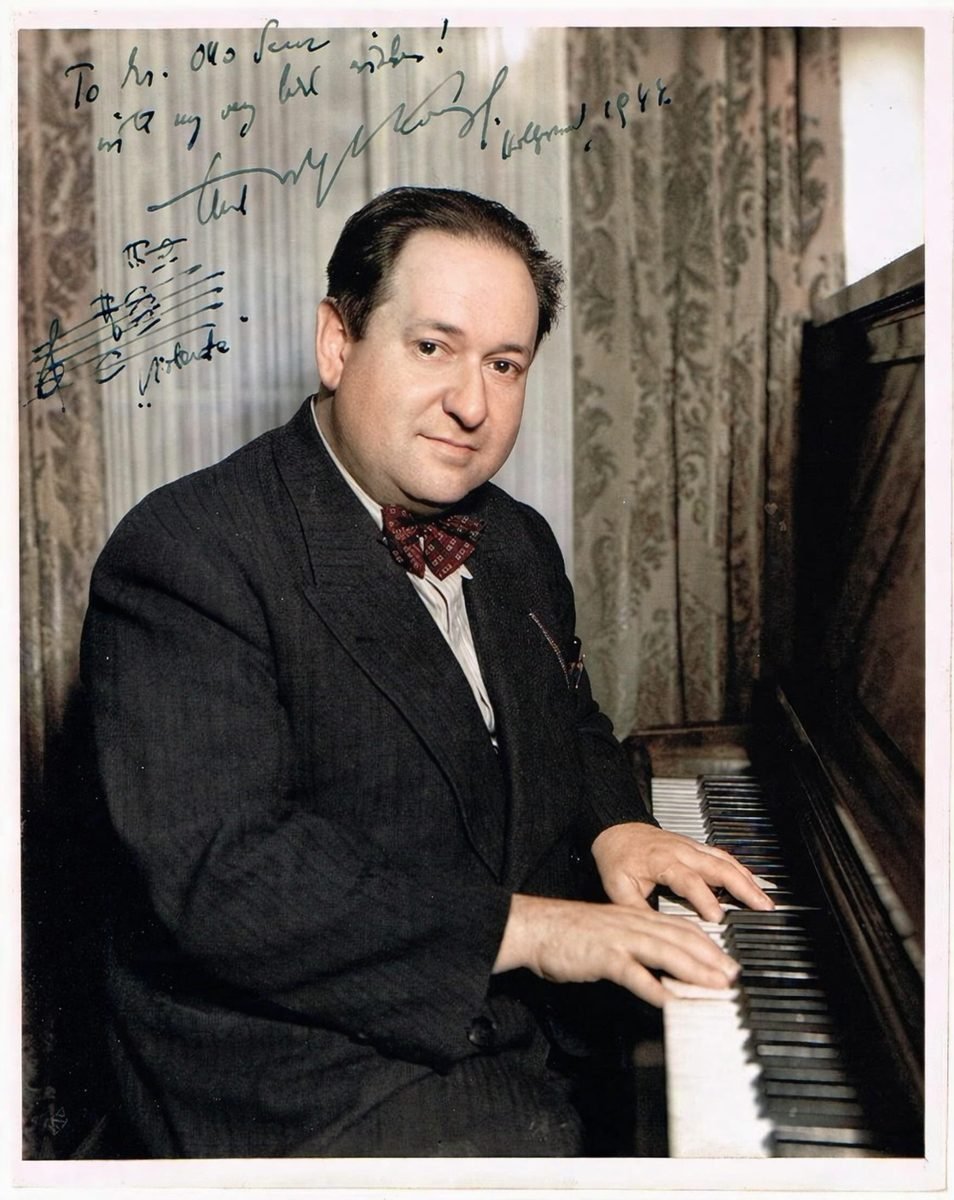
Erich Wolfgang Korngold: The Prodigy Who Carried Vienna Into Hollywood And Turned Lyric Fire Into Legend
There are composers whose lives unfold within a single world, and there are others whose destiny seems split between continents, genres, and eras. Erich Wolfgang Korngold belonged unmistakably to that second order. He was born in Brünn, Moravia, on 29 May 1897 and died in Hollywood, California, on 29 November 1957. He was an Austro-Hungarian prodigy who became an American composer, a child genius admired in Vienna, the composer of Die tote Stadt, and later one of the foundational creators of the grand symphonic Hollywood film score. Few lives in music join such different worlds so completely.
What makes Korngold especially fascinating is that he was never merely a "film composer" who had once written serious music, nor merely a lost Viennese opera prodigy who happened to work in Hollywood. Both halves of his life were real, and both were magnificent. Before Hollywood, he was already a major European figure, famous for operas, chamber music, orchestral works, piano music, and arrangements. In America, he helped define the sound-world of classical film music so powerfully that later generations of movie composers inherited his language whether they knew it or not. He did not abandon one world for another; he carried Viennese lyricism, orchestral richness, and operatic drama into the new art of cinema.
Korngold was born into a Jewish family and grew up in Vienna, where his father Julius Korngold became one of the city's most influential music critics. The young Erich's gifts were recognized with astonishing speed. The Library of Congress and the Korngold Society both describe him as a true child prodigy, and later tradition preserved the famous story that Gustav Mahler recognized his extraordinary talent very early and recommended that he study with Alexander von Zemlinsky.
This beginning matters enormously. Korngold did not emerge as a talented child in the ordinary sense. He emerged as one of those rare figures who seem born already hearing in finished forms. By age eleven, his ballet Der Schneemann caused a sensation in Vienna, and his early piano sonata was taken seriously by major musicians. Even in youth, he was not treated like a charming novelty. He was treated like a phenomenon. He did not just promise greatness; he seemed to arrive with it already half-formed.
There is also something revealing in the cultural environment around him. Vienna at the turn of the century was still one of Europe's supreme musical capitals, saturated with opera, orchestral life, criticism, aesthetics, and intellectual combat. Korngold was raised not in innocence, but at the center of one of the most demanding musical worlds imaginable. That helped give his later music its unusual confidence. He never sounds like a provincial talent trying to rise. He sounds like someone formed inside a great civilization from the beginning.
Korngold's early career in Europe was astonishingly rich. Before he was thirty, he had already produced works that made him a major name, above all the opera Die tote Stadt, first performed in 1920 and rapidly established as an international success. Britannica specifically identifies it as the work that gave him worldwide operatic fame. At the same time, he was writing chamber music, orchestral pieces, piano music, songs, and stage works, while also working as a conductor and arranger.
This period is essential because many people still approach Korngold backward, as though he began in Hollywood and only later got rediscovered as a serious composer. In reality, the reverse is true. Korngold was already a fully formed European master before Hollywood ever touched him. That is one reason his film scores sound so different from routine studio work: they were written by a man who already thought in opera, leitmotif, symphonic breadth, and late-Romantic orchestral color.
His European music from these years shows a composer of extraordinary melodic abundance, harmonic richness, and theatrical instinct. Korngold never feared beauty, never feared lyric intensity, and never feared emotional directness. Even his detractors later had to admit that he possessed one of the most naturally sumptuous orchestral imaginations of his generation. That gift would later become both his triumph and, for a time, his burden.
Among Korngold's pre-Hollywood achievements, Die tote Stadt stands highest. It is the work that proved he was no mere prodigy who had matured into respectable competence, but a genuine operatic force. Britannica notes its international impact, and it remains the central operatic pillar of his reputation today.
Why was it so important? Because it revealed the mature Korngold in full: sensuous orchestration, emotionally direct melody, dreamlike atmosphere, erotic melancholy, and a theatrical instinct of unusual vividness. It is a work saturated with late-Romantic language, but it never feels merely derivative. It sounds like a young man who already has access to a vast orchestral and emotional world. That combination of emotional fluency and technical finish is rare in any era, and almost incredible in a composer so young.
This success also fixed a certain expectation around Korngold: that he would become one of the central operatic composers of the German-speaking world. The tragedy of history is that politics, exile, and changing musical taste would later divert that trajectory. But the greatness of the early achievement remains.
Korngold first went to Hollywood in the mid-1930s, initially to adapt Mendelssohn's music for Max Reinhardt's film of A Midsummer Night's Dream. Soon afterward, with the rise of Nazism and then the Anschluss, exile ceased to be a temporary professional episode and became a matter of survival. The Library of Congress and other sources note that Korngold and his family were among the many European artists displaced by Nazism who settled in the United States. A later account also observes that his Hollywood work effectively saved his life by keeping him in America when Austria was absorbed into Nazi Germany.
This is one of the central moral and historical facts of his life. Korngold did not go to Hollywood because he had failed in Europe. He went there because history broke Europe apart. Yet he responded not by shrinking artistically, but by transforming the medium he entered. In Hollywood, he became one of the principal creators of the symphonic film score, bringing to cinema the full resources of operatic leitmotif, late-Romantic orchestration, and dramatic continuity. He did not descend from "high" music to a lower form; he elevated the new medium by treating it with a full composer's gravity.
That is why Korngold matters so much in film history. Later Hollywood music, especially adventure, fantasy, and historical epic scoring, owes him an enormous debt. His sound-world became part of the emotional grammar of cinema itself.
Korngold's most famous Hollywood achievements include Captain Blood, The Adventures of Robin Hood, and other major Warner Bros. films. His score for The Adventures of Robin Hood won the Academy Award, and scholarly discussion still treats it as one of the archetypal swashbuckling film scores ever written.
What made these scores so decisive was not merely their excitement. It was their coherence. Korngold scored films as if they were vast theatrical organisms, assigning motives, shaping emotional arcs, and making the orchestra narrate as fully as the actors. He also worked with exceptional care, tailoring music scene by scene and insisting on a level of compositional seriousness that was far from routine studio practice. In Korngold's hands, the film score ceased to be mere accompaniment and became a true orchestral drama.
A particularly poignant detail is that the political catastrophe of Europe and the artistic flowering of Hollywood were inseparable in his case. The same historical rupture that forced him into exile also gave cinema one of its greatest musical voices.
After World War II, Korngold wanted to return more fully to concert music. By then he had become a naturalized American citizen, but artistically he remained haunted by the desire to reclaim his place as a "serious" composer outside film. Sources note that this postwar period was a turning point: he became increasingly disillusioned with Hollywood and turned back toward the concert hall and stage.
This return, however, was painful. Musical taste had changed. The world that had once celebrated late-Romantic opulence now often preferred austerity, irony, or new modernist languages. Korngold's postwar works, including the Violin Concerto and the Symphony in F-sharp, were not universally welcomed at first. The Korngold Society notes that the Violin Concerto later emerged as a repertory success even though it faced dismissive reactions at its premiere, and the symphony also initially divided opinion.
This is one of the saddest dimensions of his biography. He had survived exile, reinvented a medium, and then returned to the concert hall only to find that taste had moved away from him. Yet history has been kinder than fashion. Those works now stand far more securely than many of the judgments once leveled against them.
How should one describe Korngold's musical language? The simplest answer is that it is immediately recognizable: lavish, melodic, emotionally direct, and orchestral in the richest possible sense. But that is only the surface. Beneath the beauty lies extraordinary craft. His music is not merely decorative late Romanticism. It is tightly organized, dramatically purposeful, and often astonishingly economical in how it uses leitmotivic thinking and orchestral color.
He also belongs to that increasingly rare class of composers who were never embarrassed by melody. Korngold did not treat lyricism as something to conceal behind system or irony. He believed in singing line, in emotional directness, and in the power of orchestral glow. That conviction made him vulnerable to later critical fashion, but it is also why his music still wins listeners so quickly and so deeply.
In opera, concert music, and film alike, he sounds like a composer who hears drama through color and melody rather than through abstraction alone. That makes his music instantly communicative, but never trivial.
Korngold died in Hollywood in 1957. For a time after his death, his reputation remained oddly divided. He was remembered by film lovers, admired by some musicians, but not yet fully restored to the broader canon. Over recent decades, however, his standing has risen sharply. Concert works once dismissed have returned, the Violin Concerto has become firmly established, and his operas and orchestral pieces are heard with increasing seriousness. The Korngold Society explicitly notes how strongly he has emerged from the shadows in recent years.
Why does he still matter so much? Because he unites worlds that modern criticism too often tried to separate. He matters because he was a real prodigy who became a real master. He matters because he proved that film music could be art of the highest orchestral and dramatic integrity. He matters because his exile story is part of the larger tragedy of European culture in the 20th century. And he matters because his music still reminds us that beauty, melody, and emotional fulness are not weaknesses, but powers.
For followers of classical music on Facebook, that may be the most compelling way to remember him. Erich Wolfgang Korngold was not merely a child prodigy, not merely the composer of Die tote Stadt, and not merely one of Hollywood's great names. He was the prodigy who carried Vienna into Hollywood, the exile who turned late-Romantic fire into cinematic legend, and the composer who proved that true lyricism could survive even when history tried to break it.