3 July 2026
Dvořák and Sibelius: Two National Voices, Two Visions of the Symphony
On Classicapedia: Antonín Dvořák, Jean Sibelius, Karl Goldmark, Robert Fuchs, Johannes Brahms
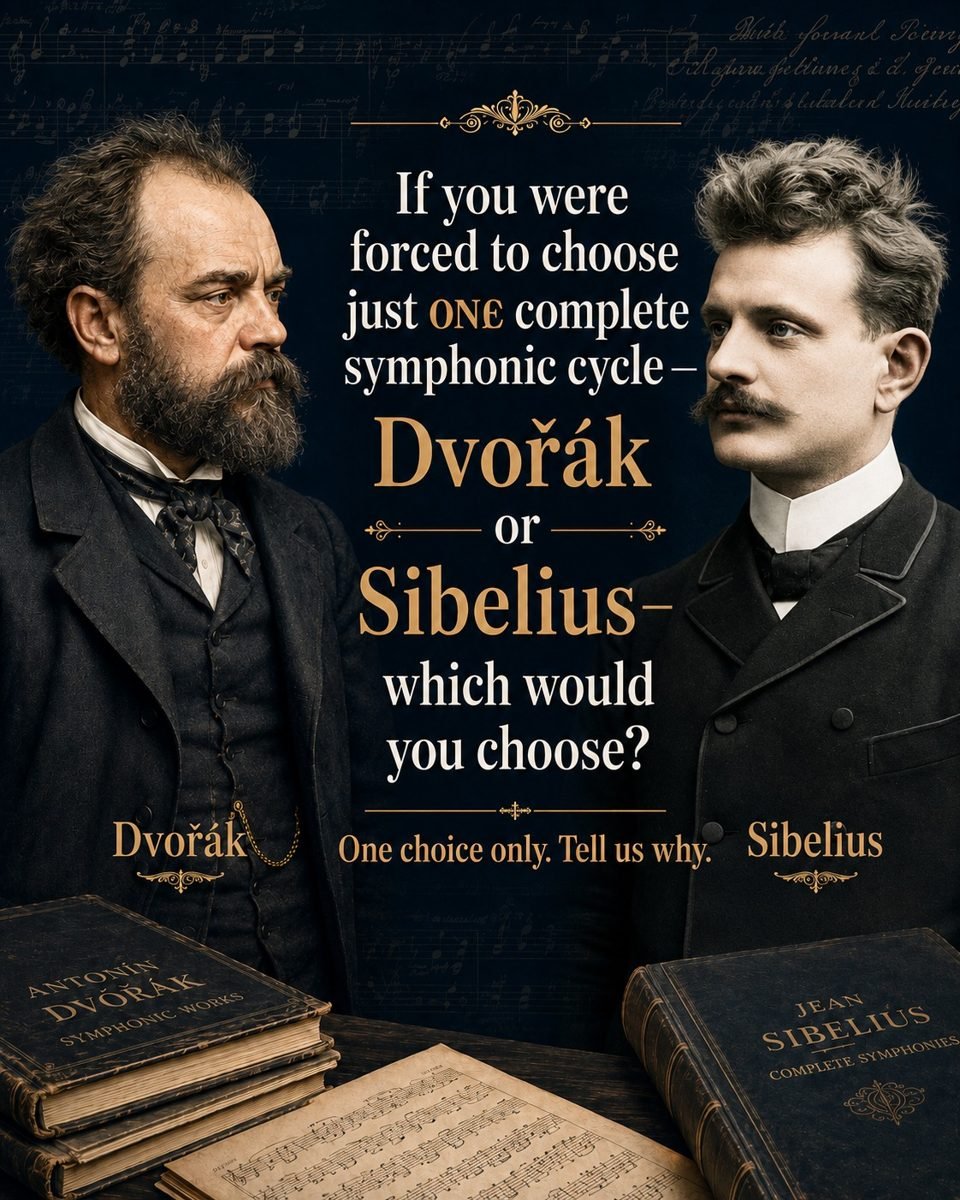
Antonín Dvořák and Jean Sibelius belong to two different generations, but they share one essential historical idea: both transformed the musical identity of a small nation into a universal artistic language. Dvořák was born in 1841 in Bohemia and died in 1904 in Prague; Sibelius was born in 1865 in Finland and died in 1957 in Järvenpää. Dvořák was therefore twenty-four years older than Sibelius, and by the time Sibelius was beginning to define his voice, Dvořák was already an internationally recognized master.
Both composers are often described as “national” composers, but this word can be misleading if it is understood too narrowly. Dvořák did not merely quote Czech folklore; he absorbed the rhythms, colours and melodic inflections of Bohemia and Moravia into classical forms inherited from Beethoven, Schubert and Brahms. His music often seems to sing naturally, with a human warmth that makes even his most sophisticated works feel spontaneous.
Sibelius, by contrast, created a more severe and elemental kind of nationalism. His imagination was shaped by Finnish nature, Nordic mythology and the Kalevala, but his greatest works rarely sound folkloric in a simple decorative sense. Instead, they seem to grow like forests, ice, wind and granite: from small cells, fragments and dark sonorities into vast organic structures. Sibelius’s early breakthrough came with Kullervo, inspired by the Kalevala, and he later became a central figure in the formation of Finnish cultural identity.
The difference between them is especially clear in the symphony. Dvořák’s symphonies are expansive, lyrical and generously melodic. Even when they are dramatic, they usually retain a sense of dance, song and human directness. His Seventh Symphony is tragic and noble; his Eighth is radiant and pastoral; his Ninth, From the New World, turns exile, memory and discovery into one of the most beloved symphonic statements of the nineteenth century.
Sibelius’s symphonies move in another direction. They are less concerned with lyrical abundance than with concentration, transformation and inevitability. The Second Symphony still has a late-Romantic grandeur, but by the Fifth, Sixth and Seventh, Sibelius had developed a language of extraordinary compression. The Seventh Symphony, in one continuous movement, feels almost like a mountain slowly revealing its shape.
Their emotional worlds also differ. Dvořák is a composer of human warmth. His music often suggests village life, prayer, homesickness, friendship, tenderness and celebration. Even in sorrow, he rarely loses the sense that melody can console. Sibelius is more solitary, more inward and more metaphysical. Sibelius does not console in the same way; he confronts silence, landscape, destiny and the mysterious pressure of nature.
Did they ever meet? There is no clear documented evidence of a personal meeting between Dvořák and Sibelius. A meeting was theoretically possible, because Sibelius studied in Vienna in 1890–1891, at a time when Dvořák was already a celebrated Central European composer. However, the surviving biographical record usually emphasizes Sibelius’s Viennese contact with teachers such as Karl Goldmark and Robert Fuchs, and even notes his unsuccessful attempt to meet Brahms, not Dvořák.
The absence of a documented meeting is significant. Their relationship seems to have been not personal, but historical and aesthetic. Dvořák represented one possible path for a composer from a smaller European nation: to enter the great Germanic symphonic tradition while retaining a distinctive national accent. Sibelius followed a related but more radical path: he did not simply add Finnish colour to inherited forms; he reshaped symphonic form itself from within.
In that sense, Dvořák may be seen as a bridge between national melody and universal Romanticism, while Sibelius is a bridge between national myth and twentieth-century modernity. Dvořák opens windows; Sibelius carves stone. Dvořák sings; Sibelius condenses. Dvořák embraces the listener; Sibelius draws the listener into a vast inner landscape.
Both, however, achieved the same miracle: They made their homelands sound universal. Dvořák gave Bohemia a voice that could speak to the whole world; Sibelius gave Finland a sound that became almost inseparable from the idea of national awakening, landscape and spiritual independence.
If they probably never met in life, they do meet in music: in the concert hall, where the warmth of Dvořák and the elemental power of Sibelius stand as two of the greatest answers to the same question — how can a composer be deeply national and yet completely universal?