11 April 2026
Claude Debussy
On Classicapedia: Claude Debussy, Antoine-François Marmontel, Albert Lavignac
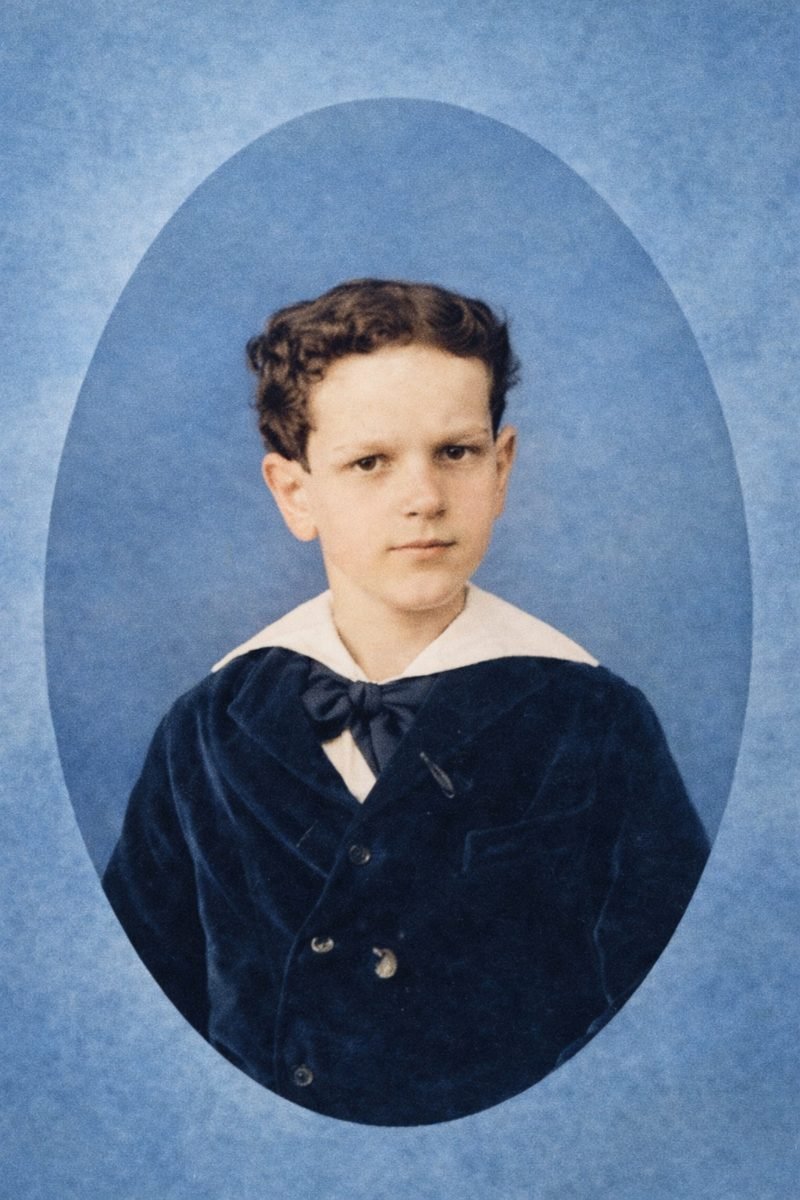
Claude Debussy was born on 22 August 1862 in Saint-Germain-en-Laye, near Paris. Nothing in his earliest surroundings clearly foretold that he would become one of the most revolutionary musicians in history. His family was not one of established artistic prestige, and his first years were not shaped by the kind of intense musical environment that nourished many other prodigies. His beginnings were comparatively modest, even uncertain. Yet it is often precisely in such unexpected origins that one finds the first mystery of genius: a child with no great inherited musical world, yet with an inward capacity that would later change music.
The first decisive turn came during the Franco-Prussian War of 1870. Paris was under siege, and like many families seeking safety, Debussy's mother took him away from the danger, to Cannes. This displacement, caused by war and uncertainty, unexpectedly opened the door to his artistic life. There, at the age of about seven, he received his first piano lessons from Jean Cerutti, an Italian violinist. These lessons were not yet the beginning of a public career, but they were the first moment in which his natural responsiveness to music found a concrete outlet.
A further element of great importance was the support of his aunt Clémentine, who helped finance those early lessons. Such gestures often disappear in broad biographies, yet they are crucial. Without such practical support, many talents remain latent. In Debussy's case, this encouragement helped move him from mere possibility toward real formation. What began in the shadow of war thus became his first musical foundation.
Once back in Paris, Debussy's talent developed quickly enough to attract serious notice. An especially important figure at this stage was Antoinette Mauté de Fleurville, a piano teacher who claimed a connection to Chopin's tradition. Whether every detail of that claim can be pressed literally or not, what matters is that she recognised Debussy's exceptional gifts and prepared him for entrance into the highest musical institution in France.
In 1872, at the age of ten, Debussy was admitted to the Paris Conservatoire. This was an enormous step. The Conservatoire was not simply a school; it was the great centre of official French musical training, discipline, and prestige. To enter it at such an early age was already proof that Debussy possessed unusual talent. He would remain there for eleven years, a period that shaped him profoundly, even though his relationship with the institution was never simple.
The irony is striking. Debussy, who would later become one of the most original and anti-formulaic composers in modern history, was formed within one of the most structured and rule-bound musical environments of his age. His admission to the Conservatoire was therefore not just the beginning of professional study. It was the beginning of a long inner tension between institution and imagination.
At the Conservatoire, Debussy studied piano with Antoine François Marmontel and solfège with Albert Lavignac. These teachers represented a serious and highly developed tradition of French musical education. Students were expected to absorb discipline, clarity, precision, technique, and reverence for established methods. For many pupils, this was the ideal environment in which to flourish. For Debussy, it was both necessary and constraining.
From the beginning, he showed gifts that could not be ignored. He had remarkable powers of sight-reading, a refined ear, and an unusually subtle musical sensitivity. He could perceive colour and nuance in ways that already distinguished him from more routine students. Yet he also showed signs of resistance to the expected path. He did not submit naturally to inherited rules. Even when young, he seemed to hear beyond them.
This created friction. Some teachers admired his natural gifts, but others were exasperated by what they saw as indiscipline or eccentricity. His harmony teacher, Émile Durand, reportedly criticised his "desperately careless" attitude. The phrase is revealing. What seemed carelessness from the academic point of view was, in part, Debussy's refusal to think only within accepted formulas. He did not reject knowledge, but he resisted becoming merely obedient. Even as a student, he was already impatient with convention.
It would be wrong, however, to imagine Debussy as simply a rebellious dreamer failing within the system. He achieved real successes. In 1877 he won the Second Prize for Piano, a significant recognition in so demanding an institution. He continued to study harmony and composition, building the technical foundation without which later innovation would have been impossible.
This is one of the most important truths about Debussy's development. He did not become original because he lacked training. He became original because he absorbed training deeply enough to move beyond it. His later freedom was not ignorance masquerading as novelty. It was mastery transformed into new language.
The Conservatoire years thus contain an essential paradox. On one hand, Debussy was a child prodigy shaped by one of the strictest musical institutions in Europe. On the other hand, that same child was already inwardly dissatisfied with the limitations of official academic taste. The tension between those two realities would define much of his life. He learned the grammar of tradition thoroughly, but he would not remain imprisoned inside it.
During those eleven years, Debussy was not yet the creator of Prélude à l'après-midi d'un faune, Pelléas et Mélisande, or the Preludes for piano. Yet the seeds of that future imagination were already present. What distinguished him was not merely brilliance at the keyboard, but a way of hearing. He responded to sound not as a fixed system of harmonic duties, but as a world of shades, textures, movement, and atmosphere.
That is why the Conservatoire period matters so much. It was not simply a chapter of lessons and prizes. It was the place where Debussy first encountered the full force of musical orthodoxy and began, quietly but decisively, to define himself against it. The institution gave him language, method, craft, and access to the musical elite of Paris. But it also gave him something equally valuable: a clear sense of what he did not want to be.
His early years there therefore belong not only to biography, but to the deeper story of modern music. The young boy who entered the Conservatoire at ten was learning scales, harmony, accompaniment, and keyboard discipline. But he was also, without fully knowing it yet, preparing to loosen the old bonds of tonality, redefine musical colour, and change forever the relationship between sound and feeling.
Claude Debussy's childhood and Conservatoire years reveal a story far richer than that of a gifted student simply rising through the ranks. He began in relatively modest circumstances, received his first encouragement almost accidentally in wartime exile, and entered the Paris Conservatoire at the astonishingly young age of ten. There he remained for eleven years, studying, absorbing, struggling, and quietly resisting.
He showed exceptional gifts from the beginning: excellent sight-reading, musical sensitivity, and a rare instinct for nuance. At the same time, his teachers already sensed that he did not fit comfortably within traditional methods. That tension was not a flaw. It was the first sign of genius. The child prodigy at the Conservatoire was already becoming the artist who would later teach music to breathe in a different way.
In that sense, Debussy's early formation was not merely the beginning of a career. It was THE BEGINNING OF A MUSICAL REVOLUTION.
PHOTO: Debussy as a pupil at the Conservatoire (circa 1874), where he began his studies at the age of ten.