15 April 2026
Carl Friedrich Zelter (1758–1832): Guardian of the German Musical Tradition
On Classicapedia: Carl Friedrich Zelter, Johann Wolfgang von Goethe, Johann Sebastian Bach, Carl Friedrich Christian Fasch
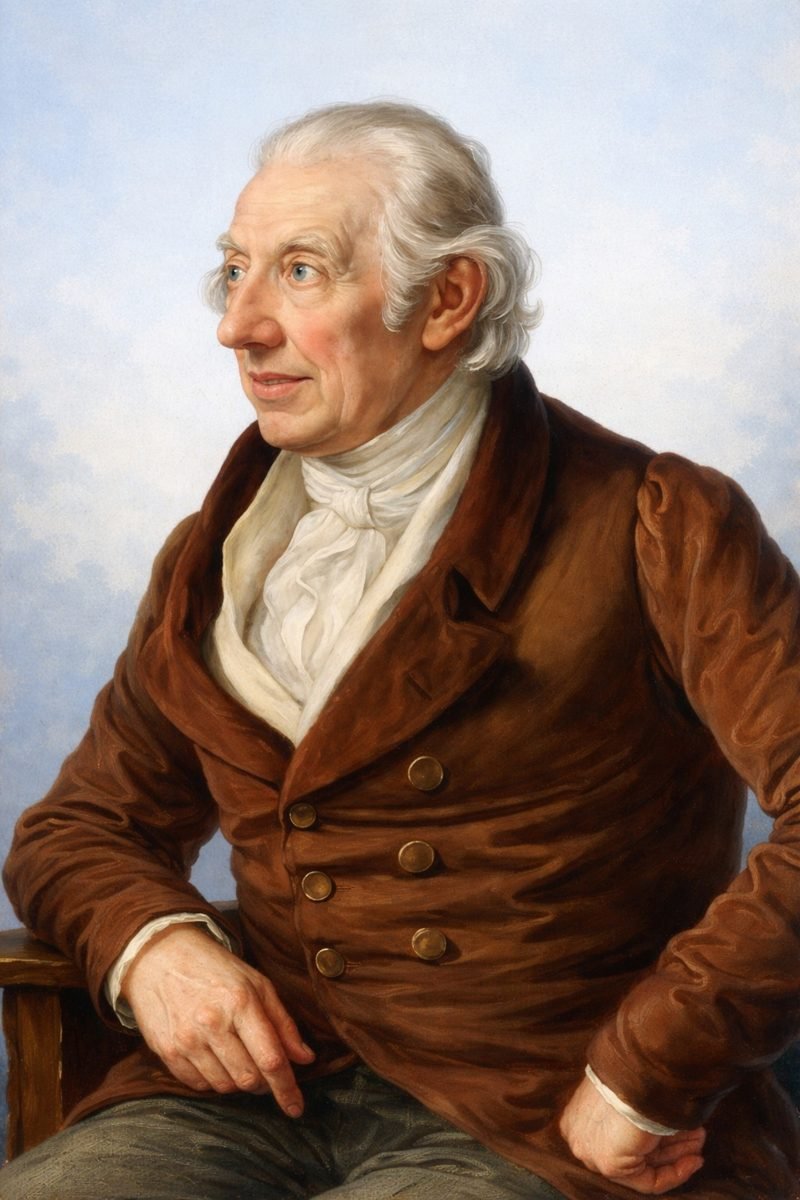
Teacher and Mentor to Felix Mendelssohn
Early Life and Formation
Carl Friedrich Zelter was born on December 11, 1758, in Berlin, at a time when the Prussian capital was flourishing under Frederick the Great’s cultural patronage. Unlike many musicians of his generation, Zelter did not come from a professional musical family. His father was a builder and mason, and for much of his youth, Zelter himself worked in the same trade. Yet even during his apprenticeship as a bricklayer, he cultivated a passion for music, studying composition and instrumental performance privately while working long hours at construction sites.
Zelter’s early musical training was largely self-taught. He learned violin, piano, and organ, and immersed himself in the study of counterpoint and harmony by analyzing scores of Bach, Handel, and Graun. His dual life — craftsman by day, musician by night — gave him a sense of discipline, practicality, and order that would mark his entire career. This grounded temperament would later attract the admiration of Germany’s intellectual elite, including Johann Wolfgang von Goethe, who saw in him the ideal embodiment of bourgeois virtue and artistic sincerity.
Career in Berlin and the Singakademie
By the 1780s, Zelter had abandoned construction for music entirely. He became a choral conductor, composer, and teacher, gradually earning recognition in Berlin’s growing musical circles. In 1791, he joined the Berlin Singakademie, a choral society founded by Carl Friedrich Christian Fasch, devoted to sacred and choral repertoire — especially the neglected works of Johann Sebastian Bach.
When Fasch died in 1800, Zelter succeeded him as director of the Singakademie, a position he would hold until his death in 1832. Under his leadership, the Singakademie became one of the most important musical institutions in Europe. It was here that the seeds of the Bach revival were first sown: long before Mendelssohn’s legendary 1829 performance of the St. Matthew Passion, Zelter and his singers had been rehearsing and performing Bach’s choral works privately for decades.
Zelter saw the Singakademie not merely as a concert venue but as a moral and educational institution — a place where music elevated the soul and refined the intellect. His rehearsals were strict, methodical, and deeply reverent. He believed that “music must teach virtue before it can give pleasure,” a sentiment that reflected the Protestant and Enlightenment ethics of his generation.
Composer and Thinker
Though not a major creative innovator, Zelter was a respected composer of songs, cantatas, and choral works. His music, deeply rooted in the German Lied tradition, combined clarity of form with sincerity of expression. He wrote over 200 Lieder, many set to poems by Goethe, whom he regarded as both mentor and friend. His works also include several oratorios and church cantatas that were regularly performed by the Singakademie.
Stylistically, Zelter belonged to the late Classical school, following in the footsteps of C.P.E. Bach and early Haydn. His music avoided the emotional turbulence of early Romanticism, preferring restraint, balance, and moral clarity. This conservative aesthetic was not a weakness but a conscious statement: for Zelter, music’s purpose was not to excite passion but to cultivate inner discipline and spiritual harmony.
Friendship with Goethe
One of the most important relationships of Zelter’s life was his long and intimate friendship with Johann Wolfgang von Goethe. The two met around 1796, and their correspondence — which lasted more than three decades — forms one of the richest documents of early 19th-century German cultural history. Their letters, later published in multiple volumes, discuss music, literature, philosophy, and the moral role of art in society.
Goethe admired Zelter’s unpretentious character and moral integrity, describing him as “a man who builds in sound as he once built in stone.” Zelter, in turn, revered Goethe as the embodiment of artistic wisdom and spiritual clarity. They influenced each other profoundly: Goethe’s poems inspired many of Zelter’s songs, while Zelter’s views on musical setting helped shape Goethe’s understanding of lyric form.
It was through Zelter that Goethe became acquainted with the young Felix Mendelssohn, a meeting that would leave a lasting impression on both the aging poet and the prodigious musician.
Teacher and Mentor to Felix Mendelssohn
Among Zelter’s many pupils, none was more gifted — or more historically significant — than Felix Mendelssohn Bartholdy. The relationship between teacher and student began around 1817, when the eight-year-old Mendelssohn, already showing signs of extraordinary talent, was introduced to Zelter by his family. The Mendelssohns were one of Berlin’s most cultivated families, deeply involved in the city’s intellectual life, and they regarded Zelter as the perfect guide for their son’s musical education.
Zelter’s teaching philosophy was rooted in discipline, tradition, and craft. He believed that genius must be trained through rigorous study — through the mastery of counterpoint, harmony, and form — before it could express itself freely. Under his guidance, Felix studied the choral works of Bach, Handel, and Palestrina, learning the structural and moral rigor of earlier music. Zelter made him copy out fugues and analyze their architecture line by line, training both his ear and his intellect.
But beyond technical instruction, Zelter gave Mendelssohn something even more valuable: a sense of lineage. He connected the boy to the living tradition of German music — the spiritual descent from Bach to Haydn to Mozart, and now to him. It was Zelter who first instilled in Mendelssohn the conviction that music could embody moral truth, and that to compose was to serve something greater than oneself.
Zelter also encouraged Felix to conduct and to compose for chorus and orchestra. The young Mendelssohn’s early symphonies, string quartets, and choral works bear the imprint of his teacher’s methodical approach. Yet the student’s imagination quickly exceeded the master’s limitations. Zelter, ever honest, admitted that the boy’s talent “outran my instruction, as the sapling rises beyond the gardener’s reach.”
Zelter, Mendelssohn, and Goethe
One of the most memorable moments in Zelter’s life came in 1821, when he took his brilliant pupil to Weimar to meet Goethe. The poet, then in his seventies, was astonished by the twelve-year-old’s artistry. After hearing Mendelssohn play, Goethe remarked:
“Once, in my youth, I met the boy Mozart; and now, once again, I have met the same.”
Goethe affectionately referred to Mendelssohn as “my little David”, saying, “He delights me with his music when I am weary of the world.” Zelter’s pride in this encounter was immense — for him, it symbolized the passing of genius from one age to the next, from Goethe’s literary ideal to Mendelssohn’s musical realization.
Through Zelter, Mendelssohn absorbed the intellectual and ethical spirit of the Enlightenment, even as he grew into one of Romanticism’s most luminous figures. The older man’s influence provided the moral foundation upon which Mendelssohn would build his art: clarity, reverence for tradition, and the conviction that beauty is inseparable from truth.
Later Years and Death
Zelter continued directing the Singakademie and teaching until his death on May 15, 1832, in Berlin. His passing was deeply mourned by Goethe, who wrote soon afterward:
“I have lost the man through whom music spoke to me with truth and simplicity.”
Mendelssohn, by then already a rising composer, expressed profound gratitude for his mentor, saying that “everything solid in my art I owe to him.” In a gesture of homage, Mendelssohn later conducted the St. Matthew Passion in 1829 — the very work Zelter had revered but never dared to perform publicly. That concert, which revived Bach’s masterpiece for the first time in a century, was the ultimate fulfillment of Zelter’s lifelong devotion to the music of the past.
Legacy
Carl Friedrich Zelter was not a revolutionary but a custodian of musical conscience. He stood as a bridge between centuries — between the rational clarity of the 18th century and the emotional depth of the 19th. As a composer, conductor, teacher, and thinker, he preserved the ideals of craftsmanship and moral responsibility at a time when art was becoming more impulsive and individualistic.
His true monument lies not in his own compositions but in his students and in the tradition he kept alive. Through Mendelssohn, his influence extended far beyond Berlin, shaping the very foundation of 19th-century choral and symphonic art.