12 December 2025
Brahms on Mozart: Opinions, Quotes, and Primary Sources
On Classicapedia: Johannes Brahms, Wolfgang Amadeus Mozart, Ludwig van Beethoven, Clara Schumann, Richard Heuberger
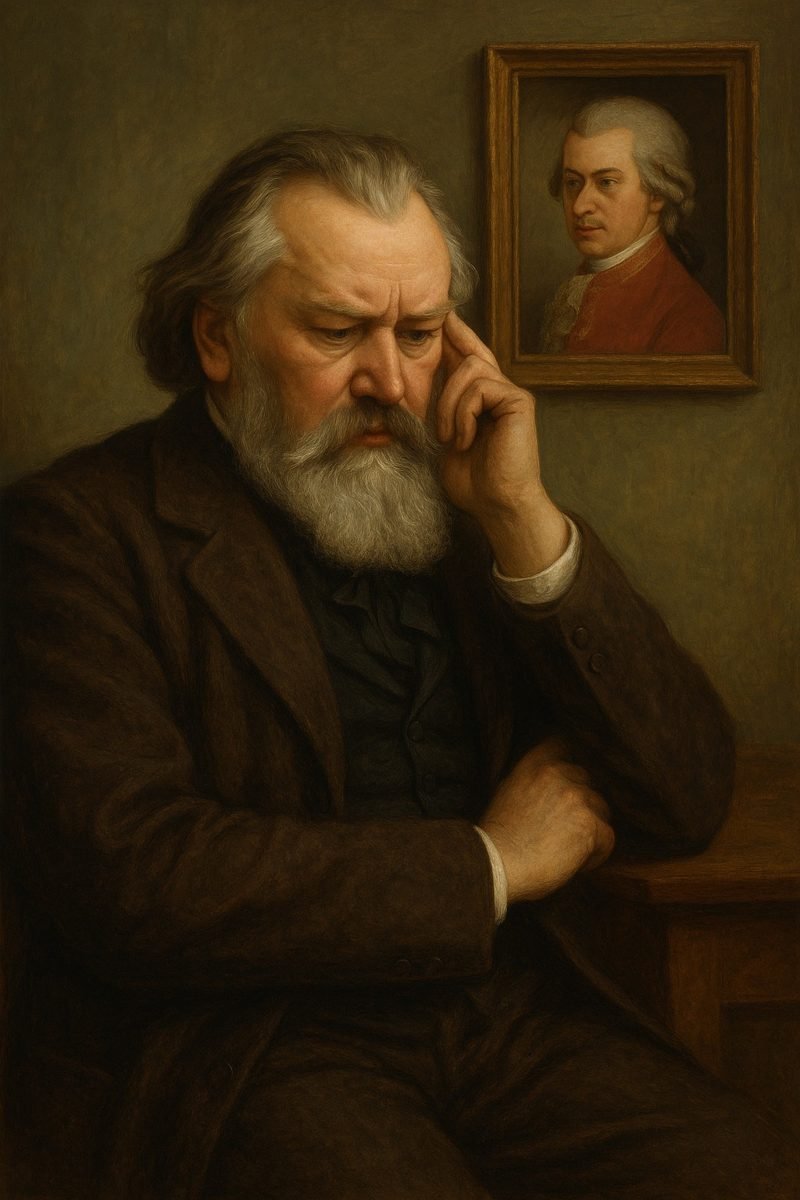
A de las declaraciones más célebres de Brahms proviene de un comentario transmitido por su amigo Richard Heuberger:
>
“That’s the only thing that means anything to me — Mozart!”
Source: Richard Heuberger, Erinnerungen an Brahms, in Neue Freie Presse, 1896.
Brahms rarely expressed enthusiasm with such intensity; Mozart occupied a uniquely sacred position in his artistic universe.
Although Beethoven was Brahms’s lifelong idol, he felt a closer affinity with Mozart’s craftsmanship.
He famously told Theodor Billroth:
>
“Study Mozart! That is how one becomes a master, not by studying Beethoven.”
Source: Letters to Theodor Billroth, ed. Hans Gál, Vienna, 1935.
This is an extraordinary statement: Brahms, often seen as Beethoven’s heir, pointing to Mozart as the essential guide for musical craft.
When the Breitkopf & Härtel Complete Works of Mozart were being prepared, Brahms worked as an editor and advisor.
Writing to the publisher Simrock, Brahms said:
>
“It is impossible to express the joy and reverence I feel when I hold anything of Mozart in my hands.”
Source: Brahms–Simrock Correspondence, ed. Styra Avins, 2003.
This is not mere admiration: it is worship. Brahms felt spiritually uplifted by touching Mozart’s handwriting.
These two late works were among Brahms’s lifelong touchstones.
To Clara Schumann, Brahms wrote:
>
“How wonderfully Mozart wrote for the clarinet!
No one has ever composed for this instrument as he did.”
Source: Johannes Brahms: Briefwechsel, ed. Berthold Litzmann, 1904.
He believed these pieces represented the purest lyricism ever achieved for the instrument — a model for his own late Clarinet Quintet and Clarinet Sonatas.
In a conversation recorded by Gustav Jenner, Brahms remarked:
>
“Mozart’s *Requiem* is sublime — a work of wondrous depth and earnestness.”
Source: Gustav Jenner, Johannes Brahms als Mensch, Lehrer und Künstler, Leipzig 1912.
Brahms appreciated the combination of structural clarity and spiritual gravity — which he later sought in the German Requiem.
Despite Mozart’s reputation for elegance, Brahms insisted on Mozart’s serious contrapuntal mastery.
He told Eusebius Mandyczewski:
>
“People do not know how great Mozart is.
They do not know how beautiful his counterpoint is.”
Source: Quoted in Mandyczewski’s recollections, published in Musikalisches Wochenblatt, 1897.
For Brahms — a strict contrapuntalist — this was one of the highest praises possible.
He was particularly enamored of the G minor Symphony (No. 40):
According to his student Gustav Jenner:
>
“Brahms spoke of the G minor Symphony with deep emotion, calling it a work of tragic beauty.”
Source: Jenner, Brahms als Mensch..., 1912.
He studied it constantly, using it as a model of perfect classical tragedy.
Brahms kept Mozart’s portrait in his home, especially in his study, where he composed.
The pianist Fanny Davies recalled:
>
“Brahms kept a portrait of Mozart before him on his writing desk.”
Source: Fanny Davies, in The Musical Times, 1906.
This reveals how deeply Mozart functioned as a presence and guide in Brahms’s creative life.
Brahms once said, paraphrased by Arthur Abell:
>
“When one thinks of how much Mozart achieved in his short life, one can only bow one’s head.”
Source: Arthur M. Abell, Talks With Great Composers, 1912 (recounting conversations from the 1890s).
Even if Abell’s book mixes memory with idealization, the sentiment perfectly aligns with all documented sayings.
If all sources are distilled to one core truth:
For Brahms, Mozart represented the absolute ideal of musical beauty, craftsmanship, depth, and purity — a standard impossible to surpass yet essential to study.
Brahms loved Mozart not because he was “easy,” but because his perfection was terrifyingly unattainable.